

Not every client who calls you is a client worth taking. Just like a doctor learns to spot the warning signs that separate a routine headache from something dangerous, you need to recognize the 7 red flags for headache clients before you're already deep into a job that's draining your time, cash, and sanity. Ignoring these signals is how contractors end up chasing checks, fighting scope disputes, and finishing projects they should have walked away from on day one. This guide gives you a clear, practical framework to screen clients early and protect your business.
Table of Contents
- Understanding headache clients and warning signs
- The 7 client red flags every contractor must know
- Recognizing subtle client red flags and behavioral nuances
- Practical screening tools and techniques for identifying headache clients
- Early detection and proactive management to prevent project headaches
- Why conventional client screening often misses the mark — and what really works
- Streamline client screening with SnapQualify software
- Frequently asked questions
Key Takeaways
| Point | Details |
|---|---|
| Early red flag detection | Identifying warning signs early helps you avoid costly client problems and project delays. |
| Systematic screening | Use structured intake forms and checklists rather than relying on intuition alone. |
| Watch client behavior patterns | Consistency in documenting client communication and requests reveals hidden risks. |
| Use data-driven tools | Screening software improves accuracy and saves time in client evaluation. |
| Proactive decision-making | Treat red flags as decision points to pause or stop negotiations before issues escalate. |
Understanding headache clients and warning signs
In medicine, headache red flags don't just mean pain. They mean something bigger might be wrong beneath the surface. The same logic applies to your clients. A single odd comment or a slightly vague answer doesn't automatically mean trouble. But when you start seeing patterns, that's when you pay attention.
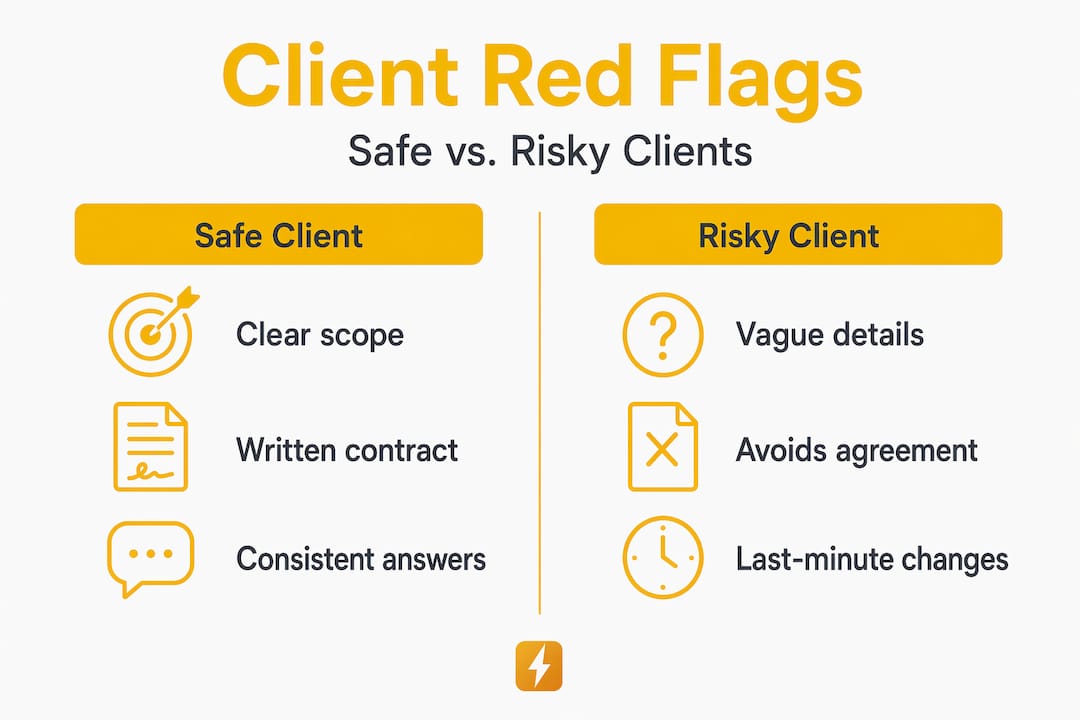
Harvard Health makes the point well: headache meaning depends on associated patterns, not just pain intensity. Client problems work exactly the same way. One late reply to an email? Fine. Late replies, vague budget answers, and a refusal to sign anything in writing? That's a pattern, and patterns predict outcomes.
Here's what makes client screening hard for most contractors:
- You're busy, so you want the job to be a good one
- Clients often seem reasonable in the first conversation
- Red flags can feel like minor quirks until they aren't
- There's pressure to fill your schedule, especially in slower seasons
The goal of identifying headache triggers early isn't to become cynical. It's to make smarter decisions with the information you already have access to. You can read more about the red flags of a bad contractor client to build a fuller picture before we get into the specific warning signs.
The 7 client red flags every contractor must know
Let's get specific. These are the seven warning signs that should immediately raise your alert level during any client headache assessment. Each one on its own might be explainable. Multiple together? That's your signal to slow down or walk away.
-
Refuses to put anything in writing. If a client resists a written contract, scope of work, or change order process, that's not a personality quirk. It's a liability waiting to happen.
-
Pushes for an unusually large upfront deposit, or refuses any deposit at all. Both extremes are a problem. Demanding you start with no deposit signals they may not pay. Offering a huge deposit upfront can signal they want leverage over you later.
-
Can't or won't discuss budget clearly. Vague answers like "we'll figure it out" or "just get started and we'll talk numbers" are headache symptoms to watch. A client without a budget is a client who will fight every invoice.
-
Pressures you to start immediately or sign fast. Urgency manufactured by a client, not by genuine circumstances, is a classic pressure tactic. It's designed to get you committed before you've thought it through.
-
Refuses to discuss permits or proper licensing. As industry guidance confirms, clients who push back on permits are either trying to cut costs illegally or avoid creating a paper trail. Either way, you're the one holding liability.
-
Can't provide references or avoids the question. A legitimate client who has worked with contractors before will have no problem giving references. Avoidance here means something went wrong in a previous project.
-
Insists on cash-only payments. This removes your paper trail, makes disputes nearly impossible to resolve, and often signals they're hiding something from a tax or legal standpoint.
Here's a quick comparison to help you see the difference between a safe client and a risky one:
| Behavior | Safe client | Risky client |
|---|---|---|
| Contract discussion | Welcomes written agreement | Avoids or delays signing |
| Budget clarity | States a clear range | Deflects or says "we'll see" |
| Permit discussion | Expects proper permits | Pushes back or ignores it |
| Payment terms | Agrees to milestone payments | Wants cash or resists structure |
| References | Provides them readily | Can't recall or avoids the topic |
| Timeline pressure | Reasonable and flexible | Demands immediate commitment |
| Deposit approach | Agrees to standard terms | Extreme in either direction |
Pro Tip: Don't evaluate these flags in isolation. Use a client red flags checklist every time you screen a new lead. Patterns matter more than individual moments.
You'll also want to read about how to avoid clients who don't pay and how scope creep prevention starts at the screening stage, not after work begins.
Recognizing subtle client red flags and behavioral nuances
Some clients pass the obvious tests but still cause serious problems. These are the ones who seem perfectly reasonable in the first call, then start showing their true behavior once the project is underway. Identifying headache triggers in this group requires a sharper eye.
Watch for these subtler warning signs:
- Inconsistent communication. They're fast to respond when they want something, but go quiet when you need a decision or approval. That pattern will repeat itself when you're waiting on payment.
- Vague answers to specific questions. When you ask about square footage, timeline, or existing conditions and they consistently deflect, that's not forgetfulness. It's a signal they haven't thought it through, or they're hiding something.
- Last-minute scope changes before signing. If they're already trying to add things or reframe the project before you've even started, expect that to continue throughout the job.
- Emotional volatility in early conversations. A client who gets frustrated, dismissive, or aggressive when you ask basic qualifying questions will not become easier to work with under the stress of an active project.
- Excessive price shopping with no clear decision timeline. Some clients collect quotes endlessly. They're not serious buyers. They'll waste your estimating time and disappear.
Early recognition matters here. As Cedars-Sinai notes, subtle pre-onset changes are key to preventing escalation. The same is true for clients. Catching these signals before you quote saves you far more than catching them after you've started.
Pro Tip: Use structured intake forms and follow-up questionnaires to capture these nuances before the first in-person meeting. The questions to ask a client before a quote and your approach to prequalifying homeowners before quoting are your first line of defense.

Practical screening tools and techniques for identifying headache clients
Good client headache assessment doesn't happen by instinct. It happens through consistent, documented process. The most reliable contractors don't rely on how a client makes them feel. They rely on the data they collect.
Here are the key screening questions every intake form should include:
- What is your total project budget, including contingency?
- Have you worked with a contractor on a similar project before?
- Do you have a timeline in mind, and what's driving it?
- Are you aware of the permit requirements for this type of work?
- How do you prefer to handle communication and approvals during a project?
- Are you the sole decision-maker, or are others involved?
That last question matters more than most contractors realize. A client who says "my spouse will need to weigh in" or "I'll have to check with my business partner" introduces a hidden decision layer that can stall approvals, change orders, and payments at every stage.
Here's how different intake methods compare:
| Method | Consistency | Time required | Data quality | Best for |
|---|---|---|---|---|
| Phone call only | Low | High | Low | Simple, small jobs |
| Paper form | Medium | Medium | Medium | In-person consultations |
| Email questionnaire | Medium | Low | Medium | Initial outreach |
| Automated intake software | High | Very low | High | All project types |
As Cedars-Sinai points out, documenting characteristics consistently reduces uncertainty and improves accuracy. That principle applies directly to how you evaluate clients. The more structured your intake, the fewer surprises you face later.
Pro Tip: Review your intake form every quarter. If you've run into a new type of problem client, add a question that would have caught it earlier. Your contractor intake form should evolve with your experience.
Early detection and proactive management to prevent project headaches
Spotting a red flag is only useful if you act on it. Here's a practical sequence for what to do once your screening surfaces a concern:
- Verify everything independently. Don't take a client's word for their timeline, budget, or property ownership. Pull permit records, check property data, and confirm they're authorized to approve the work.
- Require a written contract with a defined scope before any work begins. No exceptions. A vague scope is an open invitation for disputes. Your contract should include payment terms, change order procedures, and project milestones.
- Set milestone payments, not open-ended billing. Structuring payments around completed phases protects you if a client becomes difficult mid-project. It also filters out clients who never intended to pay in full.
- Communicate concerns directly and early. If something feels off, say so. A straightforward conversation at the start is far less costly than a dispute at the end.
- Walk away when the flags outweigh the opportunity. This is the hardest one for most contractors, but it's the most important. A bad job costs more than no job.
"Red flags are leading indicators that predict disputes even without outright fraud. Use them as decision gates, not negotiation points." — National Home Services Authority
Early documentation and clear communication reduce your exposure significantly. Revisit your approach to scope creep prevention and your process for screening clients who don't pay as part of your standard project setup.
Why conventional client screening often misses the mark — and what really works
Here's the uncomfortable truth: most contractors screen clients the same way they've always done it. A phone call, a gut feeling, maybe a quick look at the address on Google Maps. That approach works until it doesn't, and when it fails, it fails expensively.
The problem isn't that contractors are careless. It's that intuition is pattern recognition without structure. You've seen enough bad clients that your gut picks up signals. But without a documented process, you can't act on those signals consistently, and you can't improve your screening over time.
Medical triage offers a better model. Harvard Health notes that screening question emphasis should be on timing and pattern, not just severity. A single alarming symptom might mean nothing. A pattern of mild symptoms over time might mean everything. That's exactly how client risk works.
The contractors who rarely get burned aren't luckier. They're more systematic. They use the same intake questions every time. They document what clients say. They compare answers against a client red flags checklist before they quote. And when multiple flags appear, they don't talk themselves into taking the job anyway.
Gut feelings are a starting point. A documented screening process is what actually protects your business.
Streamline client screening with SnapQualify software
You now know what to look for and how to act on it. The next question is how to make this process fast enough that you'll actually use it on every lead, not just the ones that already feel suspicious.
SnapQualify is built specifically for trade contractors who want to screen clients without adding hours to their workflow. The platform uses customizable intake forms and AI-powered risk analysis to generate a color-coded SnapScore for each lead, giving you a clear, consistent read on client reliability before you ever pick up the phone. It captures the data that matters, flags the patterns that predict problems, and helps you prioritize the clients worth your time. You can also review SnapQualify's security features to see how client data is protected throughout the process. Stop guessing. Start screening.
Frequently asked questions
What are common warning signs of a problematic contractor client?
Common warning signs include refusal to sign a written contract, pressure to start immediately, vague budget answers, and avoidance of permit discussions. As classic risk screening flags confirm, cash-only demands and inability to provide references are also strong indicators of future problems.
How can I effectively screen clients before starting a project?
Use structured intake forms with consistent questions about scope, budget, timeline, and decision-making authority, then verify licenses, permits, and references before signing anything. Consistent intake data reduces screening uncertainty and improves the accuracy of your risk assessment.
When should I decide to walk away from a potential client?
Walk away when multiple red flags appear together, especially if a client refuses a written contract, insists on cash payments, or applies pressure to commit quickly. Red flags as decision gates means treating them as reasons to stop, not obstacles to negotiate around.
Can subtle client behaviors indicate problems even if major red flags are absent?
Yes. Inconsistent communication, vague answers, and last-minute scope changes before signing are reliable early warning signs that often predict larger problems once the project starts. Early recognition of subtle patterns is the most effective way to prevent escalation.
How does using software help with client screening?
Screening software automates data collection, applies consistent evaluation criteria to every lead, and flags risk patterns you might miss in a casual conversation, so you can make faster, more confident decisions before investing time in a quote.