

Most contractors who go out of business don't fail because they lacked skill. They fail because they took on the wrong projects, signed unclear contracts, or never saw the financial hit coming until it was too late. Contractor business risk explained simply means understanding the specific threats that can derail your projects, drain your cash, or expose you to legal liability before you ever swing a hammer. This guide breaks down every major risk category and gives you practical tools to identify and reduce them before work begins.
Table of Contents
- Understanding the main types of risks in contractor businesses
- Contractual and payment risks: avoiding disputes and cash flow problems
- Occupational safety risks and compliance essentials
- Insurance and liability: mapping exposures and coverage
- Implementing systematic risk management for contractors
- How effective client qualification reduces contractor business risk
- Why most contractors underestimate business risk and how to shift your mindset
- How SnapQualify can help you manage contractor business risk
- Frequently asked questions
Key Takeaways
| Point | Details |
|---|---|
| Know key risk types | Trade contractors must understand safety, contractual, financial, regulatory, and subcontractor risks to protect projects. |
| Use clear contracts | Detailed, documented contracts and change orders are crucial to prevent disputes and payment delays. |
| Prioritize safety continuously | Ongoing training and leadership reduce the majority of construction site fatalities from common hazards. |
| Map insurance carefully | Differentiate between general and professional liability to ensure adequate coverage aligned with contract roles. |
| Qualify clients upfront | Effective client screening aligns expectations and documentation, minimizing project and financial risks from the start. |
Understanding the main types of risks in contractor businesses
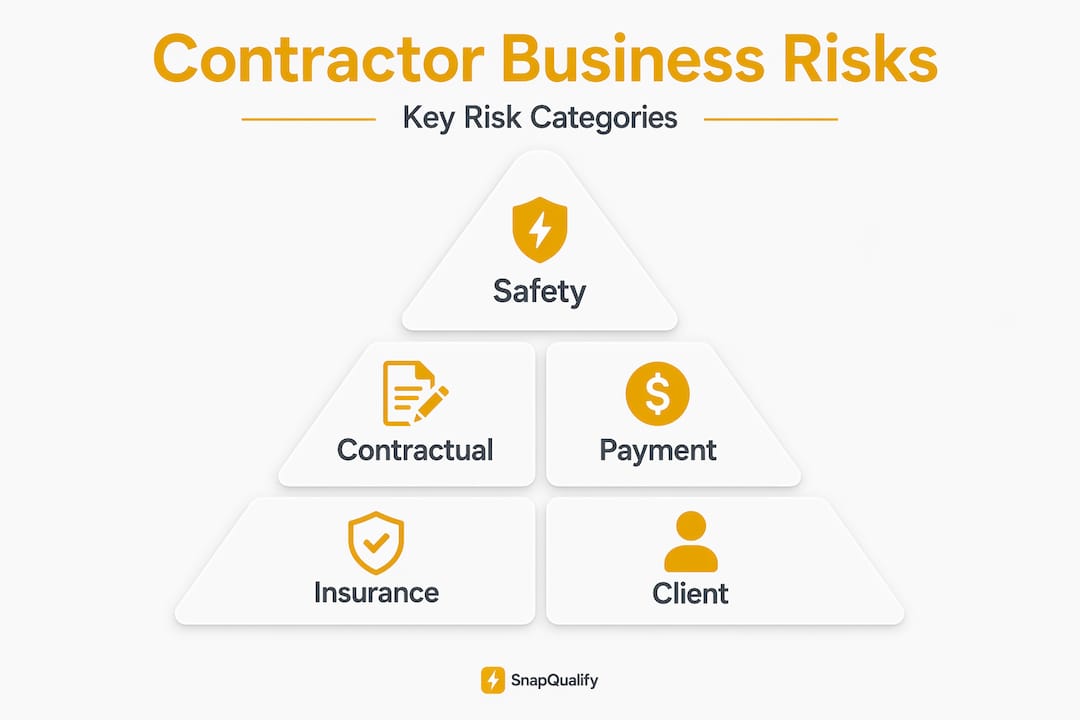
Before you can manage risk, you need to name it. Vague awareness that "things can go wrong" is not a plan. According to top construction risks, the most common business risk categories trade contractors should plan for include occupational safety hazards, contractual liabilities, financial risks, regulatory non-compliance, and subcontractor performance issues. Each one can independently sink a project or your entire business.
Here is a quick breakdown of what each category actually means in practice:
- Occupational safety hazards: Falls from roofs, electrical strikes, and equipment accidents. These create workers' comp claims, OSHA fines, and project shutdowns.
- Contractual liabilities: Scope creep, payment ambiguity, and undocumented change orders that turn into disputes.
- Financial risks: Cost overruns, delayed payments, and clients who disappear mid-project.
- Regulatory non-compliance: Missed permits, code violations, and licensing lapses that can void your contract or trigger fines.
- Subcontractor performance: A sub who misses deadlines or does shoddy work makes you liable to the client.
Early identification is everything. The contractor who spots a client red flag before signing a contract is in a completely different position than the one who figures it out on day 30 of a 45-day job.
With a baseline understanding of key risks, let's dive deeper into the frequent legal and contractual challenges contractors face.
Contractual and payment risks: avoiding disputes and cash flow problems
Contract disputes are not random. Legal risks for contractors are frequently driven by vague scope and payment terms, missing or unwritten change orders, and project delays that escalate into breach-of-contract claims. The pattern is almost always the same: both parties thought they agreed, but the contract said something different.
Payment is where it gets painful fast. Client non-payment or delayed payments can trigger mechanic's liens and serious legal expense, disrupting your cash flow at the worst possible moment. Chasing a check while trying to run a job site is a losing situation.
Here is how to protect yourself before the ink dries:
- Write a detailed scope of work. Every task, material, and exclusion should be spelled out. If it is not in the contract, you will be expected to do it for free.
- Set milestone-based payment schedules. Tie payments to specific project phases, not calendar dates. A 30% deposit, 30% at rough-in, 30% at completion, and 10% on final walkthrough is a common structure that protects your cash flow.
- Document every change order in writing. Even small verbal additions should generate a signed change order before work starts. No exceptions.
- Include a dispute resolution clause. Specify mediation before litigation. It saves both parties time and money.
- Know your lien rights. File a preliminary notice early in states that require it. It preserves your right to place a mechanic's lien if payment fails.
Learning how to avoid clients who don't pay starts before the contract is signed. Ask the right questions before you quote and you will filter out most payment problems before they start.
Pro Tip: If a client pushes back hard on a written change order process, that is a signal. Clients who resist documentation are often the same ones who dispute invoices later.
Beyond contracts and payments, safety hazards represent one of the most critical risks for contractors.
Occupational safety risks and compliance essentials
The numbers here are not abstract. Construction fatalities cluster in four hazard categories, known as the "Fatal Four": Falls, Struck-by incidents, Electrocution, and Caught-in/Between accidents. Together, these account for about 58.6% of all construction worker deaths. If you work in roofing, electrical, or any trade that puts workers at height or near heavy equipment, these are your biggest exposures.
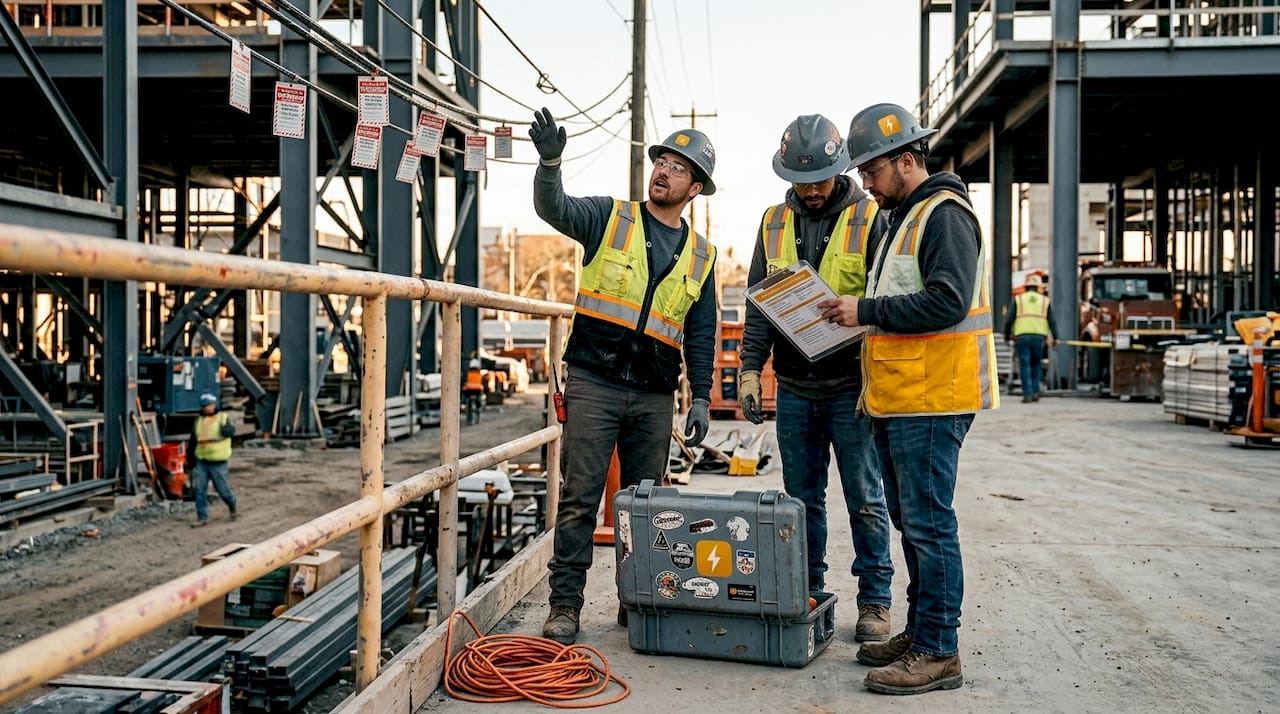
What most contractors get wrong is treating safety as a one-time setup. You post the OSHA poster, hand out hard hats, and consider the box checked. That is not how it works. AGC of America's safety leadership framework emphasizes ongoing programs and training infrastructure as essential for reducing construction risk. Sites change. Crews change. Conditions change. Safety has to be active and continuous.
Practical safety measures that actually move the needle:
- Hold weekly toolbox talks. Short, specific conversations about the hazard of the week keep safety top of mind without burning crew time.
- Conduct pre-task planning. Before any high-risk task, the crew identifies hazards and controls together. It takes 10 minutes and prevents serious incidents.
- Inspect fall protection before every shift. Harnesses, anchor points, and guardrails degrade. A daily check is not optional.
- Track near-misses. Most serious accidents are preceded by near-misses that went unreported. Build a culture where workers report them without fear.
Pro Tip: Your contractor safety checklists should be site-specific, not generic. A roofing checklist looks nothing like an electrical checklist. Generic forms give you false confidence.
Alongside safety, managing insurance and liability exposures is vital to transferring risk appropriately.
Insurance and liability: mapping exposures and coverage
Most contractors carry general liability insurance and assume they are covered. The reality is more complicated. General liability vs professional liability covers different things: general liability targets third-party bodily injury and property damage claims, while professional liability covers allegations tied to professional services that cause financial loss. If a client claims your design recommendation caused them to lose money, general liability will not help you.
Here is a quick comparison to clarify the difference:
| Coverage type | What it covers | Common trigger |
|---|---|---|
| General liability | Bodily injury, property damage | Worker injures a third party, damages client property |
| Professional liability | Financial loss from professional services | Design error, bad advice, coordination failure |
| Workers' compensation | Employee injuries on the job | Worker injured on site |
| Builder's risk | Property damage during construction | Fire, theft, or weather during the project |
Additional insured endorsements add another layer of complexity. Endorsement scope varies widely: some cover liability arising out of your work broadly, while others only cover liability directly caused by your actions. That mismatch is a frequent litigation trigger. When a GC requires you to name them as an additional insured, read the endorsement language carefully. A narrow endorsement may leave the GC exposed and coming after you.
Understanding insurance is part of a larger framework: managing risk systematically throughout your projects.
Implementing systematic risk management for contractors
Risk management sounds like something large firms do. In practice, it is just a structured way of thinking that any contractor can apply. Modern contractor risk management emphasizes using risk registers that score probability and impact, allocating risks to the parties best positioned to control them, and building response plans around four strategies: avoidance, mitigation, transfer, or acceptance.
Here is the process in order:
- Identify risks before the project starts. Walk the site, review the contract, and talk to your crew about what could go wrong.
- Assess each risk by scoring its likelihood (1 to 5) and potential impact (1 to 5). Multiply them for a priority score.
- Allocate the risk to whoever can best control it. Weather risk stays with you. Payment risk can be shifted through deposits and liens.
- Plan your response. Avoid high-probability, high-impact risks when possible. Mitigate medium risks. Transfer low-probability risks to insurance. Accept minor risks consciously.
- Monitor throughout the project. New risks emerge as work progresses. A weekly review of your risk register keeps you ahead of problems.
A simple risk register entry looks like this:
| Risk | Probability (1-5) | Impact (1-5) | Priority | Owner | Response |
|---|---|---|---|---|---|
| Client delays payment | 4 | 5 | 20 | PM | Milestone payments + lien notice |
| Subcontractor no-show | 3 | 4 | 12 | PM | Backup sub identified |
| Permit delay | 2 | 3 | 6 | Office | Apply 3 weeks early |
The goal is not to eliminate all risk. It is to make sure every risk you carry is one you chose deliberately, not one that snuck up on you.
Good scope management and solid client prequalification feed directly into this process. They reduce the number of risks you have to manage in the first place.
Equipped with systematic risk strategies, let's examine how client qualification plays a critical role in minimizing your project risks and losses.
How effective client qualification reduces contractor business risk
Here is what most risk guides miss: a significant portion of contractor risk walks in the door with the client. A client who has no clear budget, no decision-making authority, and a history of disputing invoices is a risk before you even mobilize. Qualifying clients before work begins aligns documentation, escalation paths, and governance with measurable scope and expectations. Without it, disputes default to costly negotiation or litigation.
Effective client qualification means verifying several things upfront:
- Budget clarity: Can the client actually fund the project? Vague answers about budget are a warning sign.
- Decision-making authority: Is the person you are talking to the one who signs checks? If not, get the decision-maker involved early.
- Payment history and reliability: Have they worked with contractors before? Did those projects end well?
- Documentation comfort: Are they willing to sign change orders, receive written scopes, and engage in a formal process? Resistance here is a red flag.
- Realistic expectations: Do they understand what the project involves, how long it takes, and what disruptions to expect?
Pro Tip: Ask every potential client how their last contractor relationship ended. The answer tells you more about them than any other single question. A client who blames every past contractor for everything is a client you want to identify as a red flag early.
Early screening saves you time, money, and the legal headaches that come from bad client signs you ignored because you needed the work. The client qualification steps you put in place now will pay off every time you avoid a problem project.
Having established practical client qualification benefits, let's explore a unique perspective on contractor risk management that most miss.
Why most contractors underestimate business risk and how to shift your mindset
Here is the uncomfortable truth: most trade contractors underestimate business risk not because they are careless, but because saying yes to every job feels like survival. When work is slow, turning down a project feels reckless. But avoiding unfavorable risk-reward ratios sometimes means turning down a project or renegotiating terms. That mindset shift is crucial for small contractors who feel pressured to accept everything that comes through the door.
The jobs you say no to are often the ones that would have cost you the most. A project with a vague scope, a client who haggles over your deposit, and a timeline that does not account for permit delays is not a revenue opportunity. It is a liability wearing a contract.
Contracts are risk allocation documents, not just paperwork. Every clause either puts risk on you or moves it somewhere else. Most costly outcomes come from contractors who sign without fully understanding what they just agreed to carry. Read every indemnification clause. Question every "time is of the essence" provision. Know what you are accepting before you accept it.
Safety leadership is the same. Minimum OSHA compliance keeps you legal. It does not keep your crew safe. The contractors who build strong safety cultures see fewer incidents, lower insurance premiums, and better crew retention. That is a business advantage, not just a moral obligation.
The shift is simple but not easy: stop treating risk as something that happens to you and start treating it as something you actively manage. Thoughtful client selection, careful contract review, and continuous safety leadership are not extra work. They are the work that keeps everything else running.
How SnapQualify can help you manage contractor business risk
Understanding contractor business risk is the first step. Acting on it before a bad client costs you thousands is the real goal.
SnapQualify is built specifically for trade contractors who want to stop guessing about client quality. The platform sends potential clients a branded intake form that asks targeted questions about project scope, budget, timeline, and past contractor experience. The responses are analyzed automatically and generate a color-coded SnapScore that tells you, at a glance, whether a client is worth your time. No more gut-feel decisions. No more finding out a client is a nightmare on day one of the job. SnapQualify also takes data protection seriously, with security features built to keep your client information safe. If you are ready to qualify clients with confidence and protect your business from preventable risk, SnapQualify gives you the tools to do it.
Frequently asked questions
What are the main types of risks that affect contractor businesses?
Contractors face risks including occupational safety hazards, unclear contract terms, financial delays or overruns, regulatory non-compliance, and subcontractor performance issues. Construction business risks span every phase of a project, from the first client conversation to final payment.
How can contractors reduce payment and cash flow disputes?
Use clear milestone payment schedules, document every change order in writing, and avoid verbal-only agreements. Mitigation practices like detailed contracts and written change orders prevent most payment disputes before they escalate.
Why is ongoing safety management important on construction sites?
Most fatalities come from a small set of recurring hazards like falls and electrocutions, and continuous safety training reduces those risks far more effectively than one-time checklists or orientation sessions.
What is the difference between general liability and professional liability insurance?
General liability covers third-party bodily injury and property damage, while professional liability protects against financial loss caused by professional services or advice. These two coverages address different types of claims and both may be necessary depending on your scope of work.
How does client qualification help minimize contractor business risks?
It aligns expectations, documentation, and payment processes before work starts, reducing the chance of disputes. Qualifying clients upfront enables better governance throughout the project and keeps disagreements from turning into litigation.