

Contractor time wasters are any activities, leads, or habits that consume your working hours without producing revenue or moving a project forward. For independent trade contractors, the three biggest offenders are unqualified leads, poor scheduling, and administrative overload. Each one is preventable. This article breaks down the most frequent contractor issues you will encounter and gives you specific, tested methods to stop losing time and money to them.
1. Unqualified leads that drain your estimating time
The single most expensive time waster for most trade contractors is writing detailed estimates for people who were never going to hire you. Unbillable estimating time averages around $381 per estimate when you factor in travel, prep, and follow-up. Multiply that by a handful of tire-kickers every month and you have a serious profit leak.
The fix starts before you ever get in your truck. Use an intake form that asks for project type, budget range, and timeline. Best-performing intake forms balance filtering with ease of submission, so serious buyers complete them and window-shoppers drop off. Tools like SnapQualify automate this step with a branded form and AI-driven scoring, so you see a clear signal on client readiness before you pick up the phone.

Follow the form with a 10 to 15 minute phone screen. Ask about budget comfort, decision-making authority, and project start date. If the answers are vague on all three, that is your signal to pass. Calling new leads within 5 to 15 minutes increases your odds of qualifying them by over 60 percent. Speed matters, but so does having a script ready so you stay consistent.
Pro Tip: Charge a consultation fee of $95 to $500 for detailed scoping visits, credited toward the project cost if they hire you. Consultation fees filter out tire-kickers immediately and signal that your time has value.
2. Skipping the decision-maker in early conversations
One of the most common contractor pitfalls is spending two hours on a site visit only to hear "I need to check with my spouse" or "the property manager has to approve this." That is a full reset on your time. Involving actual decision-makers in the first conversation prevents redundant visits and negotiation breakdowns later.
Ask directly during your phone screen: "Will everyone involved in approving this project be available for our meeting?" If the answer is no, reschedule. This one habit alone can cut your revisit rate significantly. For a deeper look at how to structure this process, the guide on screening owners before saying yes is worth reading.
3. Scheduling mistakes that cascade into delays
Double-booking crews, poor dispatching, and failing to coordinate trade sequences are among the most frequent contractor issues on active job sites. Inefficient scheduling causes wasted fuel, idle labor, and cascading delays that push every downstream task back by days.
The solution is treating your schedule as a living document, not a static plan you set once. Top contractors run weekly look-ahead planning that reflects real crew availability, pending permit approvals, and material delivery windows. This prevents the most common scheduling failures before they happen.
Key scheduling habits that protect your time:
- Build backward from the project deadline, then add buffer time for permits, inspections, and material lead times
- Align trade interfaces early so electrical, plumbing, and framing crews are not waiting on each other
- Order materials early and submit permits in advance to avoid the most predictable delays
- Use integrated scheduling software to flag conflicts before the day starts, not after your crew is already on site
4. Manual admin work that eats your evenings
Admin overhead is a quiet time waster that most contractors underestimate. Timesheet approvals, invoice generation, follow-up emails, and data entry can consume hours every week that should be billable. Automation using the 30-second rule cuts manual admin time by up to 80 percent, saving 40 or more hours monthly.
The rule is simple: if a task takes 30 seconds or fewer and requires five taps or less, automate it. Invoicing, appointment reminders, and payment follow-ups all qualify. Tools like Jobber, ServiceTitan, and Housecall Pro handle these workflows without requiring you to touch them. Automation also improves customer satisfaction and employee retention by reducing errors and processing delays.
Pro Tip: Target high-frequency, low-judgment tasks first when building your automation stack. Invoicing and appointment reminders before anything else. Save your mental energy for decisions that actually require your expertise.
| Admin task | Automation approach |
|---|---|
| Invoice generation | Auto-send on job completion via Jobber or ServiceTitan |
| Appointment reminders | Scheduled SMS or email through your CRM |
| Timesheet approvals | Rule-based auto-approval for standard hours |
| Payment follow-ups | Automated reminder sequence at 3, 7, and 14 days |
5. App-switching and fragmented communication
Jumping between text messages, email, Facebook Messenger, and voicemail to manage a single project is a time management failure that most contractors do not recognize as a problem until it causes a real mistake. Fragmented communication leads to missed instructions, duplicate work, and client disputes that require hours to resolve.
Centralize all project communication in one platform. Whether you use Buildertrend, CoConstruct, or a simple shared Google Drive folder, the rule is that project decisions live in one place and get confirmed in writing. Written scopes and change orders reduce ambiguity and rework far more effectively than any conflict resolution tactic after the fact.
6. Ignoring lead response time
Speed-to-lead has a cliff effect in the trades. Even a few minutes of delay can dramatically reduce your lead conversion rate. Contractors who respond within five minutes convert leads at a significantly higher rate than those who call back an hour later. The prospect has already moved on to the next contractor on their list.
Pair speed with a consistent qualification script so you are not just fast but also filtering effectively. Automated lead follow-up tools can send an immediate text acknowledgment while you finish a job, buying you a few minutes without losing the lead. For a detailed workflow on this, the guide on stopping wasted quote visits covers the full sequence.
7. Scope creep from unclear project agreements
Scope creep is one of the most damaging red flags in contractors' project histories. It starts with a verbal agreement, grows through informal add-on requests, and ends with you doing unpaid work or fighting over what was included. Every hour spent on undocumented work is a direct loss.
The prevention is documentation discipline. Issue a written scope before any work begins. Require a signed change order for every addition, no matter how small. Consistent qualification scripts and systems that include scope documentation convert leads more efficiently and protect you from disputes. This is not about being difficult with clients. It is about protecting the time you have already committed.
Key takeaways
Avoiding contractor time wasters requires filtering leads before site visits, treating your schedule as a live system, and automating repetitive admin tasks so your hours go toward billable work.
| Point | Details |
|---|---|
| Qualify leads before visiting | Use intake forms and a 10 to 15 minute phone screen to filter out tire-kickers before spending time on estimates. |
| Involve decision-makers early | Confirm all approvers are present at the first meeting to prevent redundant visits and stalled projects. |
| Treat scheduling as a live system | Run weekly look-ahead planning with real constraints to stop cascading delays before they start. |
| Automate low-judgment admin tasks | Apply the 30-second rule to invoicing, reminders, and approvals to reclaim 40 or more hours monthly. |
| Document everything in writing | Written scopes and signed change orders prevent scope creep and client disputes that waste hours. |
What I have learned about fighting time waste in the trades
The contractors I have watched struggle most are not the ones with bad skills. They are the ones who say yes to every lead and then wonder why they are exhausted and underpaid. I used to think charging a consultation fee would scare clients away. The opposite happened. It filtered out the people who were never serious and made the clients who paid it feel more committed to the project.
The mindset shift that matters most is moving from reactive to proactive. Reactive contractors wait for problems to show up on site. Proactive ones build qualification, scheduling buffers, and written agreements into their standard process before a single nail is driven. That shift does not require expensive software or a business degree. It requires deciding that your time is worth protecting.
The tools available now, from automated intake forms to live scheduling platforms, make this easier than it has ever been. The contractors who adopt them are not just saving hours. They are building businesses that are less stressful and more profitable at the same time. Small, consistent changes in how you qualify leads and manage your schedule compound quickly into measurable results.
— Colin
Stop losing hours to the wrong clients and the wrong jobs
If you recognize yourself in any of these patterns, SnapQualify was built specifically to address them. The platform gives you a branded intake form that screens clients on project scope, budget, and timeline before you invest a minute of your time. Its AI-driven SnapScore delivers a color-coded read on client reliability so you know who is worth calling back within five minutes and who is not worth the drive.
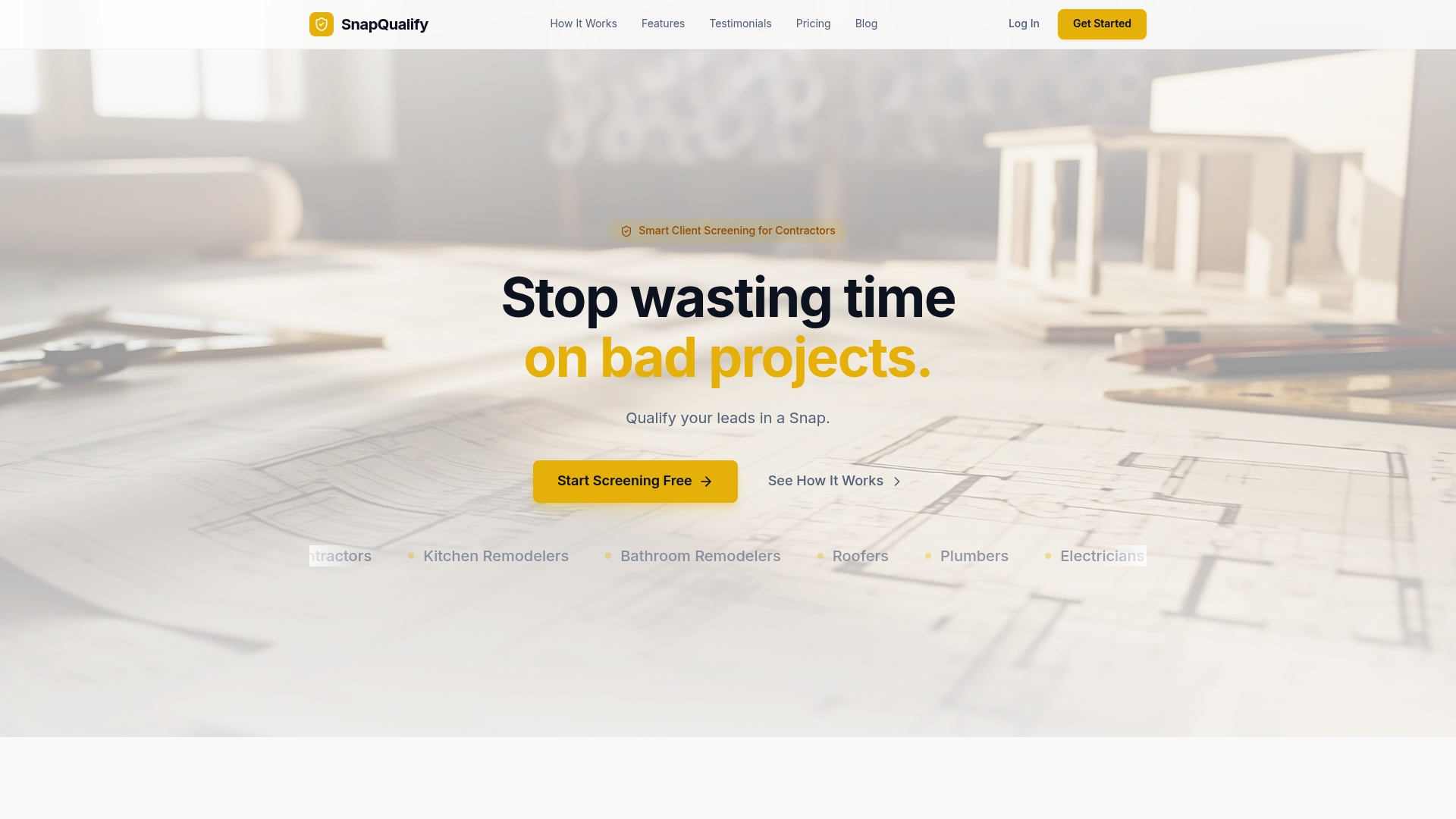
Fewer unqualified leads means fewer wasted estimates, tighter schedules, and more time on jobs that actually pay. SnapQualify handles the screening so you can focus on the work. Your data stays protected under SnapQualify's security standards, and setup fits into your existing workflow without disruption. See how it works at SnapQualify.
FAQ
What are the biggest contractor time wasters?
Unqualified leads, poor scheduling, and manual admin overhead are the three largest time wasters for independent trade contractors. Each one is preventable with intake forms, live scheduling systems, and task automation.
How do I qualify leads faster without losing good clients?
Use a short intake form asking for project type, budget, and timeline, then follow up with a 10 to 15 minute phone screen. Calling within 5 to 15 minutes of a new inquiry increases qualification success by over 60 percent.
Should I charge for estimates or consultations?
Charging a consultation fee of $95 to $500, credited toward the project if hired, filters out tire-kickers and signals professionalism. It preserves your estimating time for prospects who are genuinely ready to move forward.
How does automation help with contractor time management?
Automating tasks that take 30 seconds or fewer, such as invoicing, reminders, and timesheet approvals, can cut admin time by up to 80 percent and recover 40 or more hours per month for billable work.
What is the fastest way to prevent scope creep?
Issue a written scope before work begins and require a signed change order for every addition. Written scopes and change orders prevent ambiguity and rework more effectively than any after-the-fact negotiation.