

You've probably been there. You take on a project, the owner seemed reasonable at first, and three weeks in you're chasing a check, rewriting the scope for the fourth time, and fielding calls at 9 p.m. Understanding how general contractors screen owners before signing anything is the skill that separates profitable contractors from exhausted ones. The right client turns a good project into a great experience. The wrong one turns a fair contract into a financial drain. This guide breaks down the exact methods smart contractors use to evaluate owners before a single shovel hits the ground.
Table of Contents
- Key takeaways
- How general contractors screen owners before starting work
- Using discovery calls to spot red flags early
- Contract and payment structures that filter problem owners
- Pre-construction planning as a screening tool
- My take: saying no is a business strategy
- Let Snapqualify do the screening for you
- FAQ
Key takeaways
| Point | Details |
|---|---|
| Identify the decision-maker | Confirm who holds final approval authority before investing time in any proposal. |
| Use discovery calls strategically | Multiple red flags in one call are a reliable signal to walk away. |
| Lock down scope in writing | A detailed Statement of Work with signed change orders prevents most disputes. |
| Require milestone payments | Structured deposits and phased payments protect your cash flow and filter unserious clients. |
| Use pre-construction as a test | How an owner responds to detailed planning reveals whether they are ready to work professionally. |
How general contractors screen owners before starting work
Not every owner who calls is a good fit. The contractor owner vetting process starts with a simple question: does this person have the mindset, financial readiness, and communication style to be a reliable partner? Most contractors learn the hard way that skipping this step costs far more than a rejected bid.
Here are the core criteria experienced contractors use to evaluate potential owners:
- Decision-maker clarity. Who actually signs off on changes and payments? If the owner keeps referencing a spouse, business partner, or committee that you have never spoken to, that ambiguity will slow every decision on the job. Confirm the approval chain before you go further.
- Financial readiness. Ask directly whether the owner has financing secured or funds available. An owner who hedges on budget conversations or pushes back on deposit requirements is showing you their financial limits early.
- Communication habits. Does the owner respond to emails within a reasonable window? Do they show up prepared for meetings? Slow or chaotic communication during the sales process will be ten times worse once you are on the job.
- Respect for formal processes. Owners who resist written agreements, say things like "we don't need all that paperwork," or want to skip the formal contract phase are signaling that they will also resist change orders and scope documentation later.
Vetting criteria vary by state, but the behavioral signals above are universal. You are not just assessing the project. You are assessing the person you will be working with for weeks or months.
Pro Tip: Ask every new prospect, "Who else will be involved in approving the final scope and payments?" The answer tells you more about the project's risk level than any budget number.
Using discovery calls to spot red flags early
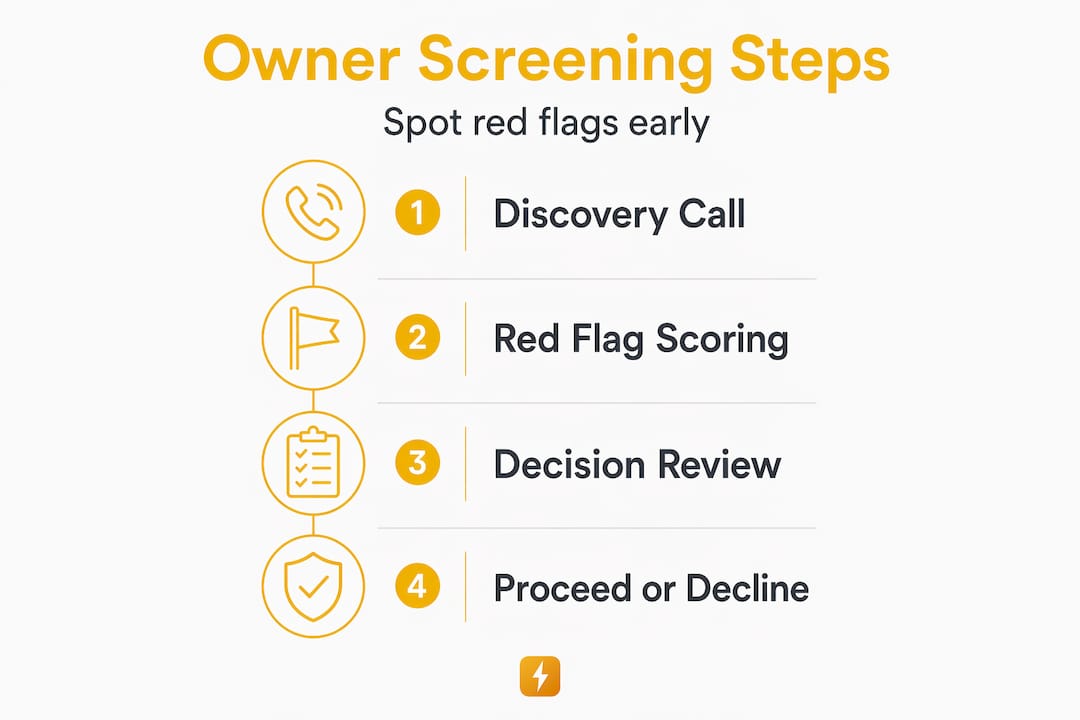
The discovery call is one of the most underused tools in a contractor's client screening process. Done right, it gives you 30 minutes of behavioral data that predicts how an owner will act throughout the entire project. Experienced contractors use a structured red flag scan during these calls to decide whether to proceed or pass.
Here is a simple framework to run during every discovery call:
- Ask about the decision-making process. "Who else needs to be involved before you can move forward?" Vague answers like "I'll figure it out" or "it's just me, sort of" signal unclear authority and future bottlenecks.
- Test scope stability. Describe the project back to the owner and ask them to confirm it. If they start adding items, changing parameters, or saying "well, we were also thinking about..." the scope is already unstable before you have even quoted.
- Listen for price-first focus. Owners whose first three questions are all about price, discounts, or beating another contractor's bid are rarely focused on quality or partnership. They are shopping for the lowest number, not the best fit.
- Probe communication expectations. Ask how they prefer to handle updates and approvals. An owner who expects hourly updates or says they want to be on-site every day is signaling a micromanagement dynamic that will slow your crew.
- Note resistance to process. If you mention contracts, change orders, or deposits and the owner pushes back immediately, mark that as a serious warning sign.
Discovery calls revealing multiple red flags should lead you to consider declining the project. Two or three red flags in a single call is not a coincidence. It is a pattern. You can review a full client warning signs checklist to build this into your standard intake process.
Pro Tip: Take brief notes during every discovery call. Score each red flag area from 1 to 3. Any total score above 10 out of 15 means you should seriously consider passing on the project.
Contract and payment structures that filter problem owners
How you structure your contracts and payment terms does more than protect you legally. It also acts as a filter. Owners who are serious, financially prepared, and committed to a professional process will accept reasonable terms without drama. Owners who push back aggressively on standard protections are showing you who they are.
Here is how the key contract elements stack up:
| Element | What it does | Why it filters problem clients |
|---|---|---|
| Statement of Work (15 sections) | Defines scope and explicitly lists out-of-scope items | Clients who resist detailed scope documents resist accountability |
| Upfront deposit (10 to 30%) | Secures commitment and covers early costs | Clients unwilling to pay a deposit rarely pay reliably later |
| Milestone payments | Ties payment to completion stages | Prevents overextension and keeps both parties accountable |
| Signed change orders | Documents every scope addition in writing | Eliminates "but I thought that was included" disputes |
| Termination clause | Defines exit terms for both parties | Signals you are serious and filters unserious clients |
A detailed Statement of Work that explicitly defines what is not included can prevent up to 80% of scope creep. That is not a small number. Meanwhile, milestone payments tied to progress reports serve as a critical risk mitigation tool, preventing you from overextending financially while giving owners a clear picture of what they are paying for at every stage. Professional contractors typically require upfront deposits of 10 to 30% as standard practice. For more on protecting your cash flow, this guide on avoiding non-paying clients is worth reading alongside your contract templates.

Pre-construction planning as a screening tool
Most contractors think of pre-construction planning purely as a logistical step. It is also one of the best screening mechanisms available to you. How an owner engages with the planning phase tells you whether they are genuinely ready to see the project through.
Mapping every trade sequence and inspection schedule before breaking ground acts as a litmus test for owner alignment. Owners who resist this process, call it unnecessary, or want to skip straight to demolition often create the most expensive delays later. What you learn during pre-construction planning:
- Whether the owner can commit to a structured timeline and approval schedule
- How they respond when plans require adjustment or reveal unexpected complexity
- Whether they understand and accept the sequencing logic that drives your cost estimates
- How quickly they turn around required decisions, permits, or owner-supplied documentation
Treating pre-construction as a stress test rather than a formality gives you real behavioral data. An owner who is cooperative, responsive, and engaged during planning is almost always easier to work with on-site. An owner who pushes back on every step before the work even begins is showing you the project's future in real time. Expectation setting during this phase directly reduces scope disputes and delays, not just as a concept but as a documented practice among experienced builders.
My take: saying no is a business strategy
I've watched contractors burn through an entire season chasing one bad client. The hours spent managing that relationship, rewriting scopes, arguing over invoices, and sitting in dispute calls could have funded two solid projects with good owners. The math is brutal.
In my experience, the contractors who build the best portfolios and the healthiest businesses are not the ones who say yes to everything. They are the ones who get firm on boundaries early and trust the signals they get during vetting. Contractors often regret accepting projects with problematic owners. That regret is almost always tied to ignoring a red flag they saw in the first conversation.
Trust your process. Trust your gut when the two align. And remember that every bad project you decline makes room for a good one.
— Colin
Let Snapqualify do the screening for you
If running discovery calls, scoring red flags, and reviewing contract terms for every lead sounds like a second job, that is exactly the problem Snapqualify was built to solve.
Snapqualify is a client screening platform built specifically for trade contractors and home services businesses. When a new lead comes in, they complete a branded intake form with targeted questions about their project scope, budget, timeline, and decision-making process. Snapqualify's AI then analyzes those responses and generates a color-coded SnapScore so you know, before you spend an hour on a call, whether this owner is a reliable fit or a risk. You can review your data security details before getting started. Stop guessing and start qualifying at Snapqualify.
FAQ
How do general contractors evaluate new clients?
Contractors evaluate clients by assessing decision-maker clarity, financial readiness, communication habits, and willingness to sign formal contracts. Discovery calls and pre-construction planning are the most reliable behavioral screening tools.
What are the biggest red flags in owner discovery calls?
Multiple red flags to watch for include vague decision-making authority, unstable project scope, aggressive price focus, and resistance to standard contracts or deposits.
Why do contractors require upfront deposits?
Deposits of 10 to 30% serve two purposes. They cover early project costs and act as a filter, since owners unwilling to commit financially at the start rarely pay reliably throughout the project.
How does a Statement of Work help with owner screening?
A detailed Statement of Work forces the owner to agree to exactly what is and is not included in the project. Owners who resist signing one are often the same owners who dispute invoices later.
What questions should contractors ask before quoting a project?
Start with budget confirmation, decision-maker identification, and timeline expectations. You can find a structured list of pre-quote questions designed specifically for contractor intake conversations.