

Chasing a check is one of the most demoralizing parts of running a trade business. You show up, do the work, and then spend weeks calling, emailing, and hoping. Knowing how to avoid clients who don't pay is not just a billing skill — it is a business survival skill. Non-paying clients drain your cash flow, stall your next project, and burn time you cannot get back. The good news is that most payment problems are preventable. This guide walks you through exactly what to do before, during, and after a job to keep your money where it belongs.
Table of Contents
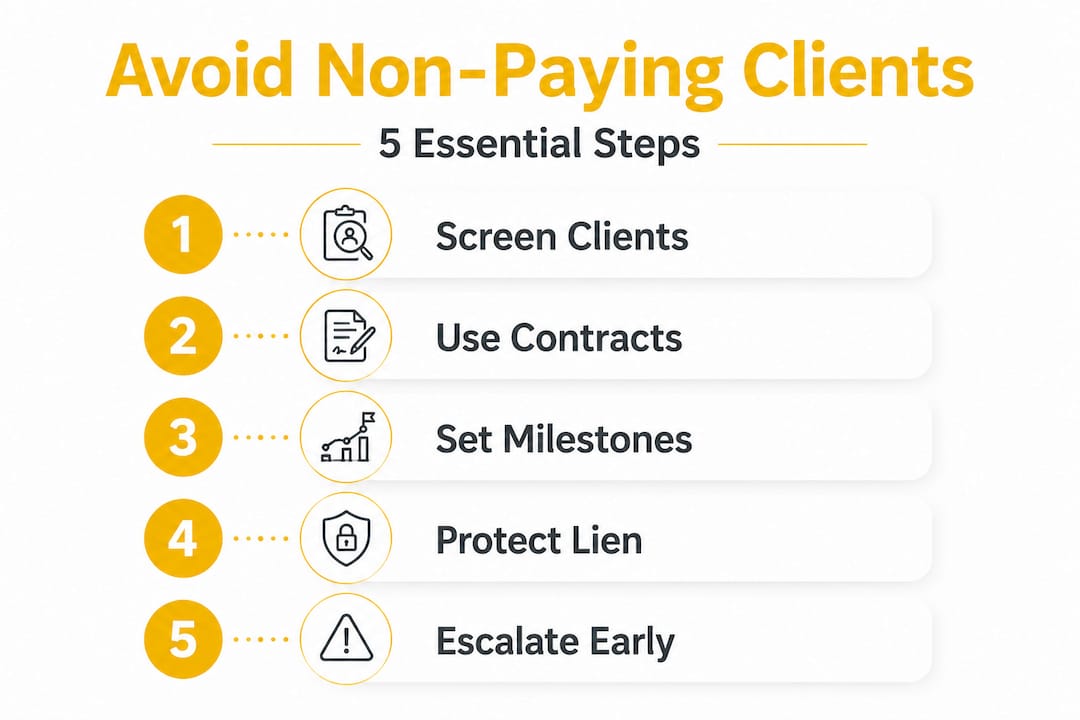
- Setting up to avoid non-paying clients: contracts and client screening
- Using milestone-based payments to maintain control and minimize risk
- Protecting your lien rights to secure payments on legal grounds
- Managing overdue payments: communication and escalation strategies
- Why structured client screening and milestone payments are non-negotiable
- Protect your business with SnapQualify's client screening solutions
- Frequently asked questions
Key Takeaways
| Point | Details |
|---|---|
| Use signed contracts | A written contract specifying payment terms and late fees protects your right to be paid and provides legal recourse. |
| Milestone payments reduce risk | Tying payments to verifiable project phases keeps you financially protected through the project's lifecycle. |
| Preserve lien rights | Timely notice filing is essential to maintain legal leverage for unpaid work, especially in California and Texas. |
| Screen clients early | A structured client intake process helps spot red flags before work starts, saving time and money. |
| Follow up consistently | Scheduled reminders and clear late-fee policies encourage timely payments and help manage overdue invoices. |
Setting up to avoid non-paying clients: contracts and client screening
Before you pick up a single tool, your paperwork needs to be airtight. The single most important thing you can do to prevent non-paying clients is get a signed contract in place before work begins. Not a handshake, not an email thread. A signed, written contract.

A solid contract should cover the full scope of work, specific payment amounts, exact due dates, and what happens when payment is late. As SCORE advises, you should require a signed contract detailing project scope, payment amounts, due dates, and late fees to create enforceable payment obligations. That last part matters. A late fee clause — say, 1.5% per month on unpaid balances — turns your contract from a suggestion into a financial consequence.
Client screening is equally important, and most contractors skip it entirely. Learning how to filter clients before you commit time to a site visit or quote can save you weeks of regret. The clients most likely to cause payment problems often show the same warning signs early on.
Common signs of bad clients to watch for during initial contact:
- Pushback on signing any written agreement
- Vague answers about budget or timeline
- Multiple contractors already walked off the job
- Urgency without clear reason ("I need this done immediately")
- Reluctance to discuss payment terms upfront
- A history of disputes with previous contractors
Pro Tip: Before your first site visit, send a short intake questionnaire. Ask about budget range, project timeline, and whether they have worked with contractors before. The answers — and the attitude behind them — tell you a lot.
| Screening method | What it reveals | Time required |
|---|---|---|
| Intake questionnaire | Budget clarity, communication style | 5 minutes |
| Reference check | Past contractor relationships | 10-15 minutes |
| Online search (reviews, court records) | Dispute history, financial reliability | 15-20 minutes |
| Contract willingness check | Risk tolerance, seriousness | Immediate |
Use a client red flags checklist to standardize your evaluation. Consistency matters because gut feelings alone are not a reliable filter. Building a repeatable process around client screening questions protects you from making exceptions for charming clients who later become your worst payers.
Using milestone-based payments to maintain control and minimize risk
With a solid contract and a screened client, the next step is controlling how and when money moves. Milestone-based payments are the most practical client payment strategy available to contractors. Instead of billing on a fixed date, you tie each payment to a specific, verifiable event in the project.
Here is how to structure a milestone payment schedule:
- Deposit at contract signing. A deposit of 10 to 20 percent is standard. Avoid requesting more than 30 percent upfront, which can create legal complications in some states and signals financial risk to reasonable clients.
- First milestone payment after materials delivery or rough-in completion. This confirms the project is underway and covers your material costs early.
- Second milestone payment at the mid-project inspection or agreed phase completion. Keeps cash flow moving without front-loading financial risk on either side.
- Penultimate payment at substantial completion. When the major work is done but before final walk-through.
- Final payment at punch list sign-off. Holding this last payment until the client approves the finished work gives you real leverage to collect.
As this payment schedule guide explains, milestone-based payments with modest deposits reduce waiting periods for payments and protect your leverage throughout the project. That leverage is the key point. Once a job is 100 percent complete and paid for, you have no more cards to play. Holding back that final phase gives you a reason the client has to pay to move on.
Pro Tip: Put the milestone schedule directly in the contract with dollar amounts, not just percentages. "Payment of $4,200 due upon completion of framing inspection" is harder to dispute than "30% at phase two."
| Payment structure | Cash flow risk | Client leverage | Common use case |
|---|---|---|---|
| Lump sum at end | Very high | None | Never recommended |
| Fixed monthly billing | Medium | Low | Long-term service contracts |
| Milestone-based | Low | High | Renovation and construction |
| Weekly progress billing | Low-medium | Medium | Commercial projects |
Milestone payments also connect naturally to preventing scope creep, because each payment phase forces a documented review of what was agreed versus what was completed.
Protecting your lien rights to secure payments on legal grounds
Even with payment controls in place, some clients still stall. That is where lien rights become your financial safety net. A mechanic's lien (also called a construction lien) gives you a legal claim against the property itself if you are not paid for work performed. It is one of the most powerful tools available for dealing with unpaid invoices, but it only works if you follow the procedural rules exactly.
Key lien rights basics every contractor should know:
- Lien rights are governed at the state level, so requirements vary significantly
- Most states require you to file a preliminary notice (also called a pre-lien notice) within a specific window of starting work
- In California, you must send preliminary notice within 20 days of first furnishing labor or materials
- In Texas, subcontractors must send monthly notices by the 15th day of the second month following each month of unpaid work
- Missing a single deadline can forfeit your lien rights for that entire period of work
| State | Notice type | Deadline | Who must file |
|---|---|---|---|
| California | Preliminary notice | Within 20 days of start | Subs, suppliers, general contractors |
| Texas | Monthly fund trapping notice | 15th of 2nd month after work | Subcontractors, suppliers |
| Florida | Notice to owner | Before first furnishing | Subs, suppliers |
| New York | Notice of lien | Within 8 months of completion | All claimants |
The procedural discipline required here is real. Set calendar reminders the day you start a job. Missing deadlines means missing rights, and missing rights means dealing with unpaid invoices with far less legal backing. Think of lien notices as your insurance policy. You hope you never need them, but the moment you do, you will be glad they were filed on time.
Knowing the signs of bad clients early, covered in detail on this contractor client guide, can help you identify which projects warrant extra procedural care from day one.
Managing overdue payments: communication and escalation strategies
You did the work, the invoice is out, and now the due date has passed. Here is how to handle it without burning the relationship unnecessarily — or letting a client walk away without paying.
- Day one past due: send a payment reminder. A simple, professional email referencing the invoice number, amount, and due date. Keep it factual, not emotional.
- Day five: follow up by phone. A brief call often resolves issues that emails leave open. Clients sometimes have a legitimate billing delay. Find out.
- Day fifteen: issue a late fee notice. Reference the late fee clause in your contract. Put the new balance in writing.
- Day thirty: send a formal demand letter. State the outstanding balance, reference the contract, and give a specific deadline to pay before further action.
- Beyond thirty days: escalate. Options include stopping work on active projects, filing a lien, referring to a collections attorney, or selling the invoice to a factoring company.
"Early, scheduled follow-ups and clear late fees can prevent slow escalation of non-payment issues."
Stopping work is a powerful signal. Most clients would rather pay than have a half-finished project sitting in their home or on their commercial property. Use that leverage deliberately, not emotionally, and document every communication as you go.
One area contractors consistently underestimate is the cost of chasing bad leads in the first place. Stopping wasted quote visits to unqualified prospects is equally important for protecting your time and margins.
Why structured client screening and milestone payments are non-negotiable
Here is the uncomfortable reality: most contractors who end up dealing with unpaid invoices did not get ambushed. They saw the warning signs and chose to ignore them. The client who hesitated to sign the contract. The one who wanted the whole job done before any money changed hands. The one who could not give a clear answer about their budget. These are not mysteries in hindsight.
The conventional advice is to "just get a contract." That is necessary, but it is not sufficient. A contract you never enforce, with payment terms the client never agreed to upfront, is not protection. It is paperwork. What actually protects you is a combination of upfront screening, structured milestone payments, and lien rights filed on time.
Clients who push back on milestone payments are telling you something important about how they view your financial risk compared to their own. A reasonable client understands that a contractor cannot finance someone else's renovation. If a client resists signing payment terms or milestone structures, that is your signal to slow down or walk away before you have spent money on materials and labor.
Lien rights deserve a special mention here. Many contractors know they exist but treat them as a last resort they will figure out later. That approach fails because lien rights have front-loaded requirements. The preliminary notice has to be filed near the start, not the end. By the time you realize you need it, the deadline is often already past.
The contractors who rarely deal with payment problems are not luckier. They use tools like intake forms that qualify clients before the first visit, they read the signals early, and they walk away from projects that do not clear their baseline criteria. That is not being difficult. That is running a business. If you want a practical starting point, the avoiding non-paying clients resource covers specific tactics you can put in place this week.
Screening upfront costs you fifteen minutes. Chasing a check costs you weeks.
Protect your business with SnapQualify's client screening solutions
You now have the framework. The harder part is executing it consistently on every job, especially when you are busy and a new lead sounds promising. That is exactly where SnapQualify makes a real difference.
SnapQualify gives you a branded intake form that sends every potential client through an automated screening process before you spend a minute on a site visit. Clients answer targeted questions about scope, budget, and experience. The platform's AI-driven analysis generates a color-coded SnapScore that tells you quickly whether this client is worth pursuing. Red flags surface before you are invested. Good fits get fast-tracked. Your data stays protected with industry-grade security protocols built specifically for trade businesses. Stop guessing and start qualifying.
Frequently asked questions
What is the most effective way to avoid clients who don't pay in construction?
The most effective approach combines a signed contract with clear payment terms, a milestone-based payment schedule, and thorough client screening before starting any work. SCORE recommends a signed contract detailing scope, payment amounts, due dates, and late fees as the baseline requirement.
How do milestone-based payments protect contractors?
Milestone payments tie each payment to a verified project phase, so contractors are not waiting until the end to get paid and retain financial leverage throughout the job. Holding the final payment until punch list sign-off ensures clients must approve and pay before the project officially closes.
What happens if a contractor misses filing lien notices on time?
Missing preliminary notice deadlines can forfeit your lien rights for the affected period of work, significantly reducing your legal leverage to recover unpaid funds. Procedural discipline and calendaring notice deadlines from day one of the project are critical.
How should contractors handle late payments from clients?
Start with a professional payment reminder on day one past due, follow up by phone within the first week, and apply pre-disclosed late fees by day fifteen. If early reminders fail, escalating with late fees and formal demand letters typically resolves most disputes before legal action becomes necessary.