

You answer the phone all day, drive out for inspections, and still end up chasing jobs that never close. Sound familiar? Learning to qualify roofing leads from calls is the single fastest way to stop burning time on homeowners who were never going to sign. This guide walks you through everything: call tracking setup, scripted discovery questions, lead scoring by type, and automation that keeps your pipeline full of jobs worth taking. Follow this system and you will close more work with fewer wasted trips.
Table of Contents
-
Preparing your system: tools and setup for call qualification
-
Avoiding common mistakes and troubleshooting qualification issues
-
Verifying success and optimizing lead qualification over time
Key Takeaways
| Point | Details |
|---|---|
| Speed is critical | Calling leads within 5 minutes greatly increases your chances of qualification and closing the job. |
| Differentiate lead types | Scoring leads according to type and urgency ensures you focus on the highest-value opportunities first. |
| Track every call | Full call tracking prevents wasted marketing spend and reveals which channels bring your best leads. |
| Use structured scripts | Asking targeted questions builds trust and uncovers key qualification details efficiently. |
| Leverage automation | Integrating scoring and routing automation frees your team to focus only on the best qualified leads. |
Why qualifying roofing leads from calls is critical
Most of your business walks in through the phone. 70-80% of roofing leads originate via phone calls, yet many contractors have no system to track or score them. That means a significant chunk of your marketing spend disappears into calls you cannot measure, cannot prioritize, and cannot improve.
Here is what unqualified calls actually cost you:
-
Wasted drive time on inspections that had no real chance of closing
-
Inflated customer acquisition costs when you cannot tell which ads generate real jobs
-
Lower close ratios because your best salesperson is tied up with tire-kickers
-
The inspection gap: you fill the calendar with appointments, but signed contracts stay flat
Not every call carries the same value. An insurance claim caller with active storm damage is fundamentally different from someone calling for a general repair quote. Emergency tarping requests need an immediate response. General maintenance inquiries can wait. Treating them all the same is how you end up avoiding bad leads the hard way, after you have already spent the time.
“A roofing contractor who qualifies calls well does not just close more jobs. They close better jobs, faster, with less friction.”
The roofing lead qualification process starts before you ever send a truck. It starts on the phone.

Preparing your system: tools and setup for call qualification
Before you can qualify a single call effectively, your infrastructure needs to be right. Auditing your current phone setup is the first step. If all your calls roll into one number, you are flying blind.
Set up dedicated tracking numbers for each marketing channel. Running Google Ads, a yard sign campaign, and a referral program? Each one needs its own number. Dynamic number insertion (DNI) swaps the phone number displayed on your website based on how the visitor arrived, giving you 97-99% accuracy in identifying lead sources. That level of precision changes how you allocate your ad budget.
Integrate call data into your CRM. Call tracking without CRM integration is just data sitting in a dashboard nobody checks. When a call comes in, your CRM should log the source, duration, and outcome automatically. This speeds up follow-up and feeds your lead scoring setup.
Document your ideal customer profile (ICP). An ICP is a description of the client most likely to hire you, pay on time, and refer others. For roofers, this typically includes:
| ICP Factor | What to capture |
|---|---|
| Project size | Square footage, number of stories |
| Roof age | Under 15 years vs. aging systems |
| Damage type | Storm, wear, leak, full replacement |
| Homeowner authority | Are they the decision maker? |
| Insurance status | Claim filed, adjuster scheduled? |
| Budget range | Realistic or exploratory? |
Map every lead source to a data field. Referrals often come in with more context than cold ad clicks. Knowing that upfront helps you prequalify homeowners before you even ask the first question.
Pro Tip: Build your ICP around your last 20 closed jobs, not your wishlist. Look for patterns in project size, damage type, and how fast they signed. That is your real ideal customer.
Once your system is set up, defining your ICP and mapping lead sources enables AI-powered lead scoring and routing in your CRM, turning raw call data into actionable decisions.
Executing an effective call qualification workflow
Speed is not just a nice-to-have. Calling a lead within 5 minutes makes you 21 times more likely to qualify them compared to waiting 30 minutes. That number should change how you staff your phones.
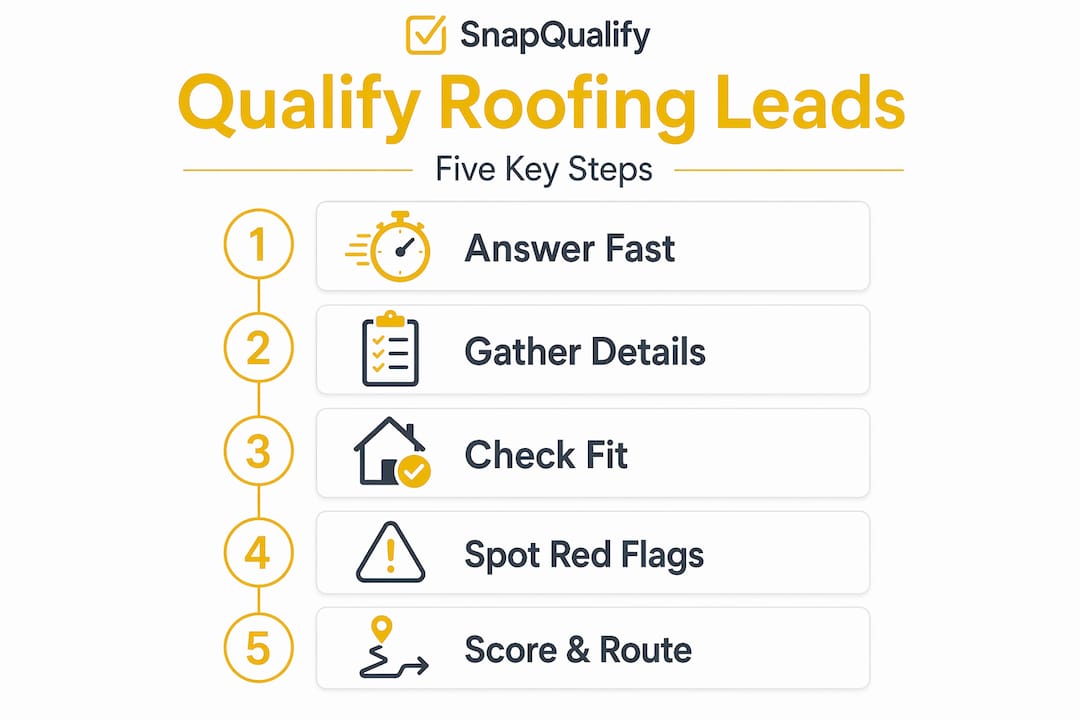
Here is a step-by-step call qualification workflow built for roofing sales calls:
-
Answer or return the call within 5 minutes. Set up immediate text alerts for missed calls and assign someone to return them fast.
-
Identify the lead type first. Is this an insurance claim, an emergency, or a general repair? Your scoring and urgency level shift immediately based on the answer.
-
Verify your non-negotiables. Homeowner authority, roof age, damage specifics, and insurance status are not optional fields. If you skip them, you are guessing.
-
Use a tool like SnapQualify to gather information. Tell the lead you'll be sending them a brief questionnaire, then send them a "smart" intake form vis SnapQualify to get info and help determine if this is a good or bad lead.
-
Route accordingly. Hot leads go straight to your top closer or inspection scheduler. Warm leads enter a follow-up sequence. Low-priority leads get a nurture email and a callback window.
Avoiding common mistakes and troubleshooting qualification issues
Even contractors with good intentions make the same errors when filtering roofing service inquiries. Here is what to watch for:
-
Pooling all calls into one number. You lose source attribution entirely. One tracking number per channel is non-negotiable.
-
Using a one-size-fits-all scoring approach. Treating all calls the same disregards the real difference in value between a hail claim and a minor repair inquiry. Score by lead type.
-
Capturing only a fraction of calls. Failing to track 100% of incoming calls means your decisions are based on 20-30% of actual data. You are optimizing for a partial picture.
-
Weak after-hours routing. Emergency calls that go to voicemail and sit until morning are lost jobs. True emergencies need an immediate notification, even if it is just a text to the on-call rep.
-
Ignoring the inspection gap. If your calendar is full but your close rate is low, the problem is not lead volume. It is qualification. You are sending trucks to the wrong calls.
“The fix for most roofing sales problems is not more leads. It is better filtering of the leads you already have.”
Pro Tip: Pull your last 30 inspections and check how many converted. If it is below 40%, your qualification process has a leak. Audit the calls that preceded those no-close inspections and look for patterns in what was missed.
Regularly audit your channel data too. Stopping wasted quote visits starts with knowing which sources send you low-quality leads so you can reallocate spend toward the ones that actually close.
Verifying success and optimizing lead qualification over time
You cannot improve what you do not measure. Once your call qualification system is running, you need a set of KPIs to tell you whether it is working.
Key metrics to track:
-
Speed-to-lead: Average time from call received to first contact. Target under 5 minutes for hot leads.
-
Qualification accuracy rate: What percentage of leads you scored as “hot” actually converted to signed contracts?
-
Call-to-inspection rate: How many qualified calls result in a scheduled inspection?
-
Inspection-to-close rate: Of those inspections, how many turn into jobs?
-
Cost per qualified lead by channel: Which marketing sources generate the best leads at the lowest cost?
| Metric | Untracked calls | Tracked and scored calls |
|---|---|---|
| Conversion to bookable job | 14-18% | 23-37% |
| Marketing attribution accuracy | Low | High |
| Speed-to-lead consistency | Inconsistent | Measurable and improvable |
| Close rate visibility | None | Full pipeline view |
Review your lead scoring thresholds at least quarterly. Storm season changes what a “hot” lead looks like. A hail event in your market makes insurance claim calls far more common and more valuable, and your routing rules should reflect that.
Why treating all roofing calls the same is a costly mistake
Here is the uncomfortable truth most roofing sales training skips: the problem is not that contractors are lazy about lead qualification. The problem is that nobody ever showed them the cost of treating every call identically.
An insurance claim caller with a filed claim and an adjuster scheduled is worth three to five times more than a general repair inquiry. They have already decided they need work done. The question is which roofer gets the job. Insurance and emergency calls require faster, prioritized handling to avoid missing high-value jobs. Every minute you delay routing that call to your best closer is a minute your competitor might be on the phone with that homeowner.
Meanwhile, the general repair caller might need a $400 patch. That is fine work, but it should not pull your top closer off an insurance job with a $15,000 replacement scope.
The “one call fits all” mentality also breaks automation. Automation only works well when scoring criteria and data fields are formalized. If your team is winging it on every call, your CRM routing rules have nothing consistent to act on. You end up with hot leads sitting in a general queue and cold leads getting callbacks before emergencies.
Formalizing your scoring criteria is not bureaucracy. It is the foundation that lets technology do the heavy lifting. Once your scoring rubric is documented and your data fields are consistent, you can automate routing, trigger follow-up sequences, and generate reports that actually reflect reality.
The contractors who spot bad client signals early and route high-value leads fast are the ones closing more jobs with the same number of trucks. That is the real competitive advantage in roofing right now.
Streamline your roofing lead qualification with SnapQualify
You now have the framework. The next question is whether you want to build and manage all of this manually, or use a tool built specifically for contractors like you.
SnapQualify automates the roofing lead qualification process from intake to scoring to routing. Instead of relying on memory or spreadsheets, you get custom scoring rules built around your ICP, automatic hot lead alerts to your top closers, and branded intake forms that replace the generic, insecure alternatives most contractors are still using. Every lead gets evaluated consistently, every time. Your data stays protected with enterprise-grade security built in. No extra setup required. If you are ready to close more profitable roofing jobs and stop wasting trips on leads that were never going to sign, SnapQualify is the tool that makes this system run.
Frequently asked questions
What is the most important factor in qualifying roofing leads from calls?
Speed of response is critical. Calling within 5 minutes makes you 21 times more likely to qualify a lead than waiting 30 minutes, so your first priority is getting to the phone fast.
How should I score different types of roofing leads from phone calls?
Score by lead type and urgency rather than using a flat system. Insurance claim leads score higher due to damage severity, claim status, and homeowner urgency compared to general repair inquiries.
Why is call tracking important for roofing lead qualification?
Call tracking tells you which marketing channels are actually generating jobs, not just calls. Failing to track all calls means your decisions are based on 20-30% of real data, which leads to wasted ad spend and missed opportunities.
What should I ask during a call to qualify a roofing lead?
Use a scripted sequence covering why they called, their biggest concern, budget expectations, project timeline, competing estimates, and who else is involved in the decision. Asking these questions in order gives you a complete picture before you ever schedule an inspection.