

Most contractors who overbid jobs aren't being greedy. That framing misses the real story. Why contractors overbid jobs is a question with a surprisingly systemic answer: payment cycles that run 90 days while your payroll runs every two weeks, retainage that ties up cash for months, and risk exposure that forces you to price in protection before you've even swung a hammer. This article breaks down the financial pressures, estimation errors, and pricing strategies that drive bid padding, and shows you what to do differently.
Table of Contents
- Key takeaways
- Why contractors overbid jobs: the financial pressure behind it
- Markup versus margin: the estimation mistake costing you money
- Contingency strategy: category-specific vs. flat-rate buffers
- Operational strategies that reduce the need to overbid
- My take on why breaking the padding habit matters
- Stop padding bids: let Snapqualify screen your clients first
- FAQ
Key takeaways
| Point | Details |
|---|---|
| Bid padding is a survival tactic | The 8% industry buffer reflects financing costs, not excess profit. |
| Markup confusion inflates bids | A 25% markup is only a 20% margin. Getting this wrong costs you either clients or profit. |
| Flat contingencies are imprecise | High-risk categories like MEP rough-in need 15-20%; finish work needs just 3-5%. |
| Transparent contingency builds trust | Itemizing reserves in proposals reduces disputes and improves your close rate. |
| Smarter client screening reduces risk | Knowing your client's reliability before you quote removes the pressure to pad for unknowns. |
Why contractors overbid jobs: the financial pressure behind it
Here's the uncomfortable reality most industry articles skip: 73% of construction firms pad bids by 6 to 10% specifically to offset financial risks tied to payment delays and unpredictable costs. That's not a minority behavior. It's standard practice, and it exists because the economics of construction cash flow are brutal.
The core problem is a timing mismatch. The construction industry averages a 90-day payment cycle, but your suppliers want payment in 30 days and your crew expects a check every two weeks. You're fronting money. A lot of it. And when a GC or owner is 30 days late, which 82% of contractors experience regularly, that gap doesn't disappear. You finance it with credit lines or cash reserves, and that financing carries real cost.
The compounding factors that drive bid padding include:
- Retainage. Owners withhold 5 to 10% of each payment until project completion. That money is earned but unavailable, sometimes for months after you've wrapped up your scope.
- Unbilled change orders. Work you've done but haven't yet formalized into a change order represents real labor and material cost sitting on your books with no corresponding cash inflow.
- Subcontractor risk. 56% of subcontractors have turned down work due to cash flow concerns. When you're competing for subs in a tight market, you may pay a premium to secure them. That premium goes somewhere, and it often goes into your bid.
"The 8% buffer isn't padding. It's the cost of financing a project that pays you 90 days after you've already spent the money." This is an industry-wide survival buffer, not a rounding error.
Pro Tip: Track your actual financing cost per project by calculating the interest on credit line draws used to cover payroll and materials between invoice and payment. Once you see that number, you'll know exactly what to build into your bids instead of guessing.
The solution here isn't to stop accounting for these costs. It's to account for them precisely rather than reflexively. Padding bids because you feel exposed is not the same as pricing in a documented financing cost.
Markup versus margin: the estimation mistake costing you money
This is one of the most common and damaging errors in contractor pricing. A 25% markup corresponds to just a 20% profit margin. These are not interchangeable terms, but plenty of contractors treat them as if they are.

Here's the math with a concrete example. Say your direct costs on a job are $80,000 and you apply a 25% markup. Your price to the client becomes $100,000. Your gross profit is $20,000, which is 20% of revenue, not 25%. If your overhead runs 22%, which is typical for small firms, you've just priced yourself into a loss.
Small firms typically carry 20 to 25% overhead when you account for insurance, equipment, office costs, vehicles, and unbillable administrative time. If your target net margin is 10%, you need to be adding roughly 33 to 40% markup over direct costs, not 25%.
Common estimation mistakes that lead to unintentional overbidding:
- Using last year's material prices without adjusting for current market rates, which can cause you to price too high or too low depending on the direction of price movement.
- Ignoring overhead allocation per project, leading to overbidding small jobs to compensate for overhead you're already recovering elsewhere.
- Applying a flat labor rate that doesn't reflect actual crew composition, skill level, or productivity variance by task type.
- Relying on memory instead of historical job cost data, which consistently produces estimates that are either too high or too low.
Pro Tip: Build a simple spreadsheet that calculates your required markup automatically based on your actual overhead percentage and target margin. Once you run your numbers, you'll stop second-guessing and start bidding with precision.
Poor estimating tools compound all of these errors. If you're pricing off gut feel or outdated spreadsheets, your bids will drift. And when contractors feel uncertain about their numbers, the natural response is to add buffer. That buffer is often what causes overpricing on otherwise competitive jobs.
Contingency strategy: category-specific vs. flat-rate buffers
Most contractors apply a blanket 10% contingency to the whole bid and call it risk management. That approach is imprecise in both directions. It overprices some scopes and underprices others, and it gives clients nothing to evaluate or trust.
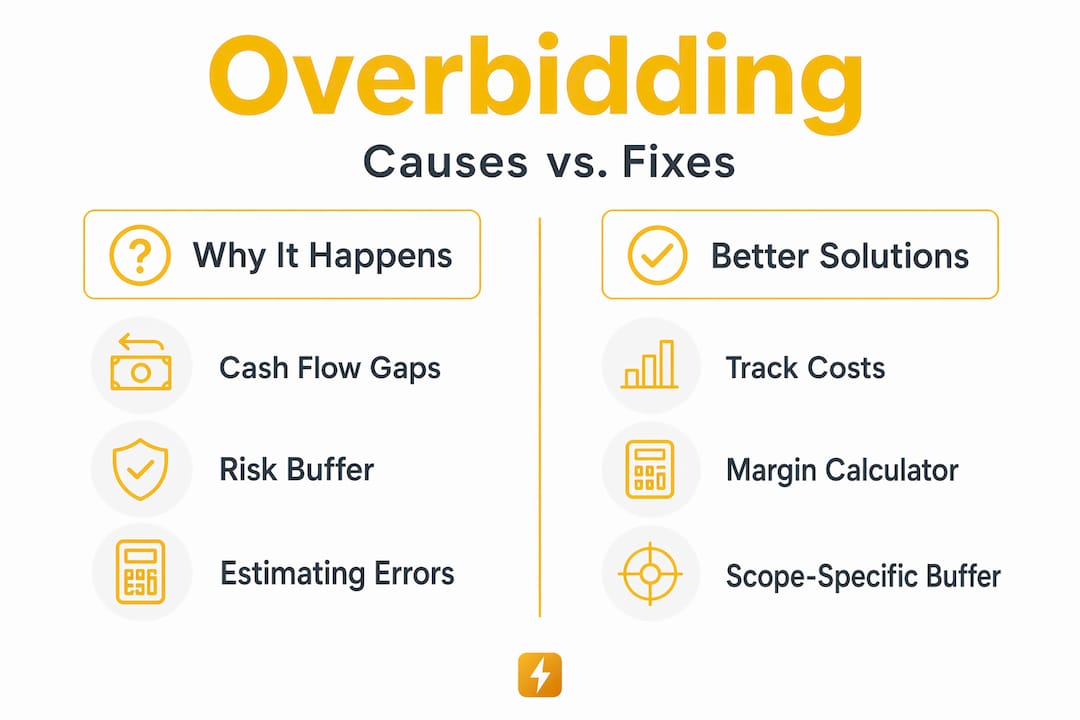
The better approach is category-specific contingency modeling. High-risk categories like MEP rough-in and structural work carry genuine variance. Those scopes can require 15 to 20% contingency buffers because of coordination complexity, inspection delays, and material lead time unpredictability. Predictable finish work, flooring or painting for example, realistically needs only 3 to 5%.
| Scope category | Recommended contingency |
|---|---|
| Structural work | 15 to 20% |
| MEP rough-in | 15 to 20% |
| Site work and excavation | 10 to 15% |
| Framing and exterior shell | 8 to 12% |
| Interior finishes | 3 to 5% |
| Painting and flooring | 3 to 5% |
Beyond contingency, contractors are also increasingly embedding a layered risk premium across labor, materials, and subcontractor pricing. This reflects persistent market volatility, not cyclical uncertainty. Material costs shift quickly. Labor availability tightens unpredictably. That reality is now priced into proposals by experienced contractors, and it's a legitimate practice when done deliberately.
What separates this from blind padding is transparency. Builders who itemize and explain contingency in proposals experience fewer disputes and higher close rates. When a client can see that you've allocated 18% contingency to the mechanical scope because of known coordination risk, they understand your number. When they see a lump-sum bid with no explanation, they negotiate against everything.
Pro Tip: Present contingency as a separate line item in your proposals with a brief written rationale. Most clients respect honesty about risk far more than a polished number with no backstory. It also protects you legally if scope changes later.
Scope creep is another reason flat contingency models break down. When you haven't accounted for scope-specific risk, you end up either absorbing change costs or fighting the client over every addition.
Operational strategies that reduce the need to overbid
If you fix the operational side of your business, you can shrink your bid padding without shrinking your margins. This is where the real leverage is for most contractors.
-
Use real-time job costing. Compare estimated versus actual costs during each project, not just at closeout. When you know where your estimates consistently run over, you can correct them for the next bid instead of padding everything by default.
-
Align payment schedules to your cash flow. Negotiate milestone-based billing that tracks your actual spending curve. Front-loading your payment schedule, where the contract allows, reduces the financing gap that forces you to pad bids in the first place. Qualifying your clients before the quote gives you the information you need to negotiate realistic terms.
-
Document change orders immediately. The true cost of unmanaged change orders is 2 to 5 times the direct amount when you factor in schedule disruption and coordination overhead. Contractors who don't capture these costs compensate by padding future bids. Strict change order documentation stops that cycle.
-
Tighten submittal management. Administrative failures in submittal handling drive rework, schedule compression, and cost overruns. When you manage submittals proactively, you prevent the hidden costs that make you feel like you need to overbid.
-
Screen your clients before you quote. Problem clients, the ones who push back on every payment, dispute change orders reflexively, or expand scope without authorization, are a primary reason contractors pad bids. Knowing a client's reliability profile before you invest hours in an estimate changes the entire risk calculation. You can also spot red flags of a bad client before they cost you real money.
-
Review historical data before pricing labor. Your actual labor productivity on past jobs is the most accurate predictor of future performance. Most contractors overbid labor on simple tasks and underbid it on complex ones because they rely on industry averages instead of their own crew's data.
The contractors who stop overbidding aren't taking on more risk. They're removing the uncertainty that made overbidding feel necessary in the first place.
My take on why breaking the padding habit matters
I've watched contractors run the same cycle for years. They pad bids to protect themselves, lose jobs to lower-priced competitors, and then take on riskier clients to fill the gap. Those clients create exactly the payment problems they were padding against. It's exhausting, and it's self-defeating.
What I've seen from disciplined firms is different. They invest in accurate estimating, negotiate payment terms that reflect their actual cash flow needs, and communicate contingency openly. They're not cheaper. They're clearer. And clear contractors win more work from clients worth working for.
The padding habit often starts as a rational response to a bad experience. One client who didn't pay, one project where material costs spiked, one subcontractor who bailed. That's understandable. But when padding becomes a reflex instead of a calculation, it stops protecting you and starts costing you. The clients who can afford your work will pay for precision and transparency. The ones who push back hardest on a padded bid are usually the clients you should be screening out anyway.
Data-driven estimating and transparent contracts aren't idealistic. They're what separates the contractors who are profitable at scale from the ones who are busy but broke.
— Colin
Stop padding bids: let Snapqualify screen your clients first
A significant share of why contractors overbid jobs traces back to client uncertainty. When you don't know whether a client will pay on time, dispute your change orders, or expand the scope without warning, the natural response is to price in protection. Snapqualify removes that uncertainty before you spend hours on an estimate.
Snapqualify's client screening platform lets you send clients a branded intake form that collects the information you actually need: project scope, budget clarity, timeline expectations, and payment history signals. The AI-powered SnapScore gives you an instant read on client reliability before you commit a single hour to estimating. You'll know which leads are worth a detailed bid and which ones you should pass on. Try Snapqualify's client screening tool and start bidding with confidence instead of fear.
FAQ
Why do contractors add padding to bids?
Contractors pad bids primarily to offset cash flow gaps created by slow payment cycles, retainage, and unpredictable material costs. Industry data shows 73% of firms add 6 to 10% to cover these financing costs.
What is the difference between markup and margin in contracting?
Markup is applied to your direct costs; margin is calculated against your total revenue. A 25% markup equals a 20% margin, not 25%, which means many contractors underprice without realizing it.
How should contractors add contingency to estimates?
Category-specific contingency is more accurate than a flat rate. Apply 15 to 20% to high-risk scopes like MEP and structural work, and 3 to 5% to predictable finish work, then document the rationale in your proposal.
Does transparent contingency help contractors win more bids?
Yes. Builders who itemize contingency in proposals report fewer disputes and higher close rates because clients can see the reasoning behind each number rather than negotiating against a lump sum.
How does client screening reduce overbidding?
When you know a client's payment reliability and scope clarity before quoting, you can price precisely instead of padding for unknowns. Screening out problem clients removes the risk that makes bid inflation feel necessary.