

Construction contract scope is a written description that defines exactly what work will be performed, who is responsible for it, and where the boundaries of that responsibility begin and end. It answers the questions every project dispute eventually circles back to: what was agreed, what was excluded, and who owns which task. For trade contractors and construction business owners, getting this document right is not a formality. It is the difference between a profitable job and a costly argument.
What is construction contract scope and what does it include?
A construction contract scope defines the work to be performed, the standards it must meet, and the responsibilities each party carries. It is not a standalone document. It sits within a broader contract package alongside pricing, payment schedules, and timelines, and each of those documents must align with the scope to function properly.
A well-written scope covers more ground than most contractors initially expect. Here is what a thorough construction project scope typically includes:
- Detailed work descriptions: Specific tasks broken into logical work packages, not vague summaries like "complete electrical installation."
- Inclusions and exclusions: Explicitly stating what is in scope and what is not. This single element prevents more disputes than any other.
- Reference documents: Drawings, specifications, and applicable standards that the work must conform to.
- Materials and allowances: Named products, approved substitutes, and provisional sums where final selections are pending.
- Schedule and access requirements: Key milestones, phasing, and site access conditions tied to the timeline.
- Deliverables, testing, and handover criteria: What must be completed, inspected, and signed off before the work is considered done.
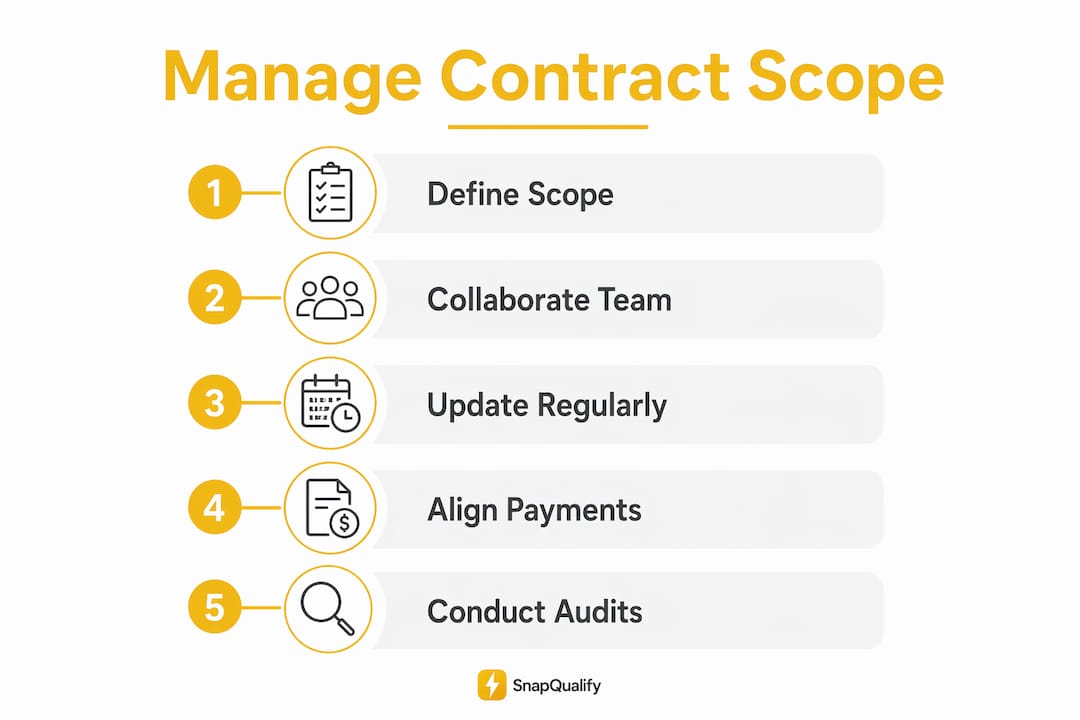
A well-written scope is a living document, updated continuously as design evolves during preconstruction and through project delivery. Treating it as a static file you draft once and file away is one of the most common and expensive mistakes in the industry.
Pro Tip: Number every revision of your scope document and date it. When a dispute arises six months into a project, the version history tells the story far better than anyone's memory.

How does scope fit within the broader contract and legal framework?
The scope of work is the operational core of any construction contract. It legally defines what the contractor is obligated to deliver and what they can charge for. A vague or incomplete scope leads directly to disputes, cost overruns, and unintended responsibilities that eat into your margin before you even notice.
Understanding how scope connects to your legal rights matters for three specific reasons:
- Payment rights depend on it. If a task is not clearly described in the scope, you may struggle to justify a charge for it, even if you performed the work. Courts and adjudicators look at what the contract says, not what you assumed.
- Change orders live or die by scope clarity. A change order is only defensible when the original scope is precise enough to show that the new work falls outside it. Ambiguous scopes make every change order a negotiation.
- Dispute resolution starts with the scope. Whether you are in mediation, adjudication, or litigation, the scope document is exhibit one. Its precision determines how quickly and favorably disputes resolve.
It is also worth knowing that legal definitions of construction contracts vary by jurisdiction. In the UK, for example, the Construction Act defines construction contracts based on the nature of "construction operations," and certain contracts, such as those with residential occupiers, fall outside its protections entirely. If you work across different project types, understanding which legal framework applies to each contract is not optional.
For subcontractors working under general contractors, the subcontractor scope of work carries the same legal weight and requires the same precision as the prime contract scope.
What are the most common pitfalls of a poorly defined scope?
Poorly defined scope documents are the leading cause of conflicts and cost overruns in construction projects, and the damage is rarely visible at the start. The problems surface mid-project, when it is too late to renegotiate without pain.
The most damaging pitfalls fall into a predictable pattern:
- Silent scope gaps: These are the invisible responsibilities that nobody explicitly assigned. Testing, commissioning, temporary works, and latent condition management are classic examples. Scope gaps between trades cause rework and margin loss because someone ends up doing the work for free.
- Assumed inclusions: When a scope says "install HVAC system" without specifying who supplies the equipment, who coordinates with the structural team, and who handles commissioning, every party reads it differently. Those assumptions become arguments.
- No exclusions list: Contractors who skip the exclusions section leave themselves exposed. If you did not list it as excluded, the owner may argue it was included.
- Failure to update after design changes: A scope written at tender stage that never gets updated as drawings are revised becomes a liability. You end up delivering to a different design than the one you priced.
Pro Tip: Before signing any contract, run a "gap audit" on the scope. List every task you know the project requires, then check each one against the scope document. Anything missing is a future dispute waiting to happen.
Scope creep in construction almost always starts with one of these gaps. A small unaddressed ambiguity grows into a pattern of extra work performed without compensation.
How to draft and manage construction contract scope effectively
Effective contract scope management starts before the contract is signed and continues through project closeout. The goal is a document precise enough to defend and flexible enough to update formally when the project changes.
Here is how strong scope documents differ from weak ones:
| Weak scope practice | Strong scope practice |
|---|---|
| Vague task descriptions ("complete all electrical work") | Specific work packages with defined deliverables and standards |
| No exclusions listed | Explicit exclusions section covering adjacent trades and assumptions |
| Single draft, never updated | Revision-controlled document with dated version history |
| Scope buried in proposal PDF | Scope referenced and attached formally in the signed contract |
| Change orders handled informally | Formal change order process tied directly to scope boundaries |
Collaborative scope writing involving architects, owners, and contractors produces more complete documents than any single party drafting alone. Each stakeholder sees different risks and assumptions, and those perspectives need to be captured before work starts.
Under NEC4 contracts, any requirement in scope documents becomes the contractor's priced obligation. Omissions cannot be claimed as extras unless a formal scope change is processed. That principle applies beyond NEC4. Whatever contract form you use, treat the scope as a priced commitment in both directions.
Payment disputes in construction are frequently rooted in scope disagreements. Aligning your scope with your payment schedule, so that milestone payments correspond to defined deliverables, gives you a paper trail that supports every invoice you send.
Key takeaways
A precisely written and continuously updated construction contract scope is the single most effective tool for protecting your margin, your schedule, and your right to payment.
| Point | Details |
|---|---|
| Define scope with specificity | Name tasks, standards, materials, and deliverables explicitly to eliminate assumptions. |
| List exclusions, not just inclusions | An explicit exclusions section prevents owners from claiming unpriced work was implied. |
| Treat scope as a living document | Update and version-control the scope every time design or project conditions change. |
| Align scope with payment milestones | Tie each payment trigger to a defined scope deliverable to support every invoice. |
| Audit for scope gaps before signing | Check every required task against the scope document and flag anything unassigned. |
Why I think most contractors underestimate the scope document
After years of watching construction disputes unfold, the pattern is almost always the same. The contractor did the work. The client disputes the charge. And the scope document, if it exists at all, is too vague to settle the argument either way.
Most contractors treat the scope as a formality, something to attach to the contract so the paperwork looks complete. The clients who cause the most problems are often the ones who exploit that vagueness deliberately or accidentally. A client who does not understand what they agreed to will always believe they agreed to more than you priced.
The contractors who avoid these situations write scopes that read like instruction manuals. Every task named. Every exclusion stated. Every assumption converted into a written condition. It takes longer upfront, but it eliminates the conversations you dread having at month three of a six-month project.
My strongest advice: treat the scope document as your primary financial protection tool, not as a description of the work. The description is for the crew. The scope is for the contract.
— Colin
How SnapQualify helps you protect your projects from the start
A precise scope protects you once the project starts. SnapQualify helps you protect yourself before you even commit to a client. The platform screens potential clients through intelligent intake forms that evaluate project scope, budget clarity, and client experience, generating a color-coded SnapScore that signals reliability before you invest time in a proposal. For roofers, electricians, plumbers, HVAC technicians, and general contractors, that early read on a client's expectations can save weeks of scope negotiation with someone who was never a good fit. Learn more about how SnapQualify keeps your data and your business protected at SnapQualify Security.
FAQ
What is construction contract scope in simple terms?
Construction contract scope is a written document that defines exactly what work a contractor will perform, what is excluded, and who is responsible for each task. It is the primary reference point for payment rights, change orders, and dispute resolution.
What should a scope of work include in a construction contract?
A complete scope of work includes detailed task descriptions, inclusions and exclusions, reference drawings and specifications, material requirements, schedule milestones, and handover criteria. Each element reduces the risk of assumptions becoming disputes.
Why do scope gaps cause so many construction disputes?
Scope gaps create unassigned responsibilities that trades assume someone else will handle. When no one handles them, rework and change order battles follow, directly cutting into project margin.
How often should a construction scope be updated?
The scope should be updated every time the design changes, new information becomes available, or a change order is approved. A revision-controlled scope with dated versions protects your agreed boundaries throughout the project lifecycle.
Can a contractor charge for work not listed in the scope?
Generally, work not described in the scope is difficult to charge for without a formal change order. The scope legally defines contractor obligations and what can be billed, making precise drafting critical to protecting your revenue.