

Evaluating electrical project fit is the structured process of assessing technical feasibility, client suitability, and financial risk before committing to a job. Most electricians treat this as a pre-quote formality. The ones who do it well treat it as a strategic filter that protects their time, margins, and reputation. How electricians evaluate project fit has evolved well beyond a site walkthrough and a gut feeling. Today, the process covers panel capacity, NEC compliance, client behavior, and cost modeling, all before a single proposal goes out.
How do electricians evaluate project fit?
Project fit evaluation combines three parallel assessments: technical, client, and financial. Each one can disqualify a project on its own. A technically feasible job with a difficult client is still a bad fit. A well-funded client with an undersized panel and no upgrade path is a money pit. The strongest electricians run all three assessments simultaneously, not sequentially.
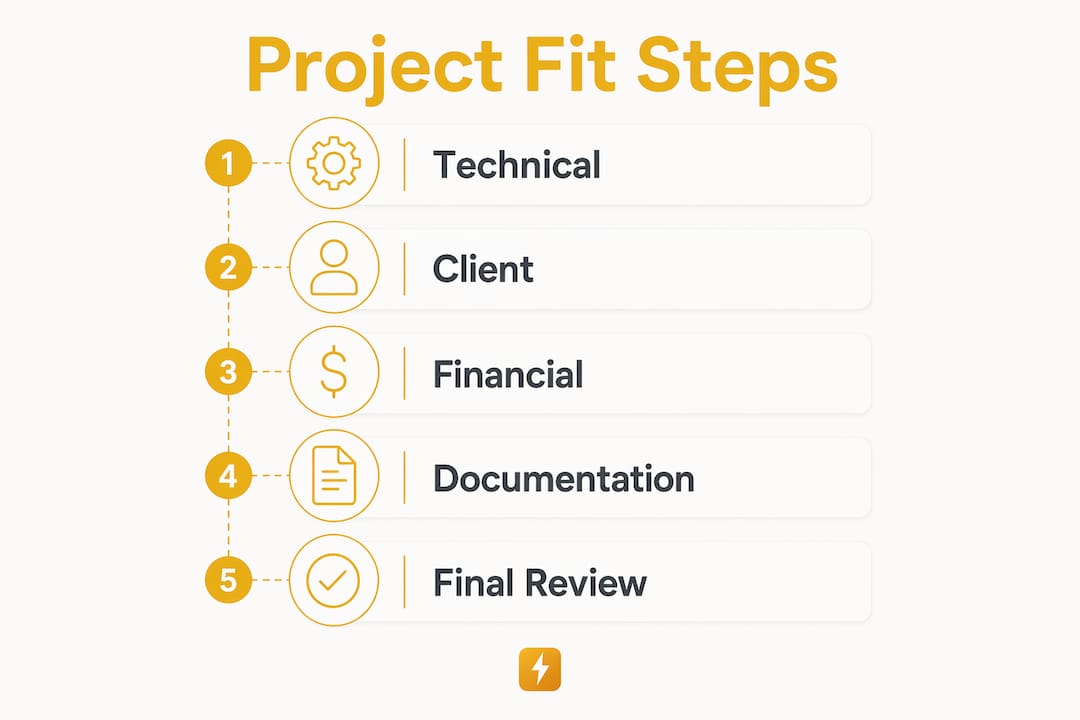
The industry term for this combined process is pre-project qualification. You may also hear it called a job suitability review or project assessment. Whatever you call it, the goal is the same: know what you are walking into before you are locked in.
What technical criteria do electricians assess for project suitability?
Technical assessment is where most electricians feel comfortable. The problem is stopping too early. A full 2026 electrical site assessment covers main fuse ratings, electrical headroom, feeder path feasibility, and grounding integrity. Documenting these findings in a formal risk log prevents cost overruns later. Most contractors skip the risk log. That is where disputes start.
Here is what a thorough technical review covers:
- Panel amperage and capacity: Can the existing service handle the new load, or does it need an upgrade?
- Load profiles: What is the peak demand, and does it match the client's stated usage?
- Conduit paths and feeder routing: Are there physical obstructions that will add labor hours?
- NEC 2023 compliance: Does the existing installation meet current code, or will remediation be required?
- Grounding and bonding: Are there deficiencies that create liability exposure?
Each of these items belongs in a written scope of work. Explicitly documenting exclusions like drywall repair or site cleanup prevents unpaid change-order disputes down the line. That one habit alone saves experienced electricians thousands of dollars per year.
Pro Tip: Watch how the site team communicates during your walkthrough. Observing site behaviors like scheduling discipline and safety practices is a stronger predictor of project profitability than the blueprints alone.

How do electricians evaluate client suitability and project risks?
Client evaluation is where most electricians lose money. Technical problems are solvable. A client who changes scope weekly, delays decisions, or disputes invoices is a different kind of problem. The goal here is to identify those patterns before you are on the job.
Here are the five client factors that matter most:
- Long-term building vision: Clients focused on long-term performance and future-proofing are lower risk. Clients who only care about the lowest price today tend to generate scope creep tomorrow.
- Communication style: Does the client respond promptly and clearly? Slow or vague communication before the contract is a preview of what you will deal with during the job.
- Scope clarity: Can the client describe what they want in specific terms? Vague project descriptions are a direct predictor of change orders.
- Past contractor relationships: Ask why they are not using their previous electrician. The answer tells you a lot.
- Staffing and contractor experience: For larger projects, evaluating contractor staffing ability and past project complexity is more reliable than reviewing licenses or initial bids alone.
Use a client red flags checklist during your intake process. It turns subjective impressions into documented signals you can act on.
Pro Tip: Ask the client directly: "What does success look like for this project in five years?" Clients who cannot answer that question are often the ones who redefine success after the job is done.
What cost and profit margin factors shape project evaluation?
Getting the numbers right is not just about winning the job. It is about not losing money on it. The core discipline here is separating direct costs from indirect costs.
| Cost Type | Examples |
|---|---|
| Direct costs | Labor hours, materials, subcontractor fees |
| Indirect costs | Overhead, insurance, vehicle costs, admin time |
| Profit target | 10%–20% of total project value |
| Contingency buffer | 5%–10% for unforeseen scope changes |
Professional electrical contractors target 10%–20% profit margins with a recommended 5%–10% contingency buffer for unforeseen site scope changes. That buffer is not padding. It is the difference between a profitable job and one you finish at cost.
The other critical discipline is using historical productivity data instead of generic averages. Accurate project evaluation separates direct labor and material costs from indirect overhead and profit, then applies your actual crew's output rates. If your team runs conduit at a different pace than the industry average, the industry average will get you in trouble. Track your own numbers and use them.
Common margin killers to watch for:
- Underestimating labor on retrofit work where walls are already finished
- Missing permit fees and inspection costs in the initial estimate
- Failing to price in travel time for remote sites
- Accepting a fixed price on a project with undefined scope
How can electricians build a repeatable project evaluation process?
A one-time assessment is useful. A repeatable system is what separates contractors who grow from those who stay stuck in the same cycle of bad projects. Treating estimates as strategic project constitutions that set financial and operational boundaries, not just price tags, is the mindset shift that makes this work.
Here is how to build that system:
- Create a standardized site assessment checklist that covers every technical item: panel capacity, load profiles, conduit paths, grounding, and NEC compliance. Use it on every job without exception.
- Build a client intake form with targeted questions about project scope, budget, timeline, and past contractor experience. The answers reveal risk before you invest hours in a proposal.
- Document exclusions in every proposal. List what is not included as clearly as what is. This single practice reduces scope disputes more than any contract clause.
- Score each project before committing. Assign a simple rating to technical complexity, client reliability, and margin potential. If two out of three are red, walk away.
- Review completed projects against your initial assessment. Where did your estimate miss? Where did client behavior match your early read? That feedback loop sharpens your judgment over time.
A lead qualification checklist built specifically for trade contractors gives you a starting framework you can adapt to your own criteria.
Key takeaways
Electricians who evaluate project fit systematically, covering technical feasibility, client behavior, and margin targets, consistently avoid the bad jobs that drain time and profit.
| Point | Details |
|---|---|
| Technical assessment is non-negotiable | Check panel capacity, load profiles, conduit paths, and NEC compliance before quoting. |
| Client behavior predicts project risk | Vague scope, slow communication, and price-only focus are early warning signs. |
| Margin targets need a buffer | Target 10%–20% profit with a 5%–10% contingency to absorb unforeseen scope changes. |
| Document exclusions explicitly | List what is not included in every proposal to prevent unpaid change-order disputes. |
| Build a repeatable system | Standardized checklists and client intake forms turn one-time assessments into consistent practice. |
Why system thinking separates the best electricians from the rest
Most electricians I have worked with are excellent at task execution. They know how to pull wire, size a panel, and meet code. Where I see the biggest gap is in system thinking. The contractors who consistently land better projects and keep better clients are the ones who walk into a site and think about how the electrical system connects to the building's long-term performance, not just how to complete the installation in front of them.
Contractors who integrate system-wide thinking, considering sustainability, operational complexity, and future load demands, achieve better outcomes and stronger client relationships. That is not a soft observation. It shows up in repeat business, referrals, and fewer disputes.
The uncomfortable truth is that most project evaluation problems are not technical. They are relational. A client who does not understand what they are buying, or who has unrealistic expectations about cost and timeline, will cause problems regardless of how well you execute the work. Asking better questions upfront, and being willing to walk away when the answers are wrong, is the skill that actually protects your business.
Shift your mindset from "Can I do this job?" to "Should I do this job?" That question changes everything about how you evaluate a project.
— Colin
Screen clients before you quote with Snapqualify

Snapqualify is built for electricians and trade contractors who are tired of discovering project problems after they have already committed. The platform sends clients a branded intake form that asks targeted questions about scope, budget, and experience. The AI-powered SnapScore gives you a color-coded read on client reliability and project suitability before you spend hours on a proposal. Your client data is protected to 2026 security standards, so you can screen with confidence. Stop guessing about which jobs are worth your time. Start qualifying clients before you quote.
FAQ
What is project fit evaluation for electricians?
Project fit evaluation is the pre-commitment process of assessing technical feasibility, client suitability, and financial viability before accepting a job. It covers site conditions, panel capacity, client behavior, and profit margin targets.
What are the biggest red flags in client evaluation?
Vague project scope, resistance to written contracts, and a focus on the lowest price are the strongest early warning signs. Clients who cannot explain what success looks like in specific terms tend to generate scope creep and payment disputes.
How do electricians set profit margin targets?
Professional electrical contractors target 10%–20% profit margins and add a 5%–10% contingency buffer for unforeseen scope changes. Using your own historical productivity data produces more accurate estimates than relying on industry averages.
Why should exclusions be documented in every proposal?
Explicitly documenting exclusions like drywall repair or site cleanup prevents disputes over unpaid change orders. Clear scope boundaries protect both the contractor and the client.
How can electricians make project evaluation consistent?
Standardized site assessment checklists, client intake forms, and a simple project scoring system turn evaluation from a gut-feel exercise into a repeatable process. Reviewing completed projects against your initial assessment sharpens your judgment over time.