

You pick up the phone, spend 20 minutes talking through a project, schedule an inspection, drive out there, and then nothing. No signed contract. No deposit. Just a homeowner who was “getting a few quotes.” If you want to qualify roofing leads from calls before you invest that kind of time, you need a system, not just a script. This guide walks you through the tools, questions, scoring methods, and workflows that separate contractors who close jobs from those who just stay busy. Every section is built around one goal: making sure the calls you act on are worth acting on.
Table of Contents
-
Avoiding common mistakes and troubleshooting qualification issues
-
Verifying success and optimizing lead qualification over time
Key Takeaways
| Point | Details |
|---|---|
| Speed is critical | Calling leads within 5 minutes greatly increases your chances of qualification and closing the job. |
| Differentiate lead types | Scoring leads according to type and urgency ensures you focus on the highest-value opportunities first. |
| Track every call | Full call tracking prevents wasted marketing spend and reveals which channels bring your best leads. |
| Use structured scripts | Asking targeted questions builds trust and uncovers key qualification details efficiently. |
| Leverage automation | Integrating scoring and routing automation frees your team to focus only on the best qualified leads. |
Why qualifying roofing leads from calls is critical
Most of your leads arrive by phone. That is not an opinion. 70 to 80% of roofing leads originate via phone calls, yet many contractors never track them properly. The result is wasted marketing spend and revenue that quietly walks out the door.
When you fail to qualify inbound calls, a few things happen fast. Your close ratio drops. Your customer acquisition cost climbs. And your sales team burns energy chasing homeowners who were never serious buyers. That is the real cost of skipping the roofing lead qualification process.
There is also what the industry calls the inspection gap. This is the disconnect between the number of inspections you schedule and the number of jobs you actually close. If your team is running three inspections to close one job, unqualified calls are likely the root cause. The fix is not more leads. It is better filtering of roofing service inquiries before you ever roll a truck.
Not all calls carry the same value or urgency. Consider the difference between these three lead types:
-
Insurance claims: High value, time-sensitive, requires verification of claim status and adjuster involvement
-
Emergency tarping or storm damage: Urgent, often converts quickly, but needs immediate routing
-
General repairs or maintenance: Lower urgency, more price-sensitive, higher risk of shopping behavior
Treating a general repair inquiry the same as a storm-damage insurance claim is like quoting a shingle patch the same as a full replacement. The stakes are completely different, and your process should reflect that.
Recognizing these differences from the first call is what separates a profitable roofing operation from one that stays perpetually busy but never quite gets ahead.
Executing an effective call qualification workflow
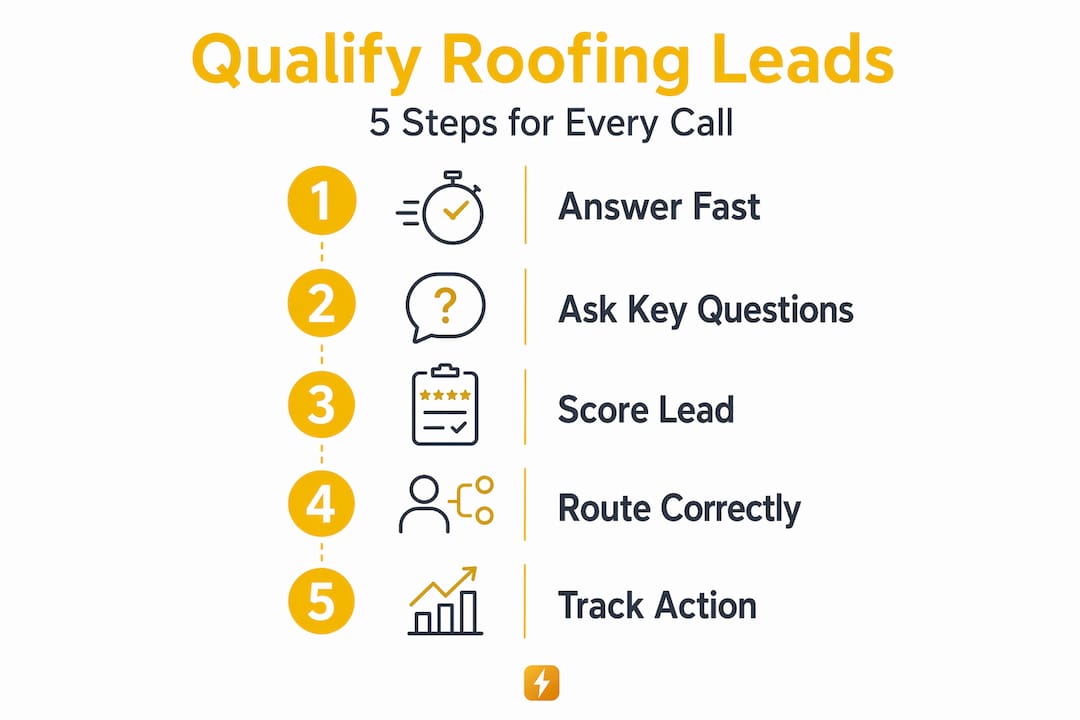
Preparation means nothing without disciplined execution. Here is how to run every inbound call like it matters, because it does.
Speed is your first competitive advantage. Calling a roofing lead within 5 minutes makes you 21 times more likely to qualify them compared to waiting 30 minutes. Most contractors wait hours. That gap is your opening.
Once you have the homeowner on the line, follow a scripted discovery sequence. A structured call script with targeted questions consistently improves qualification accuracy over open-ended conversations. Here is a proven sequence:
-
What made you reach out today? This opens the conversation and reveals urgency.
-
What is your biggest concern about the project? Surfaces priorities and emotional drivers.
-
Have you had anyone else look at it? Identifies competing estimates and buying stage.
-
What is your timeline for getting this done? Separates urgent buyers from tire-kickers.
-
Do you have homeowner’s insurance, and have you filed a claim? Critical for insurance lead routing.
-
Who else will be involved in making this decision? Confirms decision-making authority.
Score each call as you go. Use a simple point system weighted by lead type:
-
Insurance claim with active adjuster involvement: 10 points
-
Storm damage with visible urgency: 8 points
-
Full replacement inquiry, homeowner is decision maker: 7 points
-
General repair, no insurance, price shopping: 3 points
Pro Tip: Always repeat key answers back to the homeowner. “So just to confirm, you have an active claim and the adjuster is coming out Thursday?” This builds trust, reduces miscommunication, and signals professionalism before you even show up.
After scoring, route accordingly. Hot leads go straight to your top closer or directly into the inspection calendar. Warm leads enter a follow-up sequence. Cold leads get a polite close and a note in the CRM. Every call gets a clear next step. Review the questions to ask before quoting and keep a red flags checklist nearby to catch signals that a lead may not be worth pursuing.
Avoiding common mistakes and troubleshooting qualification issues
Even contractors with good intentions make these errors. Knowing them ahead of time saves you from learning the hard way.
Pooling all calls into one tracking number is the most common mistake. When every call goes to the same number, you lose the ability to tell which channel is generating your best leads. You end up funding campaigns based on gut feeling instead of data.
Treating all calls the same disregards the very different values and urgencies each lead type carries. Insurance claims and emergency calls need faster, prioritized handling. Routing them the same way you handle a general inquiry means you will miss high-value jobs.
Here are the most frequent mistakes and how to correct them:
-
Incomplete call capture: Failing to track 100% of calls means your decisions are based on only 20 to 30% of actual data, leading to wasted ad spend and missed jobs. Fix this by auditing your tracking setup monthly.
-
No after-hours routing for emergencies: If a homeowner calls at 9 p.m. about active roof damage and hits a voicemail, that job is gone by morning. Set up emergency routing with immediate SMS alerts to your on-call team.
-
Scheduling inspections without qualifying first: This is the inspection gap in action. You are filling your calendar with appointments that have no realistic chance of closing.
-
Ignoring low close rates by channel: If one lead source consistently books inspections but never closes, that is a data problem. Either the leads are unqualified or the messaging is attracting the wrong buyer.
The goal of call qualification is not to answer every call the same way. It is to treat each call as a data point that tells you exactly how much of your time it deserves.
Pro Tip: Run a monthly audit of your wasted quote visits. If more than 30% of your inspections are not converting, your qualification threshold is too low. Raise your minimum score before scheduling an appointment.
Verifying success and optimizing lead qualification over time
A qualification system is only as good as your commitment to measuring it. Here is how to know if it is actually working.
Start with a comparison of tracked versus untracked call performance. Tracked calls convert to bookable jobs at rates of 23 to 37%, compared to 14 to 18% for untracked calls. That gap is the dollar value of having a real system.
| Metric | Untracked calls | Tracked and scored calls |
|---|---|---|
| Conversion to bookable job | 14 to 18% | 23 to 37% |
| Marketing spend efficiency | Low | High |
| Sales team focus | Scattered | Prioritized |
| Close rate accuracy | Estimated | Measurable |
Set clear KPIs and review them weekly:
-
Speed-to-lead: Average time from call to first contact attempt
-
Qualification accuracy: Percentage of inspections that convert to signed contracts
-
Call-to-inspection rate: How many qualified calls become scheduled appointments
-
Cost per qualified lead: Total marketing spend divided by leads that meet your ICP criteria
Pro Tip: A/B test your call scripts every quarter. Change one question at a time and track whether your qualification accuracy improves. Small adjustments compound into significantly better results over a full season.
Use your CRM to track how qualifying inbound roofing leads translates into signed contracts over time. If a particular lead source consistently delivers high-scoring calls that close, double down on it. If another source fills your calendar with low-value appointments, cut it or adjust the messaging to attract a better fit.
Set automation alerts for any lead that scores above your hot threshold. The faster your team responds to a high-value call, the less likely that homeowner is to call your competitor next.
Why treating all roofing calls the same is a costly mistake
Here is the uncomfortable truth most roofing sales training glosses over: the “one call fits all” approach is not just inefficient. It is actively damaging your business.
When every inbound call gets the same intake process, the same questions, and the same routing, you are essentially telling your best leads to wait in line behind your worst ones. Insurance claim leads and emergency calls require faster, prioritized handling to avoid missing high-value jobs. Every minute you delay routing a storm-damage call is a minute your competitor can use.
The deeper problem is that without differentiated scoring, you cannot build effective automation. Automation only works well when scoring criteria and data fields are formalized. If your team captures different information on every call, your CRM cannot route leads consistently, your reports will not reflect reality, and your follow-up sequences will fire at the wrong people.
Most contractors know this intellectually but resist formalizing the process because it feels like overhead. It is not. It is the foundation that every other improvement in your sales operation sits on. Contractors who spot bad client red flags early and route leads by type close more jobs with less effort. Not because they work harder, but because they stop treating every call like it has the same potential.
The shift is simple in concept: assign a score, assign a route, and assign a next action to every call before you hang up. Do that consistently and your sales team will thank you, your close rate will climb, and you will stop wondering why your inspection calendar is full but your bank account is not.
Streamline your roofing lead qualification with a tool like SnapQualify
If you have read this far, you know what a strong call qualification system looks like. The harder part is building and maintaining it without adding hours of manual work to your week. That is exactly what SnapQualify was built to solve.
SnapQualify automates the roofing lead qualification process using custom scoring built around your ICP. It integrates phone call and intake data with your CRM, routes hot leads immediately to your best closers, and replaces clunky intake forms with a branded client screening experience that homeowners actually complete. Your data is protected with enterprise-grade security built into the platform from day one. The result is fewer wasted quote visits, higher close rates, and a sales team that spends its time on leads worth closing.
Frequently asked questions
What is the most important factor in qualifying roofing leads from calls?
Speed of response is critical. Calling within 5 minutes makes you 21 times more likely to qualify a lead than waiting 30 minutes, so your routing and alert systems need to support immediate action.
How should I score different types of roofing leads from phone calls?
Score by type and urgency, not just interest level. Insurance claims score higher due to damage severity, active claim status, and homeowner urgency, while general repair inquiries typically score lower and require more nurturing before they are inspection-ready.
Why is call tracking important for roofing lead qualification?
Without it, you are making budget decisions on incomplete data. Failing to track 100% of calls means you are working from only 20 to 30% of actual call data, which distorts your view of which channels are really generating profitable jobs.
What should I ask during a call to qualify a roofing lead?
Follow a structured discovery sequence. Ask in this order: what made them reach out, their biggest concerns, their budget expectations, project timing, whether they have other estimates, and who else is involved in the decision.