

Vetting subcontractors and clients together is defined as a dual-sided prequalification process that evaluates both parties' credentials, financial reliability, and compliance before any project begins. Most contractors run one-sided checks: they screen subs but accept clients on gut feel, or vice versa. That gap is where late payments, scope disputes, and no-shows live. A reciprocal vetting system, built around prequalification questionnaires, certificate of insurance (COI) verification, and reliability scoring, closes that gap on both sides of every deal.
How to vet subcontractors and clients together: the core criteria
The documents you collect and verify determine the quality of every match you make. For subcontractors, the non-negotiables are a current COI, active license, bonding capacity, safety record, and at least three verifiable project references. For clients, you need payment history, project budget confirmation, decision-making authority, and any prior contractor disputes on record.
Subcontractor prequalification should occur before bidding, not during it. Separating capability verification from price evaluation means you never end up hiring an unqualified sub because they submitted the lowest number. The same logic applies to clients: confirm budget and payment reliability before you invest time in a detailed quote.

COI verification goes deeper than reading the face page. You must confirm endorsements directly with the insurer or agent, not just accept what the certificate describes. Standard minimums are $1M per occurrence / $2M aggregate for general liability, and you should reject COIs from carriers rated below A by AM Best.
| Criteria | Subcontractor vetting | Client vetting |
|---|---|---|
| Insurance | COI with endorsements verified | Proof of property ownership or authority |
| Financial health | Bonding capacity, financial statements | Budget confirmation, payment history |
| Credentials | License, trade certifications | Decision-making authority confirmed |
| Track record | Safety record, project references | Prior contractor relationships, dispute history |
| Ongoing compliance | Annual COI renewal, re-screening triggers | Credit check or deposit behavior |
Keep every document current. Fixed requalification cycles combined with event-triggered re-screening, such as ownership changes or safety incidents, catch deteriorations that an initial check will never surface.
How does a reciprocal reliability scoring system work?
Reciprocal reliability scoring assigns numerical scores to both subcontractors and clients based on measurable past behavior, not impressions. For subcontractors, the two key dimensions are on-time mobilization and cancellation notice periods. For clients, the dimensions are draw timing and change order turnaround speed. Both scores update after every confirmed job, creating a living record of trustworthiness on each side.
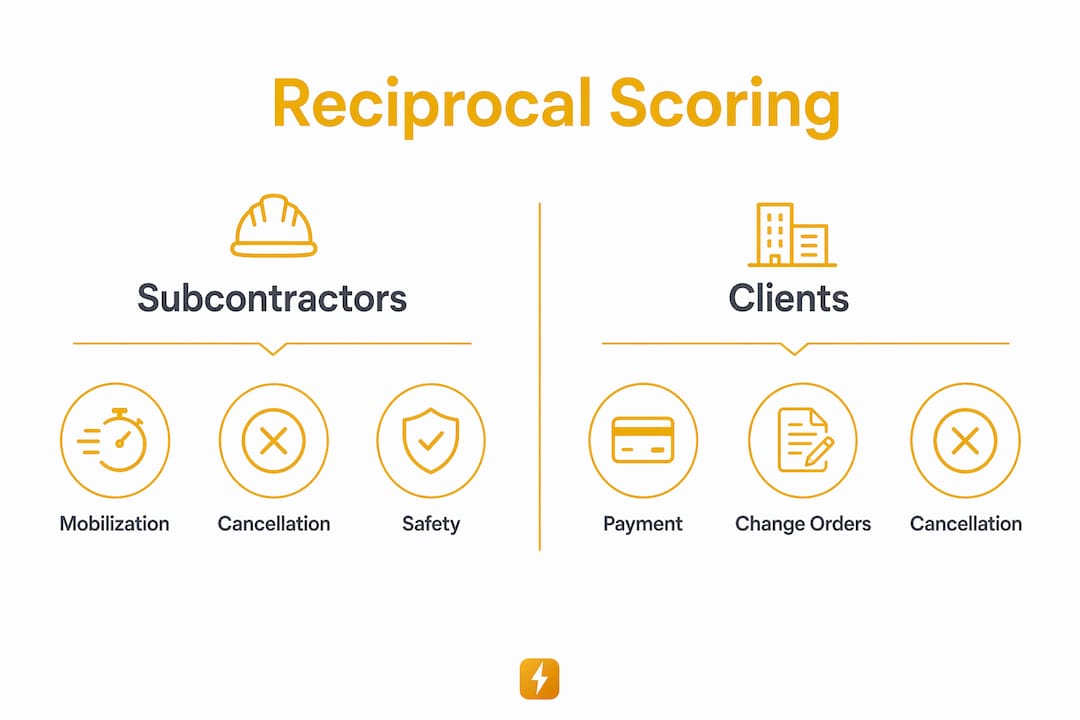
The penalty structure matters. A public reliability scoring model used in professional services assigns 0.5 penalty points for cancellations 14 or more days out, and 5 penalty points for cancellations under 24 hours or no-shows. Translated to construction, a client who delays a draw payment by more than 10 days or a sub who demobilizes without notice would each absorb proportional penalties. That visibility reduces surprises before they become disputes.
Here is how to operationalize scoring in your workflow:
- Define your scoring dimensions. Choose two to three measurable behaviors per party, such as cancellation notice, payment timing, and scope change frequency.
- Set penalty thresholds. Assign point values to each violation tier. Keep them consistent so scores are comparable across projects.
- Attach scores to profiles. Every sub and client in your system carries a live score visible to you and, where appropriate, to them.
- Trigger review at score thresholds. A score below a set floor triggers a manual review before the next project award.
- Update after every job. Scores only have value if they reflect current behavior. Build the update step into your project close-out checklist.
Pro Tip: Set a standardized 14-day cancellation or demobilization notice window as your baseline penalty trigger. Publish the scoring rules to both subs and clients upfront. When both parties know the rules, behavior improves before you ever need to apply a penalty.
What tools support continuous vetting and compliance tracking?
Manual COI tracking fails at scale. One lapsed policy on an active job site is a liability exposure that no spreadsheet reminder system reliably prevents. COI validity verification is an ongoing workflow that needs validation at project start and at each draw disbursement, flagging discrepancies against contract requirements in real time.
The right software handles this automatically. When evaluating vetting and compliance tools, prioritize these features:
- Automated COI collection and renewal alerts triggered by expiration dates, not calendar reminders
- AI-assisted endorsement verification that checks policy language, not just the certificate face page
- Integration with your ERP or project management system so approved compliance status syncs directly to job records
- Standardized digital intake forms for both subcontractors and clients that feed into a single compliance dashboard
- Event-triggered re-screening prompts for ownership changes, safety incidents, or score threshold breaches
A step-by-step prequalification process covers business identity, years in business, trade and geography, and project management credentials. When that intake data feeds directly into your compliance tracking system, you eliminate the manual transfer step where errors most often occur.
Understanding contractor business risk at the systems level helps you decide which compliance checks to automate first and which require human review.
How to match and connect vetted subcontractors and clients efficiently
Matching works best when both parties have already cleared a qualification threshold before any introduction happens. Pre-approved vendor and client lists cut bidding time significantly because eligibility is already confirmed. You are comparing price and fit, not rerunning compliance checks under deadline pressure.
Marketplaces that verify both buyers and sellers through gated access reduce information asymmetry. Role-based profile disclosure, where anonymized profiles become fully visible only after an engagement trigger, protects sensitive data while still enabling informed matching. A subcontractor sees a client's payment reliability score before committing to a bid. A general contractor sees a sub's cancellation history before awarding a scope.
Pre-screening clients before you quote is equally important. Reviewing client red flags early, such as vague budgets, multiple contractor switches, or reluctance to sign a deposit agreement, filters out problem projects before they consume your estimating time. You can also use targeted intake questions to surface payment behavior and project readiness signals before you ever pick up a measuring tape.
Pro Tip: Tier your approved lists by qualification level. Tier 1 subs and clients have completed full vetting and carry strong scores. Tier 2 have completed basic vetting but lack a track record with you. Assign project complexity accordingly and use renewal cycles to move parties between tiers based on actual performance.
Key takeaways
Vetting subcontractors and clients together requires a reciprocal system that verifies credentials, scores reliability on both sides, and uses automation to keep compliance current across every project lifecycle.
| Point | Details |
|---|---|
| Separate prequalification from bidding | Verify eligibility before price comparison to avoid hiring unqualified parties on cost alone. |
| Verify COIs beyond the face page | Confirm endorsements directly with the insurer at project start and each draw disbursement. |
| Score both parties reciprocally | Measure subcontractor schedule reliability and client payment reliability using consistent penalty rules. |
| Automate compliance tracking | Use software with renewal alerts and ERP integration to catch lapses before they become liabilities. |
| Use tiered approved lists | Pre-approve subs and clients by qualification level to reduce matching time and project risk. |
Why most contractors are only solving half the problem
I have reviewed a lot of contractor workflows over the years, and the pattern is almost always the same. Subcontractor vetting gets a process. Client vetting gets a handshake. That asymmetry is the root cause of most payment disputes and scope blowups I have seen.
The reciprocal reliability scoring concept is the piece that changes the dynamic. When a client knows their payment behavior is being tracked and scored, they treat draw timelines differently. When a sub knows their cancellation history is visible to future GCs, they give proper notice. Neither outcome requires confrontation. The system does the work.
The other gap I see constantly is treating COI verification as a one-time event. A policy that was valid at contract signing can lapse by the time the concrete is poured. Checking at each draw disbursement sounds like extra work until you price in one uninsured incident.
My honest recommendation: automate the compliance tracking first, then build the scoring system. You can prequalify homeowners before quoting with a simple intake form today. The scoring layer can follow once you have clean data flowing in. Start with the documents. The trust infrastructure builds from there.
— Colin
How SnapQualify helps you vet both sides of every project

SnapQualify is built for exactly this problem. The platform gives trade contractors a branded intake form that screens clients automatically, generating a color-coded SnapScore based on project scope, budget signals, and payment behavior indicators. You get a clear read on client reliability before you spend an hour on a quote. For contractors managing subcontractor relationships, SnapQualify's intake and compliance tracking features integrate directly into your existing workflow, reducing the manual burden of COI collection and renewal management. Your data stays protected under SnapQualify's secure data handling protocols, so sensitive financial and insurance information never sits in an unprotected spreadsheet. Stop running half a vetting process. Run both sides.
FAQ
What does it mean to vet subcontractors and clients together?
It means running parallel prequalification checks on both parties before a project begins, verifying credentials, insurance, financial reliability, and past performance on each side to reduce risk for everyone involved.
What documents are required to vet a subcontractor?
A current COI with verified endorsements, an active trade license, proof of bonding capacity, a safety record, and at least three project references are the standard minimum requirements.
How does reciprocal reliability scoring work in construction?
Each party receives a score based on measurable behaviors: subcontractors are scored on mobilization timing and cancellation notice, while clients are scored on draw payment timing and change order responsiveness, with penalty points applied per violation tier.
How often should COI verification be repeated?
COI compliance should be validated at project start and at each draw disbursement, not just once at contract signing, to catch mid-project lapses or endorsement changes.
What is the fastest way to start vetting clients before quoting?
Deploy a standardized digital intake form that asks about project scope, budget, timeline, and prior contractor experience. Tools like SnapQualify automate the scoring so you get a reliability read in minutes, not days.