

Contractors fire clients when communication breaks down, payments stall, project scope expands without authorization, or client behavior makes the work environment untenable. These are not isolated incidents. Communication failures sit at the root of most contract terminations in the construction and home services trades, and 2026 industry data from MDPI Buildings and Fine Homebuilding confirms that the pattern repeats across every trade sector. Understanding why contractors end contracts is the first step toward building relationships that hold up under real project pressure.
Why contractors fire clients: the core reasons
The decision to fire a client rarely comes from a single bad day. It builds. A missed payment here, a verbal instruction that contradicts the contract there, and then a client who stops responding to calls. Contract conflicts almost always have communication failure at their core rather than purely technical or legal issues. That distinction matters because it means the problem is fixable early, but only if you recognize the signals.
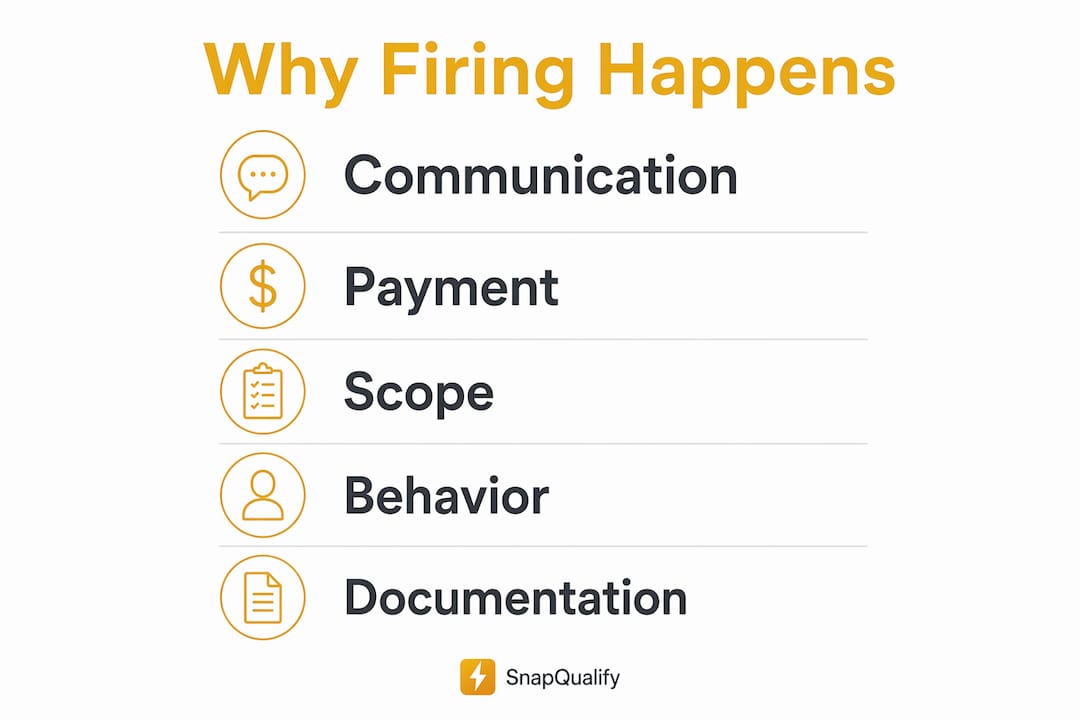
The three primary drivers behind contractor client relationship issues are:
- Communication breakdowns: Undocumented instructions, infrequent updates, and unclear expectations create disputes that escalate fast.
- Payment problems: Delayed deposits, disputed invoices, and partial payments strain cash flow and erode trust.
- Scope and change order mismanagement: Verbal agreements that never get written down turn profitable jobs into money-losing arguments.
Unprofessional client behavior, including disrespect, indecisiveness, and failure to cooperate, compounds all three. Recognizing these client red flags before a contract is signed is far less costly than managing them mid-project.
What communication problems lead contractors to fire clients?

Poor communication is the fastest path to a broken contractor-client relationship. A 2026 MDPI Buildings study found that ineffective communication appears 22 times in systematic reviews of construction disputes, linking it directly to schedule disruptions and contract terminations. That frequency tells you this is not a soft problem. It is a structural one.
The most damaging communication failures in contractor-client relationships include:
- Verbal-only instructions: When a client tells a crew member to "just move that wall a few feet," and nobody writes it down, you have a scope change with no authorization and no price attached.
- Infrequent project updates: Clients who feel uninformed fill the silence with assumptions, and those assumptions rarely match your plan.
- No formal communication channel: Without a single point of contact or a documented approval process, decisions get made by the wrong people at the wrong time.
- Delayed responses: A client who takes five days to approve a material substitution can push your schedule by two weeks and trigger downstream subcontractor penalties.
Disputes during delivery arise more from day-to-day communication failures than from flaws in the contract text itself. That means a well-written contract is necessary but not sufficient. You need a communication protocol that runs alongside it.
Pro Tip: Set a weekly written update cadence with every client from day one. A short email summarizing progress, upcoming decisions, and any open items takes 10 minutes and eliminates most "I didn't know about that" disputes.
How payment disputes and delays trigger firing in contractor-client relationships
Cash flow is the oxygen of a trade business. When a client delays payment, disputes an invoice, or refuses to fund a change order, the entire project suffers. Payment timing and change order variability are identified as structural drivers behind contractor-client breakdowns in a 2026 MDPI cost risk study. The implication is direct: financial instability on the client side becomes operational instability on yours.
The most common payment-related reasons clients get fired include:
- Refusing to pay a deposit before work begins
- Disputing invoices after work is completed without prior notice
- Making partial payments and promising "the rest next week" repeatedly
- Declining to fund approved change orders before additional work starts
- Showing signs of financial distress mid-project, such as requesting payment deferrals
Delayed payments rank among the top cost risk factors in construction projects, and their impact compounds when material prices are also fluctuating. A client who pays late on a fixed-price contract forces you to absorb both the financing cost and any material price increases that occur during the delay.
The fix starts before the contract is signed. Use milestone-based payment schedules tied to specific deliverables, require a deposit that covers your mobilization costs, and include a written clause that pauses work when payments are overdue. For a deeper look at how to protect yourself before a client relationship starts, the SnapQualify guide on avoiding non-paying clients covers the screening steps that matter most.
Why unclear project scope and change order mismanagement lead contractors to end contracts
Scope creep is the slow leak that sinks profitable projects. It rarely announces itself. It starts with a client asking to "just add one outlet" and ends with you doing 30% more work for the same contract price. Undocumented verbal change instructions are a major conflict source, according to Builder Outlook's 2026 analysis of construction disputes.
The table below shows the difference between effective and ineffective change order management:
| Practice | Effective | Ineffective |
|---|---|---|
| Authorization | Written sign-off before work starts | Verbal approval from client or site rep |
| Pricing | Fixed price or T&M rate attached to each change | Price discussed "later" or assumed |
| Timeline impact | Schedule adjustment documented with change | No schedule update made |
| Paper trail | Change order stored in project file | No record kept |
| Payment terms | Change funded before work begins | Added to final invoice |
Failure to document change orders formally leads to profit erosion and client mistrust, two of the most cited reasons for firing clients. The financial damage is real: a single undocumented change on a mid-size remodel can cost thousands of dollars in disputed labor and materials. Disciplined change order management benefits both parties by clarifying who authorized what and who owes what before the work happens.
Pro Tip: Never start work on a change until you have a signed change order in hand. If a client refuses to sign, treat that refusal as a red flag and document your response in writing.
What client behaviors and relationship issues typically prompt contractors to fire clients?
Beyond payment and scope, some clients are simply difficult to work with. Unprofessional client behavior is a legitimate reason to end a contract, and experienced contractors recognize the patterns early. The types of problem clients that most often lead to termination share a recognizable set of behaviors.
Watch for these warning signs:
- Disrespect toward your crew: A client who belittles workers on site creates a hostile environment that drives away skilled labor and exposes you to liability.
- Chronic indecisiveness: A client who cannot make decisions on time delays every phase of the project and then blames you for the schedule.
- Undermining your authority: Clients who give direct instructions to your subcontractors bypass your management structure and create conflicting work orders.
- Unrealistic timeline pressure: Demanding that a 12-week project finish in 8 weeks, without adjusting scope or budget, sets you up to fail.
- Mistrust without cause: A client who demands daily photo evidence, questions every invoice line item, and copies their attorney on routine emails signals a relationship that will cost more to manage than it earns.
Contractors often avoid escalating these issues due to concerns about future referrals or ongoing relationships. That hesitation allows dissatisfaction to build until termination becomes the only option.
How contractors can proactively manage risks to avoid firing clients
The best time to prevent a client termination is before the contract is signed. These steps reduce the likelihood of reaching that point:
- Screen clients before committing. Use a structured intake process to assess budget clarity, decision-making authority, and prior contractor experience. Tools like Snapqualify automate this with AI-scored intake forms that flag risk before you invest time in a bid.
- Set communication expectations in writing. Define your update schedule, approval process, and point of contact in the contract itself.
- Use milestone-based payment schedules. Tie every payment to a completed deliverable, not a calendar date.
- Formalize every change order. No exceptions. Even small changes get a written order with price and timeline impact attached.
- Address problems early. When a client misses a payment or bypasses your process, address it in writing within 24 hours. Silence signals acceptance.
- Know your termination rights. Understand the difference between termination for cause and termination for convenience. Legal distinctions between termination types carry real cost implications, and knowing them protects you when a relationship cannot be saved.
Key takeaways
Contractors fire clients when communication, payment, and scope management failures compound to the point where continuing the relationship costs more than ending it.
| Point | Details |
|---|---|
| Communication is the root cause | Most terminations trace back to undocumented instructions and infrequent updates, not contract language. |
| Payment problems signal deeper risk | Delayed or disputed payments strain cash flow and predict larger conflicts ahead. |
| Change orders must be written | Verbal scope changes without documentation erode profit and trust on every project. |
| Client behavior matters | Disrespect, indecisiveness, and authority undermining are legitimate grounds for ending a contract. |
| Screen before you sign | Proactive client qualification prevents most termination scenarios before they start. |
The uncomfortable truth about firing clients
I have been on both sides of this conversation, and the contractors who struggle most with firing clients are usually the ones who waited too long to set boundaries. The first missed payment is a signal. The second is a pattern. By the third, you are not managing a client relationship. You are managing a dispute.
What I have found is that the contractors who rarely need to fire clients are not the ones with the toughest contracts. They are the ones who screen harder upfront, communicate more consistently, and address problems the moment they surface. A client who knows your process and respects it from day one almost never becomes a termination conversation.
The hardest lesson is this: not every project is worth finishing. A client who disrespects your crew, refuses to sign change orders, and disputes every invoice is not a revenue source. They are a liability. Firing them professionally, with documentation and proper notice, protects your business, your team, and your reputation. Holding on out of obligation or optimism usually costs more than letting go.
If you are unsure whether a client relationship is worth saving, look at your scope creep exposure and your payment history with that client. The numbers will tell you what your instincts already know.
— Colin
Screen smarter with Snapqualify

Snapqualify gives trade contractors a faster way to qualify clients before a single hour is spent on a bid. The platform's AI-powered intake forms ask the right questions about project scope, budget, and client experience, then generate a color-coded SnapScore that flags risk before you commit. Contractors using Snapqualify reduce their exposure to scope creep, late payments, and difficult client relationships by catching the warning signs at the lead stage. Your client data is handled with care. Visit the SnapQualify security page to see exactly how your information is protected. Stop chasing checks and start choosing better projects.
FAQ
Why do contractors fire clients?
Contractors fire clients primarily due to communication breakdowns, payment disputes, uncontrolled scope changes, and unprofessional behavior. These issues compound over time and make it financially and operationally unsustainable to continue the project.
What are the most common client red flags for contractors?
The most common red flags include refusing to pay a deposit, giving verbal-only instructions, chronic indecisiveness, disrespecting crew members, and disputing invoices after work is completed. Recognizing these signs early allows contractors to address them before they escalate.
How do payment disputes lead to contract termination?
Delayed or partial payments create cash flow strain that forces contractors to fund labor and materials out of pocket. When a client repeatedly misses payment milestones, the financial risk of continuing the project outweighs the revenue it generates.
What is the difference between termination for cause and termination for convenience?
Termination for cause requires proving a breach of contract and carries higher legal and administrative costs for both parties. Termination for convenience ends the contract without proving fault, typically with compensation owed for work completed to date.
Can better communication prevent most client terminations?
Yes. A 2026 MDPI Buildings study found that communication failures appear as a leading factor in the majority of construction disputes reviewed. Setting a formal communication protocol at project start eliminates most of the misunderstandings that escalate into termination scenarios.