

Pre-qualifying project leads is the process of evaluating prospective clients against specific criteria before committing your time, truck, or crew to a site visit. For trade contractors and small construction business owners, lead qualification is the difference between a full calendar of profitable work and a week of unpaid quotes that go nowhere. Contractors lose roughly 65% of their week talking to unqualified prospects. That number alone should change how you answer your phone.
Why pre-qualify project leads before quoting?
Pre-qualification filters noise from signal. Without it, you are reacting to every inquiry with equal energy, regardless of whether the caller has a real budget, a firm timeline, or the authority to sign a contract. That is a losing model for any trade business.
The business case is clear. Qualified leads convert at 40%, compared to just 11% for unqualified leads. That is nearly four times the return on the same amount of sales effort. Every hour you spend chasing a lead that was never going to close is an hour you did not spend on a client who would have.

Pre-qualification also improves forecasting. When you know your pipeline contains only vetted prospects, your revenue projections become reliable. You can schedule crews with confidence, order materials on time, and stop padding your calendar with speculative quotes.
What does pre-qualification cover for construction leads?
The industry standard framework uses four pillars: Budget, Timeline, Authority, and Project Scope. Together, these four filters capture the top 20% of leads that generate 80% of revenue. Here is what each pillar means in practice:
- Budget: Does the prospect have a realistic budget for the work they are describing? A homeowner asking for a full kitchen remodel with a $5,000 ceiling is not your client.
- Timeline: Is their start date realistic? A lead who wants work done "eventually" is not ready to book.
- Authority: Are you speaking with the decision maker? If a spouse, landlord, or property manager needs to approve the spend, find out before you drive out.
- Project Scope: Is the job clearly defined enough to quote? Vague scope leads to scope creep, change orders, and payment disputes.
Screening for all four pillars before a site visit protects your most valuable asset: billable time.
Pro Tip: Ask about budget in the first two minutes of a call. Contractors who wait until the site visit to discuss money waste half a day on visits that early budget anchoring would have eliminated.
A multi-gate approach works best. Start with a short intake form, then follow up with a brief discovery call for leads that pass the initial screen. This two-step process preserves momentum with serious clients while filtering out tire-kickers before they consume your schedule.
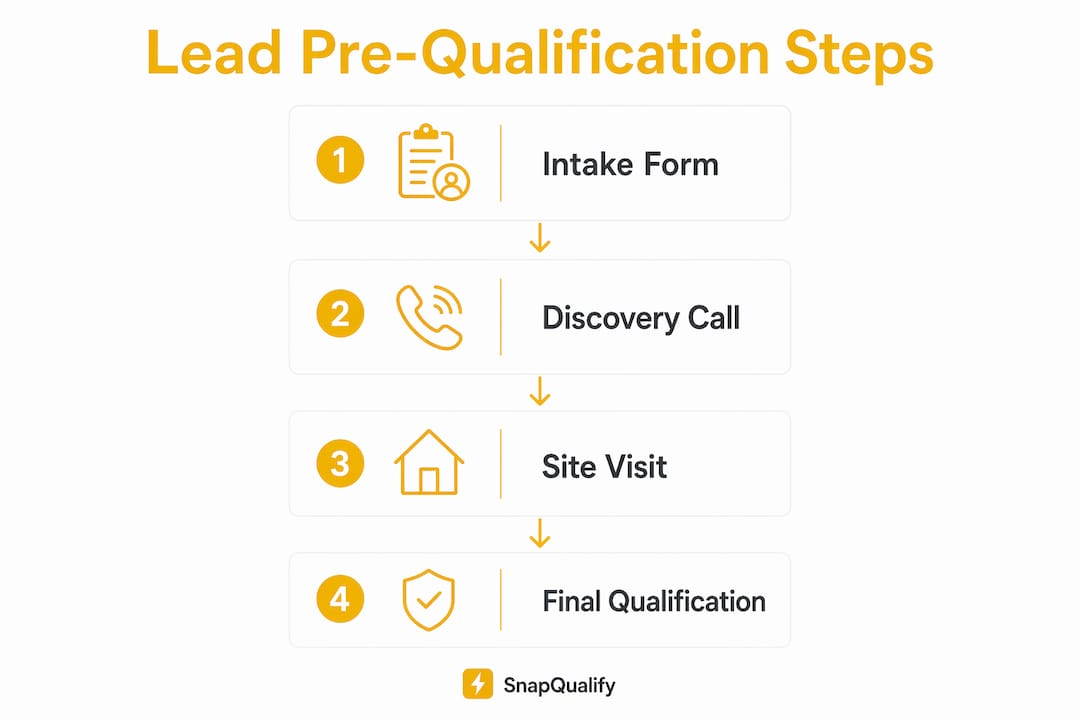
How pre-qualification improves time management and conversion
The time savings are measurable. A formal pre-qualification process reduces wasted time on non-closable leads by 30–50%. For a contractor running five to ten quotes per week, that reclaimed time translates directly into more billable hours or more capacity to pursue better projects.
"Pre-qualification turns your pipeline from a volume game into a precision instrument, increasing the number of high-quality conversations you actually have."
The table below shows the practical difference between working qualified and unqualified leads.
| Outcome | Qualified leads | Unqualified leads |
|---|---|---|
| Conversion rate | Up to 40% | Around 11% |
| Time per closed deal | Lower | Higher |
| Scope creep risk | Low | High |
| Payment dispute risk | Low | High |
| Team morale impact | Positive | Negative |
The morale point is real and often overlooked. When your crew spends Friday afternoon on a quote that goes cold by Monday, it drains motivation. Consistently working with vetted clients keeps your team focused and your business moving forward.
What are the best methods for qualifying project leads?
Contractors have three practical options for pre-qualifying leads, and the best businesses use all three in sequence.
Intake forms are the first gate. A well-built intake form asks about project type, rough budget range, preferred start date, and whether the respondent owns the property. Prospects who skip the form or refuse to answer budget questions self-select out before you spend a minute on them. Snapqualify builds this gate directly into a branded online form that clients complete before any contact is made.
Screening scripts are the second gate. For leads that pass the form, a five-minute phone screen confirms the details and tests for urgency. Ask directly: "What is your budget range?" and "When are you hoping to start?" Vague answers to both questions are a clear signal to move on.
Digital qualification funnels are the third gate. Tools like Snapqualify use AI-driven intake forms and risk analysis to generate a color-coded SnapScore for each lead. That score tells you at a glance whether a prospect is worth a site visit. The multi-gate qualification process eliminates tire-kickers efficiently without requiring you to personally screen every inquiry.
- Use intake forms on your website and any lead generation platforms you run.
- Train anyone who answers your phone to ask the four pillar questions before booking a visit.
- Review your lead qualification checklist regularly to keep your criteria current.
Pro Tip: Separating pre-qualification from the full discovery call lets you maintain client engagement while filtering for fit incrementally. You come across as thorough, not interrogative.
How to say no to a lead without burning the relationship
Saying no to a bad lead is a skill. Done poorly, it costs you referrals. Done well, it builds your reputation as a professional who knows their market.
The 1-10-100 rule applies directly here. Catching a bad lead at the inquiry stage costs you almost nothing. Catching it after a site visit costs time and fuel. Catching it after you have started work can cost thousands in disputes, delays, and legal fees. Early disqualification is always the cheapest option.
A respectful no sounds like this: "Based on what you have described, this project is outside the scope we typically handle. I want to make sure you find the right contractor for this job." That response protects your time, respects the prospect, and leaves the door open for referrals.
Polite early disqualification also protects your sales team's morale. Chasing leads that never close is demoralizing. Giving your team clear criteria for when to walk away keeps them focused on work that actually converts.
- Respond to every disqualified lead within 24 hours. Silence reads as unprofessional.
- Offer a referral to another contractor when possible. It builds goodwill.
- Document why each lead was disqualified. Patterns in your rejections reveal gaps in your marketing.
Key takeaways
Pre-qualifying project leads is the single most effective way for trade contractors to protect their time, improve conversion rates, and build a pipeline of clients worth working with.
| Point | Details |
|---|---|
| Four-pillar framework | Screen every lead for Budget, Timeline, Authority, and Project Scope before booking a visit. |
| Conversion rate gap | Qualified leads convert at up to 40%; unqualified leads convert at around 11%. |
| Time savings | A formal pre-qualification process cuts wasted time on dead leads by 30–50%. |
| Multi-gate process | Use intake forms, phone screens, and digital tools like Snapqualify in sequence for best results. |
| Respectful disqualification | Saying no early and professionally protects your reputation and your team's motivation. |
The uncomfortable truth about chasing every lead
Most contractors I talk to know, on some level, that half their quotes are going nowhere. They drive out anyway because saying no feels risky. What if that client had a big budget? What if they refer someone? That fear is understandable, but it is costing you more than you realize.
The contractors who build the most profitable businesses are not the ones who quote everything. They are the ones who get very good at identifying which 20% of leads will generate 80% of their revenue, and then they protect that focus ruthlessly. I have seen contractors cut their quote volume in half and double their close rate within a single quarter, simply by adding a basic intake form and a budget question to their process.
The other thing I would push back on is the idea that clients resent being screened. In my experience, serious clients appreciate it. It signals that you are organized, that you value your time, and that you take their project seriously. The clients who bristle at a budget question are usually the ones you did not want anyway.
Balance matters too. A 20-question intake form will scare off good leads. Keep your screening tight: four to six questions, a clear minimum project value, and a fast response time. The goal is to stop wasting quote visits on bad leads, not to make every prospect feel like they are applying for a loan.
— Colin
Snapqualify helps contractors qualify leads faster
Snapqualify is built specifically for trade contractors who are tired of spending unpaid hours on leads that never convert. The platform sends prospects a branded intake form before any contact is made. AI-driven analysis then generates a color-coded SnapScore that tells you whether a lead is worth your time.
Roofers, plumbers, electricians, HVAC technicians, and general contractors use Snapqualify to cut their screening time and focus on clients who are ready to move. The platform also takes data security seriously, so client information stays protected throughout the intake process. If you are ready to stop quoting blind, Snapqualify is worth a look.
FAQ
What does it mean to pre-qualify a project lead?
Pre-qualifying a project lead means evaluating a prospect against criteria like budget, timeline, authority, and project scope before committing to a site visit or full proposal. The goal is to confirm the lead is a genuine fit before you invest time and resources.
How much time can pre-qualification save a contractor?
A formal pre-qualification process reduces time spent on non-closable leads by 30–50%, according to sales qualification research. For contractors running multiple quotes per week, that adds up to several hours of reclaimed billable time.
What are the four pillars of lead qualification for contractors?
The four pillars are Budget, Timeline, Authority, and Project Scope. Filtering every inquiry through these four criteria identifies the top leads most likely to convert and generate revenue.
Is it unprofessional to ask about budget early?
Asking about budget early is professional, not pushy. It respects both your time and the prospect's, and it prevents costly site visits that lead nowhere. Serious clients expect the question.
How does Snapqualify help with lead pre-qualification?
Snapqualify automates the intake and screening process using AI-driven forms and risk analysis. Each lead receives a color-coded SnapScore so contractors can make fast, informed decisions about which prospects to pursue.