

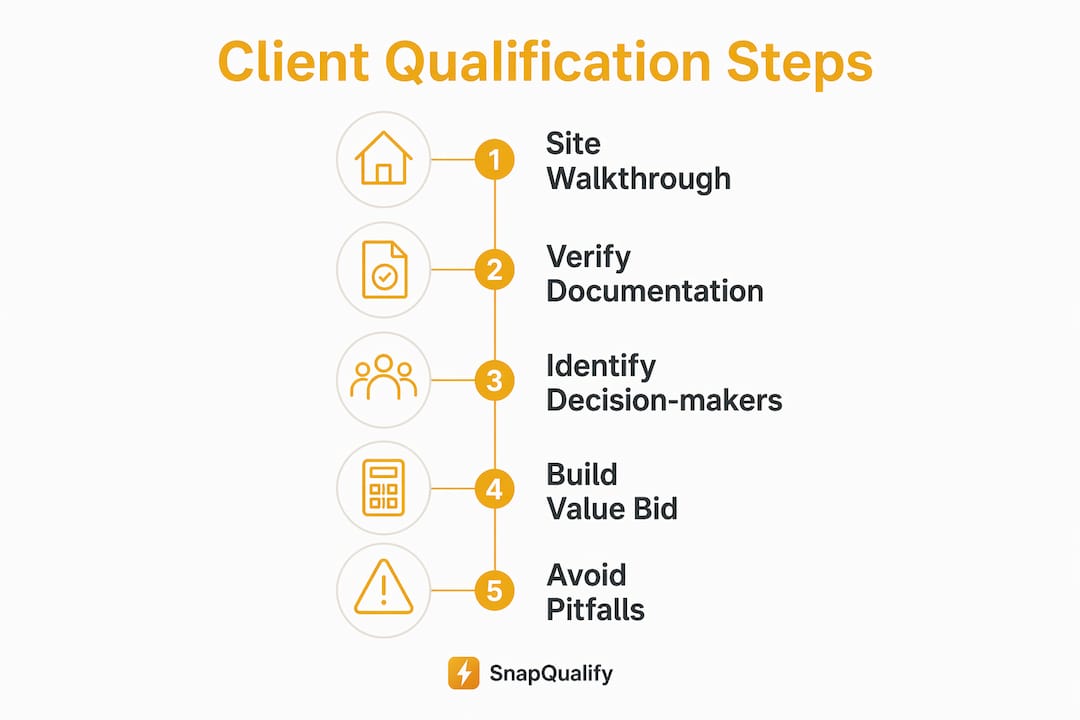
Client qualification in commercial painting is defined as the process of verifying project scope, confirming decision-maker authority, and assessing documentation before submitting a bid. Painters who skip this process routinely absorb losses from scope creep, vague specs, and clients who never intended to pay a fair price. The most effective painter client vetting process combines a mandatory site walkthrough, a clear ideal customer profile, and a value-based bid that the buyer can defend to ownership. This guide covers each step of how painters qualify commercial clients, from the first phone call to a signed contract.
Why is a mandatory site walk-through essential for qualifying commercial painting projects?
A 60-minute site walkthrough is the industry standard starting point for qualifying any commercial painting project. Skipping it is called blind bidding, and it is the fastest way to lose money on a job you thought you understood.
The walkthrough serves four specific purposes:
- Scope the surface prep. You need to see the actual substrate condition. Peeling paint, moisture damage, and previous coatings all change your labor estimate significantly.
- Build a value-based bid. Walking the property lets you identify disruption risks, access challenges, and compliance requirements that justify your price.
- Define the scope in writing. A documented scope protects you when the client later claims the hallway was "always included."
- Close with confidence. Clients who walk the property with you are more invested in the outcome. That face time builds trust before the proposal lands.
A blind bid without a walkthrough is statistically likely to result in scope creep or financial loss. The walkthrough is not a courtesy. It is a qualification gate.
Pro Tip: If a property manager refuses to schedule a site walk, treat that refusal as a disqualifier. Clients who block access are typically shopping on price alone and will push back on every line item in your bid.

How do commercial painters identify the right decision-makers?
The right decision-maker in commercial painting is rarely the building owner. Property managers, facility managers, and asset managers control maintenance budgets and approve vendor relationships. Targeting the wrong contact wastes your outreach and stalls deals.
Top-performing commercial contractors define a clear Ideal Customer Profile and execute structured outreach with roughly 12 touchpoints over a 90-day period. That consistency is what separates painters who land repeat contracts from those chasing one-off jobs.
Your outreach strategy should cover three channels:
- Phone calls. A direct call to the facility manager's office establishes your name before your email arrives. Keep it brief and specific to their property type.
- Email sequences. Send value-first emails that reference common problems for their building class, such as tenant disruption or compliance deadlines.
- In-person visits. Dropping by a property you want to work on signals commitment. Bring a one-page capability summary, not a full proposal.
Relationship-based pipelines focused on facility directors and repeat business provide the most reliable commercial painting lead sources. One satisfied facility manager who oversees a portfolio of 12 properties is worth more than 50 cold leads. Build for the relationship, not the single job. You can find a structured approach to this in the lead qualification checklist built for trade contractors.
What documentation must painters verify to qualify commercial clients?
Commercial painting clients require formal Request for Proposals that specify prep standards, products, timelines, and bid formats. If a prospect cannot provide an RFP or equivalent written scope, the project is not ready to bid.
The documentation checklist for a qualified commercial contract includes:
- Proof of your general liability insurance and workers' compensation coverage
- Bonding documentation if the project is publicly funded or requires it
- A line-item bid showing labor, materials, surface prep, and timeline separately
- Product specifications naming the coating system, coat count, and application method
The "prep is the bid" rule applies here directly. Detailed surface prep specifications and coat counts must be explicit to stand out from low-priced competitors who leave those details vague. Vague bids invite price comparisons on the wrong criteria.
Pro Tip: Ask for the RFP before you invest time in a site visit. If the client cannot produce one, offer to help draft a basic scope document together. Clients willing to do that work are serious buyers. Clients who refuse are not.
Disqualifiers are just as important as qualifiers. Missing specs, an unwillingness to share insurance requirements, and vague project descriptions all signal a client who will be difficult to manage after the contract is signed.
How do painters build value-based bids that align with commercial clients' priorities?
Commercial buyers focus on risk mitigation around tenant disruption, compliance, and timeline reliability rather than just competing on price. Your bid needs to speak directly to those concerns.
A value-based commercial bid addresses four areas:
- Disruption control. Specify whether work happens after hours, on weekends, or in phases. Property managers answer to tenants. Show them you have already thought about that.
- Warranty terms. A written warranty on both labor and materials reduces the buyer's perceived risk. Most low-price competitors offer nothing in writing.
- Compliance documentation. Reference the coating systems you use and confirm they meet any applicable VOC or building code requirements for the property type.
- Bid defensibility. Commercial contracts often require multiple approvals: the property manager manages scope, but owners or boards sign the contract. A documented scope helps the buyer defend your bid upward.
Successful painters win contracts by framing their service as problem elimination rather than just painting. When your proposal shows a phased schedule that keeps the lobby open during business hours, you are solving a problem the client was already losing sleep over.
What are the common pitfalls painters should avoid when vetting commercial clients?
The most costly mistakes in commercial client assessment follow a predictable pattern. Recognizing them early saves you from bidding jobs you should never have taken.
- Bidding without a site walk. This is the single most common error. You cannot price what you have not seen, and clients who deny a walkthrough are signaling they only buy on price.
- Chasing price-only buyers. If the first question is "what's your number?" with no discussion of scope, walk away. These clients will renegotiate after the work starts.
- Submitting incomplete documentation. Missing insurance certificates or vague line items get your bid disqualified before anyone reads the price.
- Neglecting follow-up. Targeting operational stakeholders with multiple outreach touchpoints builds trust and yields higher contract success. One email is not a strategy.
A commercial painter's success depends more on structured qualification, consistent communication, and detailed compliance than on offering the lowest price. The painters who grow past seven figures treat qualification as a system, not a gut feeling. For a deeper look at pre-qualifying leads before you invest field time, the guide on why pre-qualify project leads is worth reading.
Key Takeaways
The most effective way to qualify commercial painting clients is to combine a mandatory site walkthrough, documented scope, targeted decision-maker outreach, and a value-based bid that addresses risk directly.
| Point | Details |
|---|---|
| Site walkthrough is non-negotiable | A 60-minute walk-through scopes prep accurately and disqualifies price-only buyers who refuse access. |
| Target the right stakeholders | Property, facility, and asset managers control budgets; building owners rarely make day-to-day vendor decisions. |
| Documentation qualifies and disqualifies | Require an RFP, insurance alignment, and line-item specs before investing time in a full bid. |
| Value beats price in commercial bids | Disruption control plans, warranties, and compliance documentation position you as the low-risk choice. |
| Consistent outreach builds the pipeline | Roughly 12 touchpoints over 90 days with facility directors produces repeat contracts and referrals. |
What I have learned about qualifying commercial painting clients
The painters I have watched grow their commercial revenue fastest share one habit: they treat the site walkthrough as a sales tool, not an administrative step. Walking a property with a facility manager for 60 minutes tells you more about whether this client is worth pursuing than any intake form or phone call ever will. You see how they talk about the building, whether they know their own specs, and whether they respect your time.
The second thing I have noticed is that most painters underestimate how much commercial buyers want someone to make their job easier. A property manager juggling 200 tenant requests does not want to manage your bid process too. When you show up with a clear scope document, a phased schedule, and proof of insurance already organized, you are not just a painter. You are a vendor who does not create problems. That positioning wins contracts even when your price is not the lowest.
Structured qualification is not about filtering out clients. It is about protecting your margin and your time so you can serve the right clients well.
— Colin
Snapqualify helps painters qualify clients with confidence
Qualifying commercial clients takes time, and the documentation requirements alone can slow your pipeline. Snapqualify is built for trade contractors who need a faster, more organized way to screen leads before committing field hours.

The platform uses intelligent intake forms and AI-driven risk analysis to generate a color-coded SnapScore for each prospect. You see at a glance whether a client's budget, scope clarity, and project history align with the jobs you want to take. Client data is handled with care, and you can review Snapqualify's data protection standards to see exactly how your information is managed. For painters building a commercial pipeline, that kind of organized, repeatable vetting process is what separates profitable growth from expensive guesswork.
FAQ
How do painters qualify commercial clients before bidding?
Painters qualify commercial clients by conducting a mandatory site walkthrough, verifying RFP documentation, and confirming the decision-maker's authority and budget. Clients who refuse a site visit or cannot provide written specs are typically disqualified.
What is the ideal customer profile for commercial painting contractors?
The ideal commercial painting customer is a property manager, facility manager, or asset manager who controls a maintenance budget and oversees multiple properties. These stakeholders prioritize reliability and compliance over the lowest price.
What documents should a painter request before submitting a commercial bid?
Painters should request a formal RFP with prep standards and product specs, confirm insurance and bonding requirements, and prepare a line-item bid breakdown covering labor, materials, prep, and timeline.
Why do commercial painting bids need disruption control plans?
Commercial buyers compare bids on risk factors including tenant disruption and timeline reliability. A phased schedule or after-hours work plan shows the client you have already solved their biggest operational concern.
How many outreach touchpoints does it take to land a commercial painting contract?
Top-performing contractors use roughly 12 touchpoints over a 90-day period across calls, emails, and in-person visits to build the trust needed for a commercial contract award.