

If you've ever hired a contractor and assumed your job was simply to write checks and wait for results, you've already encountered the biggest misconception about the owner-contractor relationship. What is owner-contractor relationship, really? It's a structured, legally defined partnership where both parties carry active responsibilities from day one through project closeout. Get the roles right and your project runs smoothly. Blur them, and you're looking at cost overruns, disputes, and unfinished work. This guide cuts through the confusion so you know exactly what to expect and how to protect yourself.
Table of Contents
- Key takeaways
- What is owner-contractor relationship: roles and legal foundations
- How the relationship evolves through a project
- Common challenges and legal nuances
- Strategies for building a strong owner-contractor partnership
- Practical steps to take before your next project
- My take on what most owners get wrong
- How Snapqualify helps you start every project on solid ground
- FAQ
Key takeaways
| Point | Details |
|---|---|
| Owners carry active duties | You don't just hire and wait — owners must govern scope, approve payments, and manage changes throughout the project. |
| Contract type determines risk | Choosing between Stipulated Sum, Cost Plus with GMP, or Cost Plus without GMP directly affects who absorbs budget uncertainty. |
| Change orders are the top dispute trigger | Approving all scope changes in writing before work begins is the single most effective way to avoid cost conflicts. |
| Trust language has legal limits | "Trust and confidence" clauses in contracts don't automatically create fiduciary duties — courts look at actual behavior instead. |
| Screening matters before you sign | Vetting contractors early, through structured due diligence, prevents most relationship problems before they start. |
What is owner-contractor relationship: roles and legal foundations
At its core, the owner-contractor relationship is a contractual arrangement where one party (the owner) commissions construction or renovation work and another party (the contractor) executes it. But that simple description hides a lot of operational complexity.
The owner controls the project's scope, budget, and timeline from a governance standpoint. The contractor brings labor, materials, and technical expertise to deliver the work. These roles are distinct, but they overlap constantly in practice. Industry contract guides identify three primary contract structures that define how financial risk is shared between them.
| Contract Type | Risk Profile | Owner Control |
|---|---|---|
| Stipulated Sum (Fixed Price) | Contractor absorbs cost overruns | Lower flexibility, higher predictability |
| Cost Plus with GMP | Shared risk up to a ceiling | Moderate control with budget protection |
| Cost Plus without GMP | Owner absorbs all cost overruns | High flexibility, high financial exposure |
Architects and owner's representatives add another layer. An owner's representative is not a project manager focused on daily logistics. This person acts as the owner's strategic surrogate, managing contractor relationships and protecting the owner's financial and legal interests across the entire project lifecycle.
Pro Tip: If you're a first-time developer or tackling a large renovation, hiring an owner's rep before selecting a contractor pays for itself. They know which contract clauses contractors push back on and why.
How the relationship evolves through a project
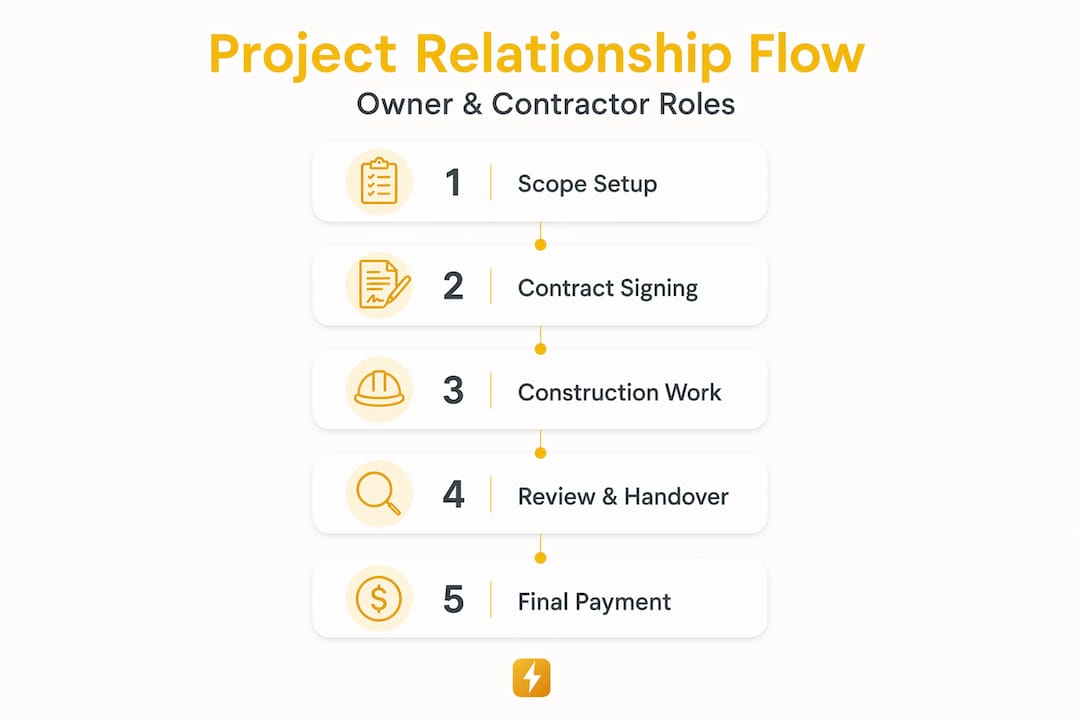
The owner-contractor relationship doesn't stay static. It changes shape depending on where you are in the project. Understanding contractor-owner relations means recognizing these three distinct phases.
-
Pre-contract phase. This is when you solicit bids, evaluate proposals, and negotiate terms. Communication is exploratory. Both sides are assessing fit. This is also the moment to define decision authorities, documentation standards, and escalation paths before either party is financially committed.
-
Contract execution phase. Work begins, and the relationship shifts into active governance. You'll approve payment applications, respond to requests for information, and manage change orders. Change orders are the most common source of project disputes, so every scope change needs your written approval before work proceeds. Informal agreements made on-site without documentation are where budgets quietly explode.
-
Post-construction phase. Punch lists, final inspections, warranty claims, and closeout documentation define this stage. Owners often disengage too early here. The contractor still has obligations. Staying engaged through final sign-off protects your investment and gives you recourse if defects surface later.
Conflicts tend to concentrate at the transition points between these stages. Contracts that anticipate those transitions with clear procedures keep disputes manageable rather than costly.
Common challenges and legal nuances
This is where understanding contractor-owner relations gets genuinely complicated. Most owners assume that signing a contract transfers risk to the contractor. The reality is more nuanced.
Owners retain responsibility for the quality of the plans and specifications they provide. If a design is flawed, the contractor builds what the drawings say. That cost lands back on you. Active owner governance means reviewing payment applications carefully, managing scope through contract clarity, and planning for unforeseen events rather than reacting to them.
One clause that frequently misleads owners is "trust and confidence" language. You'll see it in many agreements as a warm signal of good faith. But courts across jurisdictions rarely elevate this language to a true fiduciary duty. What matters legally is the actual power balance and reliance patterns in your specific relationship, not the wording in the contract.
Most legal disputes in construction don't start with bad intentions. They start with ambiguous contracts and undocumented decisions that both sides remember differently six months later.
Pitfalls to watch for in any owner-contractor agreement:
- Scope creep that starts as a small verbal request and becomes a $20,000 dispute. Read more about preventing scope creep before your project starts.
- Payment timing misalignment where the contractor expects milestone payments and the owner expects completion-based billing.
- Undefined change order procedures that let costs accumulate before anyone flags the problem.
- Dispute resolution clauses that skip directly to arbitration or litigation without requiring negotiation first. Best practice frameworks prioritize negotiation, then mediation, reserving costly legal options as a last resort.
Pro Tip: Read the dispute resolution section of your contract before you sign it. If it skips negotiation and goes straight to arbitration, request an amendment. Preserving the option to talk first saves money and relationships.
Strategies for building a strong owner-contractor partnership
The owner-contractor communication standard that separates smooth projects from painful ones is not about frequency. It's about clarity and documentation.
Here's what works in practice:
- Define who makes decisions and who gets consulted. Before the first shovel hits dirt, write down which decisions require owner approval versus contractor discretion. This removes ambiguity at the moment it matters most.
- Use an owner's representative if the project scope exceeds your expertise. The rep's strategic role goes beyond tracking schedules. They interpret contract language on your behalf and prevent contractor overreach without damaging the working relationship.
- Tie payments to documented progress. Milestone payments tied to verified completion stages give you leverage if quality falls short. Paying ahead of verified work removes that leverage permanently.
- Build a log of all project communications. Emails, meeting notes, site visit records. If a dispute arises, the party with the cleaner paper trail usually wins.
- Screen contractors before you hire. Knowing the warning signs in owner-contractor dynamics before you sign saves far more time and money than fixing problems after they surface.
The importance of owner-contractor trust cannot be overstated, but trust earned through transparency and documentation outlasts trust based on gut feeling alone.
Practical steps to take before your next project
Translate everything above into concrete action with these steps before you select a contractor or sign anything.
- Define your project scope in writing before soliciting bids. Vague scopes generate vague bids and eventual disputes.
- Research contract types relevant to your project size and risk tolerance. A guide to contract risk profiles helps you match the structure to your situation.
- Prepare a list of questions for each bidding contractor covering their experience with your project type, their change order process, and their preferred dispute resolution approach.
- Verify licenses, insurance, and references. This is non-negotiable due diligence for any project above minor repairs.
- Consult an attorney or owner's rep to review the contract before signing. One hour of legal review can prevent months of litigation.
My take on what most owners get wrong
I've seen a lot of owners treat the contract as a formality and the relationship as the real deal. I get it. A handshake with someone you trust feels more reliable than a stack of legal documents. But what I've learned is that the contract IS the relationship. It defines what trust looks like when things go sideways.
The owners who come out ahead aren't necessarily the toughest negotiators. They're the ones who spent time on preventative contract design upfront. They defined decision authority, documented everything, and hired people with genuine expertise to fill the gaps in their own knowledge.
The owner's rep dynamic is one people consistently undervalue. Most owners think of them as an added cost. In my experience, a good rep identifies one issue early in a project that would have cost ten times their fee to fix later. That's not a luxury expense. That's basic risk management.
What I'd push back on is the idea that a strong relationship means you never have conflict. The best owner-contractor relationships I've observed had clear, well-documented disagreements that got resolved quickly because the process was already in place. That's the real goal.
— Colin
How Snapqualify helps you start every project on solid ground
The owner-contractor relationship starts long before construction begins. It starts the moment you decide who to work with.

Snapqualify gives contractors a structured way to screen clients before committing to a project, and that benefits owners too. When a contractor uses Snapqualify's screening platform to evaluate fit upfront, both sides enter the project with aligned expectations and fewer surprises. The platform uses AI-driven intake forms to surface risk signals early, so contractors take on clients they're set up to serve well. Your data stays protected through Snapqualify's security protocols, and the whole process takes minutes, not days.
FAQ
What does a contractor do for an owner?
A contractor executes the physical construction or renovation work defined in the contract, supplying labor, materials, and technical expertise. The contractor is also responsible for managing subcontractors and meeting the quality, timeline, and budget standards agreed upon with the owner.
What are the main roles in owner-contractor relationship?
The owner governs the project scope, approves payments, and manages changes. The contractor delivers the work. Supporting roles like owner's representatives and architects help bridge expertise gaps and protect both parties' interests throughout the project.
How does an owner-contractor agreement protect both parties?
A well-drafted owner-contractor agreement defines scope, payment terms, change order procedures, and dispute resolution steps, giving both parties clear recourse if expectations aren't met. Without it, disagreements default to costly legal interpretation.
Why does owner-contractor communication matter so much?
Poor communication is the root cause of most construction disputes. Documented, consistent communication creates a record that protects both parties and keeps the project aligned with the original scope and budget.
Is "trust and confidence" in a contract legally binding?
Not automatically. Courts generally look at actual behavior and power balance rather than contract wording alone when deciding whether heightened duties apply, so you cannot rely on this language as a legal guarantee of the contractor's loyalty.