

Running a construction business without solid systems is like building without a blueprint. You might get walls up, but something will go wrong before you reach the roof. This is exactly why construction businesses need systems: without them, your estimating, project management, accounting, and field operations run as separate islands. Fragmented tools create information silos that slow your close cycles, multiply manual work, and expose you to risks that only get worse as your project volume grows. If you are running your business on gut feel and spreadsheets, this article will show you what you are missing and why it matters.
Table of Contents
- Key Takeaways
- Why construction businesses need systems
- Prequalification as a risk management system
- Traditional workflows vs. integrated systems
- Portfolio-level intelligence as your early warning system
- My take on what actually changes with systems
- How SnapQualify fits into your qualification system
- FAQ
Key Takeaways
| Point | Details |
|---|---|
| Systems reduce costly silos | Fragmented tools slow reporting, create data errors, and erode profit over time. |
| Prequalification protects margins | Structured client and subcontractor screening prevents high-risk contracts before they start. |
| Integration beats adding tools | Connecting existing workflows delivers more clarity than buying another standalone software. |
| Leading indicators beat lagging reports | Portfolio-level data surfaces risk signals earlier, reducing reactive fire-fighting on projects. |
| Qualification is a living process | Treating risk registers as active documents enables early mitigation, not last-minute scrambles. |
Why construction businesses need systems
The construction industry is operationally complex in ways most other industries never experience. You are managing scope, schedule, budget, subcontractors, inspections, and client expectations all at once. Without a system that connects these moving parts, your team spends more time reconciling data than managing performance.
Construction ERPs centralize project and financial data, delivering real-time updates that keep scope, cost, and schedule aligned across every team. That matters because decisions made in the field affect your budget, and decisions made in the office affect your schedule. When those two worlds are not talking to each other, you are always reacting instead of managing.
The practical benefits of integrated systems come down to a few critical areas:
- Eliminate reconciliation cycles. When estimating, project management, and accounting share a single data source, a change in one area automatically updates downstream reports.
- Improve financial visibility. Real-time cost reporting replaces the outdated monthly summaries that most contractors still depend on.
- Align field and office. Field crews, project managers, and finance teams work from the same data, not three different versions of it.
- Support confident forecasting. With clean, current data, you can predict cash flow and resource needs instead of guessing.
Pro Tip: Before adding new software, map your current workflows and find where data gets re-entered manually. Those are your highest-value integration points.
The importance of systems in construction is not about having the most technology. It is about having the right connections between the tools your team already uses.
Prequalification as a risk management system
Most contractors think of systems as internal tools. Scheduling software, accounting platforms, project trackers. But one of the most financially significant places to apply structured thinking is before you ever sign a contract.
Prequalification is your first line of defense. Structured prequalification filters subcontractors for financial stability, bonding capacity, safety records, and current backlog. When this process is systematic rather than informal, you catch red flags that an overworked project manager running on gut feel would miss.
Here is what a solid prequalification system should evaluate:
- Financial stability. Can this party actually fulfill the contract without running out of cash mid-project?
- Bonding and insurance. Are the limits appropriate for the scope and risk level of the work?
- Current capacity. Is the subcontractor or client already over-extended on other projects?
- Safety record. What does their EMR look like, and have there been recent OSHA violations?
- Communication responsiveness. Top contractors evaluate recent performance and response behavior before contract award, not after problems surface.
The biggest mistake contractors make is overriding the prequalification process when they are behind schedule and need to fill a slot fast. That shortcut puts your project manager at risk, your company at risk, and your client relationship at risk. Prequalification must be treated as a risk filter, not a checkbox that gets skipped when it is inconvenient.
Pro Tip: Keep prequalification records as living documents. Log the reasons behind any red flags so your team can track whether issues were resolved or if the risk is still active.
When PM, finance, and preconstruction teams share the same qualification data, you stop getting surprised by problems that were visible weeks earlier. That is the real benefit of organized construction workflows applied to risk management.

Traditional workflows vs. integrated systems
Here is an honest look at what changes when you move from a fragmented approach to a connected one:
| Area | Traditional approach | Integrated system |
|---|---|---|
| Cost reporting | Monthly manual spreadsheets | Real-time automated updates |
| Schedule changes | Phone calls and email chains | Instant cross-team notifications |
| Document control | Shared drives with version conflicts | Single source with audit trail |
| Risk identification | End-of-project lessons learned | Leading indicators flagged in real time |
| Client qualification | Informal gut-check conversations | Structured scoring with documented criteria |
The operational gains are measurable. Lean construction combined with digital tools cuts excavation duration by 15% and overall project time by over 2%. BIM utilization alone decreases average project completion time by 12% by reducing rework and improving coordination before crews hit the field.
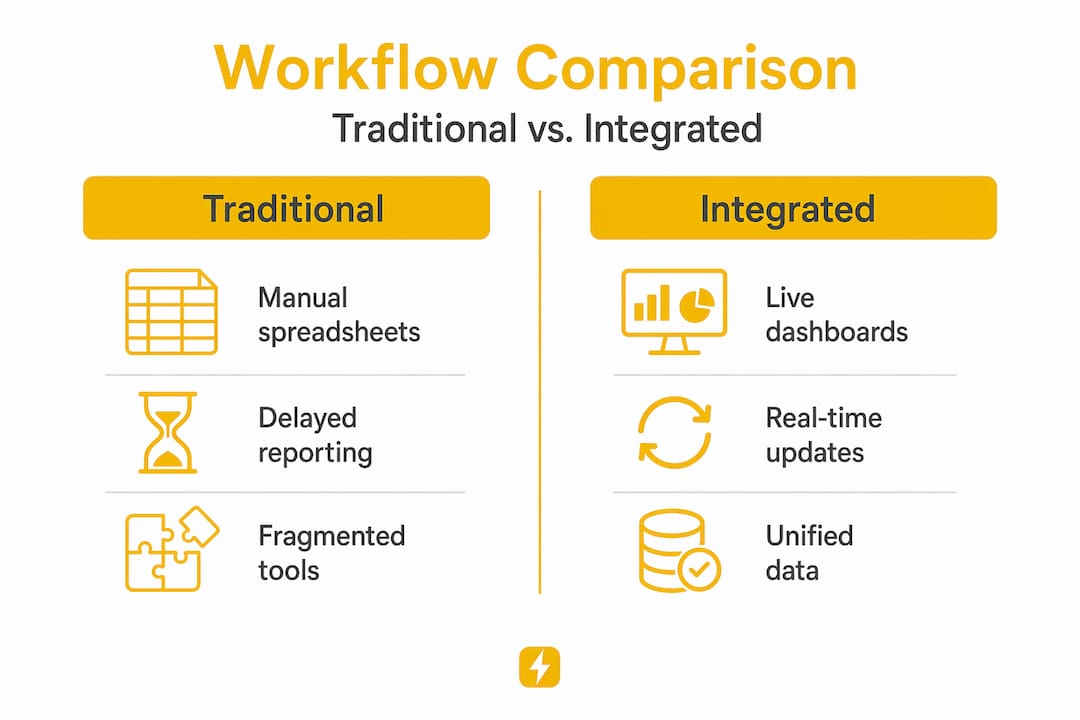
The key insight here is that efficiency gains come from reducing decision latency, not from entering data faster. Automated approvals, real-time dashboards, and connected communication tools mean your team spends less time waiting for answers and more time executing.
When you look at how digital permitting and digital plan checks are reshaping project timelines, the pattern is consistent: standardized digital workflows cut delays at every handoff point, whether that is a permit approval or a subcontractor change order.
Portfolio-level intelligence as your early warning system
Once your systems are connected, you can take visibility to the next level. Portfolio-level intelligence treats data integration as an engineering discipline, not just a reporting tool.
"The goal is to replace lagging reports with leading indicators that flag problems before they become delays, claims, or safety incidents." — ENR on integrated contractor risk systems
Replacing lagging reports with portfolio-level intelligence reduces RFI aging by 40% and change exposure by 25% without disrupting how field teams work. The intelligence layer sits on top of your existing tools and uses normalized composite scores to surface risk signals across schedule, safety, quality, and finance simultaneously.
The practical benefits for a construction business owner include:
- Catching a subcontractor's capacity overrun before it hits your critical path
- Flagging budget deviations when they are small, not when they have compounded
- Identifying safety trends across multiple projects before a recordable incident occurs
- Reducing the reactive fire-fighting that consumes management bandwidth on complex jobs
Portfolio-level systems integrate multi-domain data with engineered decision layers that enable measurable earlier interventions. For growing contractors managing multiple projects, this is where the impact on project success becomes concrete and quantifiable.
My take on what actually changes with systems
I have seen contractors triple their project volume without adding management headcount. I have also seen contractors with impressive software stacks who still run chaotic businesses. The difference is never the tool. It is the process connecting the tool to a decision.
What I have learned is that most construction businesses do not have a software problem. They have a clarity problem. When the same job cost report gets interpreted differently by the PM, the CFO, and the owner, you do not need another dashboard. You need agreement on what the data means and who acts on it.
The businesses that actually benefit from integrated construction systems are the ones that first got honest about where their workflows break down. They mapped their manual reconciliations, identified their data gaps, and built systems around how their teams actually work. Not how they wish they worked.
My strongest advice: stop adding tools and start connecting the ones you have. The integration gap between your field app, your accounting software, and your CRM is costing you more than any new feature ever will. Fix that first, and every other improvement compounds on top of it.
— Colin
How SnapQualify fits into your qualification system
If the prequalification section hit close to home, you are not alone. Most contractors know they should screen clients more carefully. They just do not have a fast, structured way to do it before the estimate conversation.
SnapQualify is built specifically for that gap. It gives contractors a branded intake form that screens clients on scope, budget, and project experience before you invest your time. The AI-powered SnapScore delivers a color-coded risk rating so you can qualify clients with confidence before you ever pick up the phone. It fits into your existing workflow without disrupting how your team operates. If you want to stop taking on the wrong jobs, this is where you start.
FAQ
What are the main benefits of systems in construction?
Systems reduce information silos, improve cost visibility, and align field and office teams around shared data. The result is fewer errors, faster decisions, and better project outcomes.
How do systems improve client qualification for contractors?
Structured qualification workflows replace informal gut-check conversations with documented criteria covering finances, capacity, and risk history. This protects contractors from high-risk projects before a contract is signed.
Why do construction businesses lose money without integrated systems?
Fragmented estimating and accounting tools create reconciliation delays and data errors that erode profit margins and reduce confidence in financial reporting.
What is portfolio-level intelligence in construction?
It is a data integration approach that uses leading indicators across schedule, safety, quality, and finance to flag risks early. This method reduces RFI aging by 40% and change order exposure by 25%.
Should construction managers prequalify homeowners, not just subcontractors?
Yes. Screening homeowners before quoting protects against scope creep, late payments, and difficult project dynamics. You can learn more about prequalifying homeowners before the estimate conversation starts.