

Bad clients are the leading cause of profit loss for contractors, operating through three financial mechanisms: withheld retainage, unresolved change orders, and delayed or disputed payments. These aren't just inconveniences. They lock up working capital, trigger legal costs, and erode margins on projects that looked profitable at signing. Understanding why contractors lose money to bad clients means understanding how client behavior intersects with contract management, cash flow timing, and documentation discipline. The contractors who protect their profits aren't necessarily the best builders. They're the ones who recognize the financial risks early and act before leverage disappears.
How retainage traps contractor cash flow
Retainage is defined as the practice of withholding 5% to 10% of progress payments until a contractor meets specific completion milestones. On a $500,000 project, that means $25,000 to $50,000 of earned money sitting in a client's account while you're paying your crew, your suppliers, and your equipment costs every week.
The problem compounds when you factor in timing. Retainage holdbacks often extend well beyond substantial completion because of punch list requirements, documentation triggers, and contract conditions that clients can interpret loosely. A bad client will use every one of those conditions to delay release. Meanwhile, you're either borrowing to cover working capital or turning down other jobs because your capital is tied up.
Retainage is also a major burden on bonding capacity, which limits your ability to bid larger projects. Most contractors treat it as a minor nuisance. It isn't. It's a structural cash flow constraint that bad clients exploit.
Pro Tip: Negotiate step-down retainage provisions before signing. A common structure reduces retention from 10% to 5% once the project reaches 50% completion. This single contract term can free up tens of thousands of dollars mid-project when you need it most.
| Retainage scenario | Cash flow impact |
|---|---|
| 10% held on $300K project | $30,000 locked until release milestone |
| Step-down to 5% at 50% completion | $15,000 freed mid-project |
| Punch list delay of 60 days | Additional borrowing costs or missed bids |
| No step-down provision | Full retention held until final sign-off |
Why change orders with bad clients destroy your margin
Change orders cause disputes primarily because verbal approvals are treated as formal authorization when they aren't. A client says "go ahead" on a field change, you commit labor and materials, and then the invoice arrives and suddenly the client has no memory of approving anything. By that point, your costs are sunk.

The financial damage from change orders isn't always dramatic. It accumulates quietly. A few unpriced additions here, a scope expansion there, and by project end you've absorbed 8% to 12% of additional cost with no corresponding revenue. That's not a bad client problem. That's a documentation problem that bad clients exploit.
Documenting change orders means capturing written authorization before you commit irreversible costs. The moment you proceed without that, you're in an uphill battle for cost recovery. Here's what every change order record needs to include:
- Written description of the scope change and reason
- Cost breakdown covering labor, materials, and equipment
- Schedule impact in calendar days
- Client signature or written email confirmation before work begins
- Reference to the original contract clause being modified
Pro Tip: Never treat a client's email saying "sounds good" as a signed change order. Reply with a formal change order document attached and state clearly that work will begin upon signed return. Most clients will sign. The ones who push back are showing you exactly who you're dealing with.
The hidden commercial risk in informal approvals is that disputes escalate fast once the project is complete. At that point, you have no leverage. The work is done, the client has possession, and you're chasing a check through attorneys.
What late payments actually cost you
Payment delays don't just slow your cash flow. They grow your financial exposure every week you continue working. Continuing work after payments are late signals to the client that your payment terms are flexible. Once that perception sets in, it's very difficult to reverse.
Here's the progression that turns a late payment into a serious loss:
- Payment is 15 days late. You follow up. Client cites a minor dispute or says the check is coming.
- Payment is 30 days late. You keep working to maintain the relationship. Your exposure grows.
- Payment is 60 days late. You stop work. The client threatens to find another contractor.
- Dispute escalates. Legal costs often exceed the disputed amount, making litigation a losing proposition even if you're right.
- Settlement or lien. You recover a fraction of what you're owed, months after the work was done.
Mechanics' liens are your most powerful legal tool, but they have strict filing deadlines that vary by state. Miss the window and you lose the right entirely. Stop-work clauses in your contract give you the right to halt work without breaching the agreement, which preserves leverage and limits exposure. When a client in Snohomish County shut down in 2026, unpaid invoices exceeded $1.5 million across more than 30 parties. Most of those contractors had no stop-work clause and no lien filed in time.
Common financial mistakes that make bad clients worse
The bad client impact on projects is always worse when internal financial discipline is weak. These are the mistakes that turn a difficult client into a genuine loss:
- Treating estimates as contracts. An estimate is not a binding document. A signed contract with defined scope, payment schedule, and change order procedures is. Clients who dispute payments often do so because the original agreement was vague enough to argue about.
- Skipping job costing. Fixing two or three job costing mistakes can restore 5% to 10% in profit margins. Without real-time job costing, you won't know a project is losing money until it's too late to adjust.
- Ignoring cash flow timing. Upfront labor mobilization and material costs create a timing mismatch with retainage-restricted payments. Contractors who don't model this gap run out of working capital mid-project.
- Failing to track retainage balances. If you don't know exactly how much retainage is outstanding on every active project, you can't manage your cash position accurately.
- Accepting vague scope language. "Complete the renovation to the client's satisfaction" is not a scope definition. It's an open invitation for disputes.
How to identify bad clients before you sign
The most effective way to avoid contractor losses from bad clients is to screen them before committing resources. Certain behaviors consistently predict payment problems, scope creep, and disputes. Client red flags include budget pressure, vague expectations, urgency manipulation, and poor payment history. Each one translates into a specific financial risk.
| Red flag | Financial risk |
|---|---|
| Refuses to sign a contract | No legal basis for payment enforcement |
| Resists paying a deposit | Likely to dispute final payment |
| Pushes for work to start immediately | Bypasses documentation and scope clarity |
| Vague about budget | Scope creep and change order disputes |
| Negative references or payment history | High probability of late or withheld payment |
A structured qualification process removes the guesswork. Reviewing a client's payment history and reputation before signing is the same due diligence you'd apply to any business decision. Tools that formalize this process, like intake forms and risk scoring, give you a consistent framework rather than relying on gut instinct. You can also review how general contractors screen owners before committing to a project for a practical framework.
Key takeaways
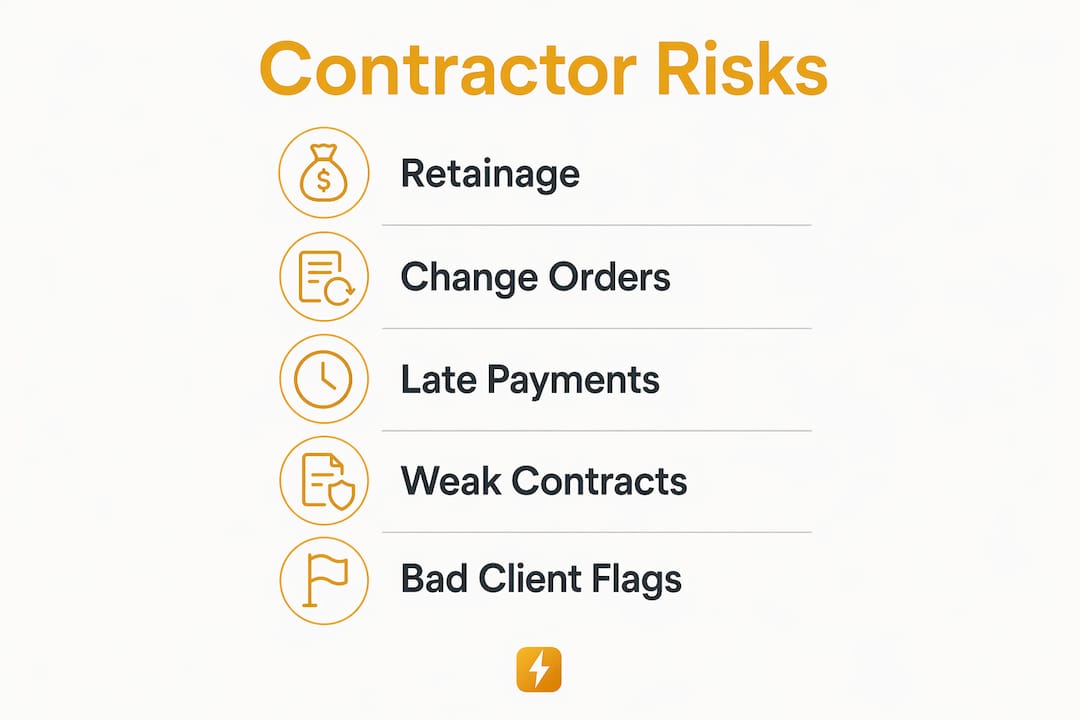
Bad clients cost contractors money through retainage delays, undocumented change orders, late payments, and weak contract terms that remove leverage before disputes begin.
| Point | Details |
|---|---|
| Retainage is a cash flow trap | 5% to 10% of project value can be locked for months; negotiate step-down provisions upfront. |
| Change orders require written approval | Verbal field approvals create unrecoverable cost exposure; document before committing labor. |
| Late payments compound fast | Continuing work after missed payments reduces leverage and increases total financial exposure. |
| Job costing gaps hide losses | Fixing recurring job costing mistakes can recover 5% to 10% in profit margin per project. |
| Screen clients before signing | Behavioral red flags like deposit resistance and contract refusal reliably predict payment disputes. |
The pattern I keep seeing contractors repeat
After years of watching contractors navigate client disputes, the pattern is almost always the same. The contractor knew something felt off early. Maybe the client pushed back on the deposit. Maybe they wanted to start before the contract was signed. Maybe they kept changing the scope during the estimate phase. And the contractor took the job anyway because the pipeline was thin or the project looked profitable on paper.
The financial mistakes contractors make with bad clients aren't usually about ignorance. They're about optimism overriding judgment. You tell yourself this client will be different, or that you can manage the risk once you're on site. By the time the first payment is late, you've already committed labor, materials, and subcontractors. Your leverage is gone.
The contractors I've seen protect their margins consistently do two things differently. They enforce payment milestones without apology, treating the first late payment as a signal rather than an inconvenience. And they walk away from clients who won't sign a clear contract, no matter how good the project looks. That second one is harder than it sounds. But every contractor who has absorbed a six-figure loss from a bad client will tell you the same thing: the red flags were there at the start.
Protect your cash flow with Snapqualify
Snapqualify is built specifically for trade contractors who are tired of discovering a client's true behavior after the contract is signed. The platform sends clients a branded intake form with targeted questions about project scope, budget, and experience. The responses are analyzed using AI and industry heuristics to generate a color-coded SnapScore that tells you, before you commit a single hour, whether this client is worth pursuing. Roofers, electricians, plumbers, HVAC technicians, painters, and general contractors use Snapqualify to cut scope creep, reduce late payments, and stop difficult clients from draining their margins. Your client data stays protected with enterprise-grade security built into every step of the process. Start qualifying smarter at snapqualify.com.
FAQ
Why do contractors lose money to bad clients?
Contractors lose money primarily through withheld retainage, undocumented change orders, and late or disputed payments that lock up working capital and trigger legal costs. Weak contract terms remove leverage before disputes begin, making recovery difficult.
What is retainage and why does it hurt cash flow?
Retainage is the practice of withholding 5% to 10% of each progress payment until completion milestones are met. On large projects, this traps tens of thousands of dollars for months, forcing contractors to borrow or turn down other work.
How can contractors protect themselves from change order disputes?
Get written authorization before committing labor or materials to any scope change. A signed change order document that includes cost, schedule impact, and client approval is the only reliable protection against post-project disputes.
What are the biggest red flags of a bad client?
Refusal to sign a contract, resistance to paying a deposit, urgency pressure to start before documentation is complete, and a history of payment disputes are the most reliable indicators of a client who will cost you money.
When should a contractor stop work due to non-payment?
Stop work as soon as a payment milestone is missed and your contract includes a stop-work clause. Continuing to work after a missed payment reduces your leverage and increases total financial exposure significantly.