

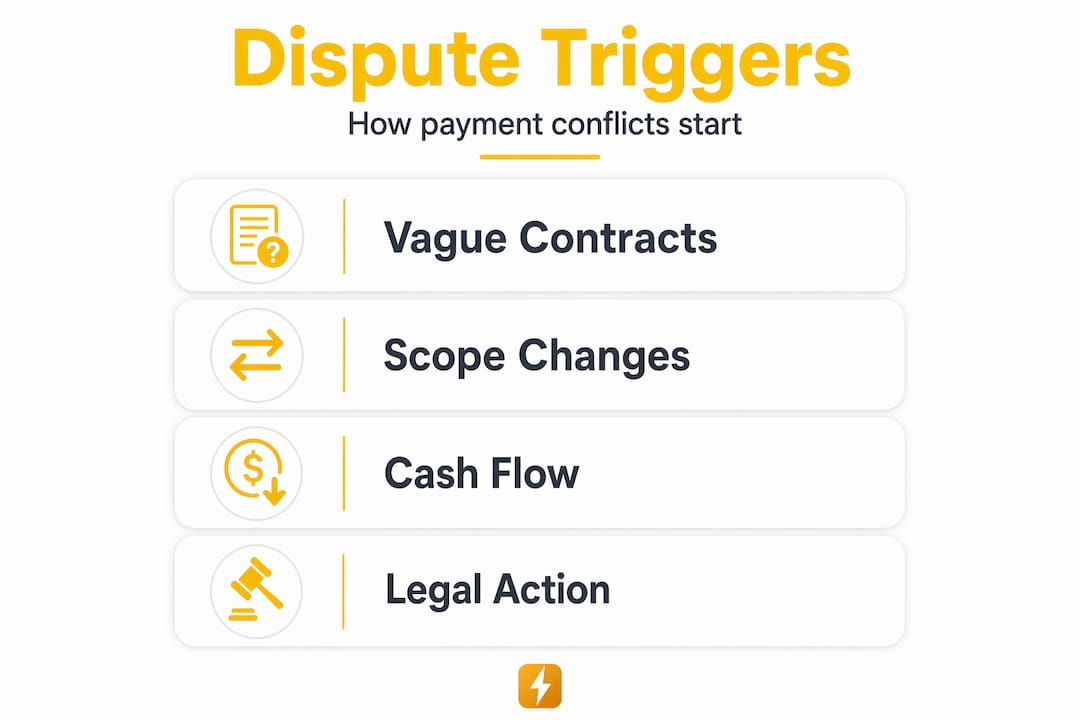
If you've ever finished a job and spent weeks chasing a check, you already know that understanding why payment disputes happen in construction is more useful than any collections script. The reality is that most contractor payment conflicts don't start when someone refuses to pay. They start weeks or months earlier, rooted in contract language, undocumented scope changes, cash flow pressure, and procedural missteps. Each of those factors compounds the others. Once you see the full picture, you can do something about it before the dispute ever lands in front of an adjudicator or attorney.
Table of Contents
- Key Takeaways
- Why payment disputes happen in construction
- Disputed work and undocumented scope changes
- Cash flow pressure and administrative delays
- Legal frameworks and dispute escalation
- Best practices to prevent payment disputes
- My take on where disputes really start
- Stop disputes before they start with Snapqualify
- FAQ
Key Takeaways
| Point | Details |
|---|---|
| Contracts create the foundation | Vague payment schedules and undefined terms are the most common trigger for construction payment issues. |
| Undocumented scope changes escalate fast | Change orders executed without written approval create entitlement gaps that derail payment applications. |
| Cash flow pressure distorts behavior | Owners and GCs sometimes withhold payment strategically, forcing contractors to finance work unpaid. |
| Legal frameworks shift negotiation leverage | Statutory adjudication laws in states and countries like Ireland set tight timelines that reward preparation. |
| Screening clients early reduces risk | Qualifying clients before mobilizing is the most underused tool for preventing contractor payment disputes. |
Why payment disputes happen in construction
Most contractors assume a payment dispute begins when a client says no. In practice, disputes often trigger from poor payment provisions and notice failures baked into contracts from day one. The dispute doesn't surface until payment application time, but the conditions were set long before a shovel hit the ground.
The causes of payment disputes in construction are rarely singular. A contract with a vague milestone payment schedule, a client under financial stress, and a foreman who verbally approved three scope changes that never got documented — those three factors together create a dispute that's nearly impossible to resolve cleanly. Knowing each root cause on its own is useful. Knowing how they interact is where you gain real control.
Here are the most common contractual pitfalls that trigger payment disagreements:
- Undefined payment schedules. Contracts that say "payment due upon completion" without specifying what completion means or what documentation is required invite disagreement.
- Missing notice requirements. Many contracts require specific written notices to preserve payment rights. If your contract requires a 14-day notice of dispute and you miss it, you may lose your legal standing entirely.
- Ambiguous scope definitions. Broad scope language like "all work necessary to complete the project" creates fertile ground for disputes over what was actually included.
- No change order procedure. If the contract doesn't define how changes are approved and priced, every verbal instruction becomes a potential entitlement gap.
Pro Tip: Before signing any contract, read every clause related to payment timing, notice procedures, and dispute resolution. If those sections are vague or missing, request a written addendum before mobilizing.
Disputed work and undocumented scope changes
Valuation disagreements are a major driver of construction industry payment problems, and they almost always trace back to what happens on-site. Unsigned or undocumented change orders executed in the field create large entitlement gaps by the time a payment application is submitted. The contractor believes additional scope was approved. The owner says it was never authorized. That gap becomes a dispute.
Here's how that sequence typically unfolds on a project:
- Verbal instruction is given. A site manager or owner representative tells a crew to perform work outside the original scope.
- Work is completed without written approval. The contractor proceeds in good faith to avoid project delays.
- Payment application is submitted. The contractor includes the additional work at the agreed or assumed rate.
- Owner disputes the line item. Without a signed change order, the owner claims the work was either included in the original scope or was never authorized.
- Dispute escalates. With no documentation, evidence-structure problems compound the situation and make resolution harder under compressed adjudication timelines.
Defective or incomplete work claims follow a similar pattern. If an owner withholds payment because of alleged defects, the contractor's ability to respond depends entirely on whether inspection records, approvals, and completion sign-offs were documented throughout the job.
Cash flow pressure and administrative delays
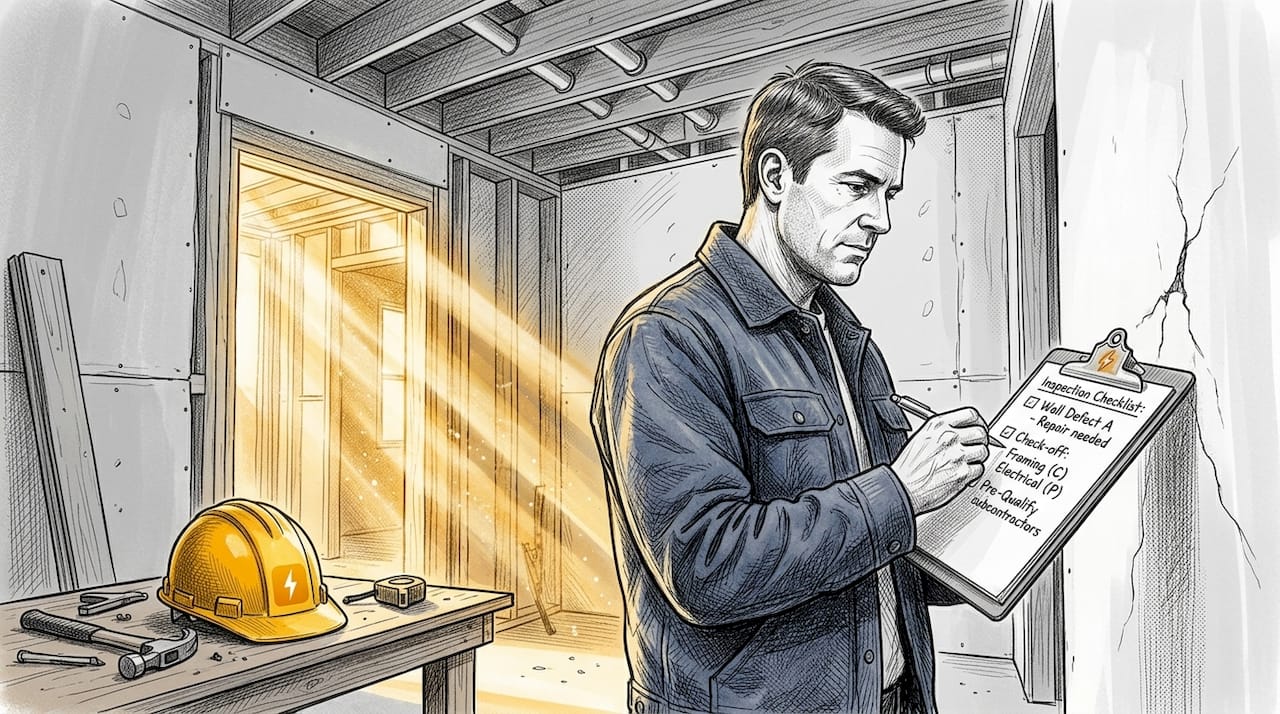
Even when contracts are solid and scope is well-documented, owner financial instability remains a leading cause of payment delays that escalate into formal disputes. An owner who ran short on financing mid-project may start disputing invoices not because the work was wrong but because the money isn't there.
Cash flow pressure also comes from the structure of construction itself. Contractors often finance work unpaid while owners and GCs hold retainage and delay certification, creating an asymmetry that intensifies conflict. The longer that imbalance persists, the more adversarial both parties become.
Other cash flow and administrative factors that fuel construction payment issues include:
- Public sector bureaucracy. Government projects often involve multi-layer payment certification that can stretch payment timelines by 60 to 90 days beyond contract terms.
- Retainage disputes. Arguments over when retainage is released and whether it applies to all work or only contested punch-list items often extend disputes for months after project completion.
- Strategic payment withholding. Some owners and general contractors deliberately delay payment to maintain leverage during final negotiations or warranty periods.
- Cascading delays to subcontractors. When a GC doesn't get paid, subs and suppliers don't get paid. That downstream effect multiplies the number of parties in a dispute and makes resolution exponentially more complex.
Legal frameworks and dispute escalation
Understanding the legal side of dispute resolution in construction gives you a clearer sense of what's actually at stake when things go wrong. Statutory adjudication regimes now exist across many jurisdictions, and they change how disputes get resolved and how quickly.
In Ireland, the Construction Contracts Act 2013 has produced 37 adjudications in 12 months covering €31.5 million in disputed amounts. Referral must happen within 7 days, and payment is due within 7 days of the adjudicator's decision. That's a fast-track process that rewards whoever is better prepared. In California, SB 440 entitles contractors to suspend work for nonpayment and mandates 2% interest per month on undisputed amounts, a statutory remedy that intensifies leverage considerably.
Legal procedure disputes often underpin payment disputes, with outcomes depending on notice compliance and statutory interpretation more than the merits of the work itself.
Here's a quick comparison of key jurisdiction frameworks:
| Framework | Key provision | Timeline |
|---|---|---|
| Ireland Construction Contracts Act 2013 | Statutory adjudication for disputes | Referral in 7 days, payment in 7 days post-decision |
| California SB 440 | Work suspension right for nonpayment | 2% monthly interest on undisputed amounts |
| General contract adjudication | Varies by contract and state law | Typically 28 to 56 days for adjudication |
One critical nuance: fast-track legal tools don't automatically win disputes. The Irish High Court has rejected simplistic procedural adjudications, confirming that solid entitlement arguments, not just timing compliance, drive outcomes.
Best practices to prevent payment disputes
Preventing frequent payment disputes starts before the contract is signed and requires discipline throughout the project lifecycle. Here's what actually works:
- Set clear payment expectations upfront. Define milestone payments with specific deliverables tied to each one. "Framing complete" is clearer than "first phase done."
- Document every scope change in writing. Even a quick email confirmation from the client counts. No verbal approvals.
- Send interim notices early. If a payment is late, send a written notice within the timeframe your contract requires. Don't wait until you're owed three months of work.
- Audit contract compliance at each phase. Review documentation requirements before submitting each pay application, not after it gets rejected.
- Identify warning signs before you start. Clients who are vague about budget, reluctant to sign a written contract, or unclear about decision-making authority are frequent payment dispute risks before the job begins.
Pro Tip: Review the scope creep prevention guide before your next project kickoff meeting. Unchecked scope expansion is one of the fastest routes to a payment dispute.
My take on where disputes really start
I've seen contractors go into adjudication with solid legal grounds and still lose because they couldn't produce a signed change order or a dated inspection record. The dispute wasn't lost during the hearing. It was lost on-site, three months earlier, when someone decided the paperwork could wait.
The most common misconception I encounter is that payment disputes are fundamentally about money. Most of them are actually about entitlement. The question isn't whether the work was done. It's whether the right to be paid for that specific work was properly established under the contract. Execution-stage drivers like undocumented variations and payment delays consistently produce more formal disputes than anything in the pre-contract phase.
What I've learned is that the contractors who rarely end up in disputes are usually the ones who screen clients carefully before signing, document relentlessly during the job, and send written notices the moment something looks wrong. None of that is complicated. But it requires treating every project like the contract will end up in front of an adjudicator, because sometimes it does.
— Colin
Stop disputes before they start with Snapqualify
Knowing why construction payments fail is only half the equation. The other half is knowing which clients are likely to cause problems before you commit time and resources to a quote.
Snapqualify is built specifically for trade contractors who want to stop chasing payments and start working with clients who are financially prepared and professionally realistic. The platform screens potential clients through intelligent intake forms and generates a color-coded SnapScore that signals reliability before you ever set foot on site. You get a clear picture of project scope, budget, and client experience, so you can make confident decisions faster. Visit Snapqualify to see how client screening can protect your cash flow on the next project.
FAQ
What are the most common causes of payment disputes in construction?
Disputes most often stem from unclear contract terms, missing payment notices, undocumented scope changes, and owner financial instability. These factors compound each other, making disputes harder to resolve the longer they go unaddressed.
How do undocumented change orders lead to contractor payment conflicts?
When scope changes are verbally approved but not recorded in writing, contractors lose the documented entitlement needed to support payment applications. Without a signed change order, owners can dispute or reject those line items entirely.
Can contractors suspend work if they aren't getting paid?
In some jurisdictions, yes. California SB 440 gives contractors the right to suspend work for nonpayment and requires 2% monthly interest on undisputed amounts that are withheld. Rights vary by state and contract terms, so reviewing your local statutory protections is always worth doing.
How does adjudication work for construction payment disputes?
Adjudication is a fast-track process where an independent adjudicator reviews the dispute and issues a binding decision. In Ireland, referral must happen within 7 days of a dispute arising, and payment is due within 7 days of the adjudicator's decision, making preparation and documentation critical to a successful outcome.
What's the best way to avoid payment disputes on construction projects?
Clear contracts with defined milestone payments, written change order procedures, and proactive client screening are the most effective prevention tools. Identifying financially unstable or scope-ambiguous clients before mobilizing removes the most common dispute triggers before work begins.