

AI lead screening is the automated process of capturing, enriching, scoring, and routing inbound prospects before a contractor ever picks up the phone. Platforms like Plura AI, Onsa AI, and Kvoka have built this into structured workflows that evaluate leads on fit, intent, and timing simultaneously. The result: contractors who understand how AI screens specialty trade leads stop wasting hours on tire-kickers and start closing the jobs worth taking. Automated AI systems respond in under 5 seconds, preventing up to 70% of conversion loss caused by slow follow-up.
How does the AI lead screening process work for trade contractors?
The AI lead screening process follows five distinct steps from first contact to routing decision.
-
Lead capture triggers. A prospect fills out a form, starts a chat, or calls in. The AI captures that signal instantly across web, SMS, and phone channels. No lead sits in a queue waiting for a human to notice it.
-
Real-time enrichment. The system pulls data from third-party sources to fill gaps in the lead profile. Project history, company size, location, and budget signals are added automatically. 50% of sales reps abandon leads with incomplete profiles, so enrichment is the single most impactful step before scoring begins.
-
Conversational qualification. An AI bot asks targeted follow-up questions across the channel the prospect already uses. It collects scope details, timeline, and budget without requiring a human to run the intake call.
-
Scoring with the Fit + Intent + Timing framework. The Fit + Intent + Timing model scores each lead on a 0–100 scale. Leads above 75 go straight to a human for immediate follow-up. Leads below 25 enter an automated nurture sequence instead of being discarded.
-
Routing. High-scoring leads reach your sales workflow within seconds. Lower-scoring leads get a structured follow-up sequence. Nothing falls through the cracks.
Pro Tip: Set up your intake form to ask about project scope, budget range, and preferred start date. Those three data points feed directly into Fit, Intent, and Timing scores and give the AI enough signal to route accurately from day one.
AI lead scoring vs. traditional qualification: what is the real difference?
Traditional lead qualification relies on static rules and manual follow-up. A rep reviews a form, calls the number, and decides based on gut feel and a short checklist. That process is slow, inconsistent, and impossible to scale.
AI models work differently. They analyze hundreds of dynamic signals at once, including behavioral data like page visits and time on site, firmographic data like business type and project history, and conversational signals from the intake exchange. The model also improves over time. Every closed deal trains the system to recognize what a good lead actually looks like for your specific trade.

| Factor | Traditional Qualification | AI Lead Screening |
|---|---|---|
| Speed | Hours to days | Under 5 seconds |
| Data sources used | 1–3 manual inputs | Dozens of enriched signals |
| Consistency | Varies by rep | Uniform scoring every time |
| Improvement over time | Depends on rep experience | Learns from every closed deal |
| Cost per qualified lead | High (rep labor) | Reduced by 4–8 times |
The limitations of AI are real too. Inconsistent CRM data is the primary cause of AI failure in trades. If your contact records are messy or incomplete, the model scores against bad inputs and produces bad outputs. AI also requires 6–10 weeks to deploy properly, including taxonomy definition and confidence threshold calibration.
- AI outperforms manual methods on speed, consistency, and cost per lead
- Traditional methods still have an edge when relationship context matters most
- Data quality determines whether AI delivers or disappoints
- Intake forms are the foundation that feeds accurate data into any AI scoring model
What business results can specialty trade contractors expect from AI screening?
The performance gap between AI-qualified leads and shared lead marketplaces is significant. AI-driven funnel optimization for trade contractors produces closing rates of 25–40%, compared to 3–7% from typical shared-lead platforms. That gap reflects the difference between a lead who has been pre-qualified for your specific scope and budget versus a name sold to five contractors at once.
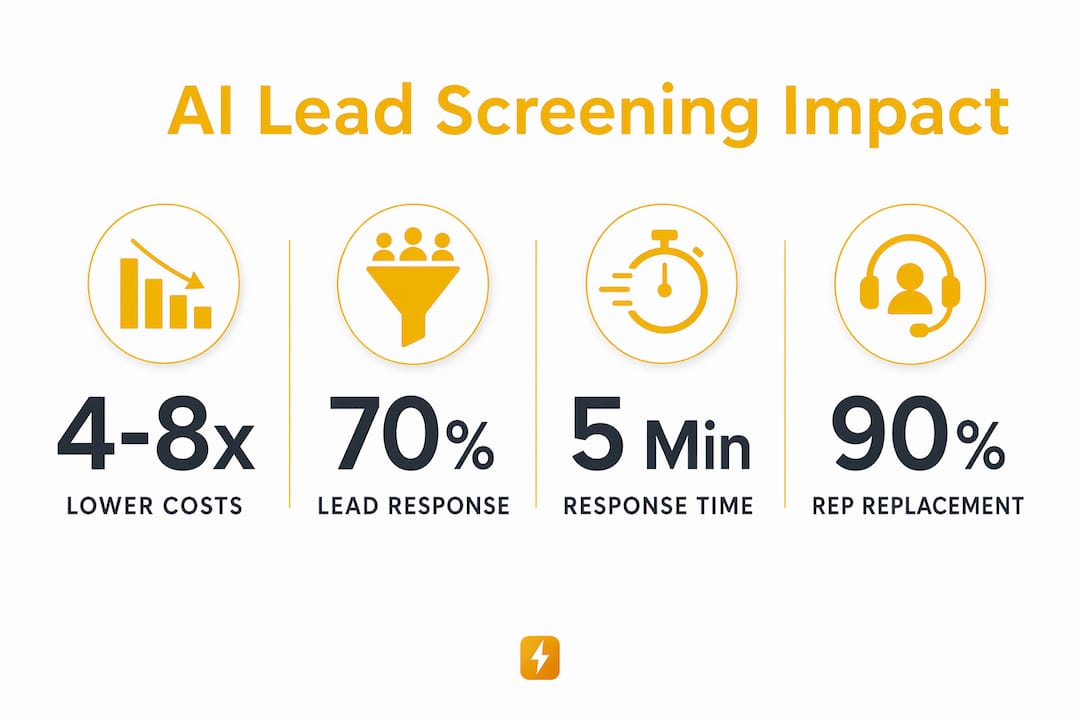
Cost efficiency follows the same pattern. AI-qualified funnels lower cost-per-customer by 4–8 times compared to traditional lead generation. For a roofer or HVAC technician spending $300 per acquired customer today, that math changes the entire business model.
Speed matters more than most contractors realize. Responding to a lead within five minutes versus thirty minutes can determine whether you get the job or lose it to a competitor. Automated follow-up prevents the conversion drop that happens when leads go cold. AI also reduces the need for dedicated sales development staff, which is a real cost saving for small trade businesses running lean teams.
What are the best practices for implementing AI lead screening in your trade business?
Getting AI lead screening right requires preparation before you flip the switch. Most failed implementations trace back to skipping the groundwork.
-
Define your ideal customer profile first. Know the project size, geography, budget range, and client type that produces your best jobs. The AI scores against this profile. If you have not defined it clearly, the model has nothing to calibrate against.
-
Run a data quality audit. Pull your CRM records and check for missing fields, duplicate contacts, and outdated project notes. Poor data quality is the leading cause of AI qualification failures in trades. Clean data before activation, not after.
-
Use a human-in-the-loop approach for the first 2–3 weeks. Human oversight during calibration improves sales acceptance rates and catches threshold errors before they affect real leads. Have a team member review AI routing decisions daily and flag mismatches.
-
Choose the right channel for conversational qualification. SMS works well for residential trades. Web chat fits commercial inquiries. Match the channel to how your best clients already communicate.
-
Use enrichment to recover abandoned leads. When a prospect submits a partial form, enrichment fills the gaps automatically. This recovers leads that would otherwise be ignored because the profile looked incomplete.
Pro Tip: When qualifying roofing leads from calls, record the key signals your best reps use to say yes or no. Feed those signals into your AI scoring criteria. The model learns faster when it starts with your real-world judgment built in.
Key takeaways
AI lead screening delivers the highest return when contractors combine clean data, a defined ideal customer profile, and a structured scoring framework before full automation goes live.
| Point | Details |
|---|---|
| Speed drives conversion | AI responds in under 5 seconds, preventing up to 70% of conversion loss from slow follow-up. |
| Enrichment before scoring | Fill incomplete lead profiles automatically before scoring to avoid abandoned leads and bad outputs. |
| Fit + Intent + Timing model | Score leads 0–100 and route above 75 to humans, below 25 to nurture sequences. |
| AI outperforms shared leads | AI-qualified funnels close at 25–40% versus 3–7% on shared lead marketplaces. |
| Data quality is the prerequisite | Clean your CRM before deployment. Poor data is the top cause of AI screening failure in trades. |
The part most contractors get wrong about AI screening
Most contractors I talk to think AI lead screening is just a smarter contact form. They expect to plug it in, watch it sort leads, and move on. That misses the real capability entirely.
The feature that actually changes outcomes is stateful memory. A well-built AI system remembers every interaction a prospect has had across every channel. When that homeowner calls after filling out your web form, the AI already knows their project scope, budget signal, and timeline. No repeated questions. No frustrated prospects who feel like they are starting over.
The second mistake is treating AI as a replacement for judgment rather than a multiplier of it. The contractors who get the best results use AI to handle volume and consistency, then apply their own experience to the leads the system flags as high priority. That combination is where the real closing rate improvement shows up.
My honest advice: do not wait until you have a perfect CRM or a dedicated operations person to start. Run the human-in-the-loop phase yourself for the first few weeks. You will learn more about your own lead patterns in three weeks of AI-assisted review than you have in years of manual follow-up.
— Colin
See how Snapqualify screens leads for trade contractors
Snapqualify is built specifically for trade contractors who need faster, more reliable lead qualification without adding headcount. The platform uses intelligent intake forms and AI-powered risk analysis to generate a color-coded SnapScore for every prospect, giving you a clear read on client reliability and project fit before you commit time to a site visit.
Every lead that comes through Snapqualify gets evaluated on scope, budget, and project history, the same signals that feed professional AI scoring models. Your data stays protected under Snapqualify's security protocols, so you qualify leads with confidence. If you are ready to stop chasing the wrong jobs, explore what Snapqualify's lead qualification tools can do for your business today.
FAQ
What is the fit + intent + timing framework?
The Fit + Intent + Timing model is the industry-standard scoring framework that rates leads on a 0–100 scale across three dimensions. Leads above 75 receive immediate human follow-up, while leads below 25 enter automated nurture sequences.
How long does it take to deploy AI lead screening?
A proper AI lead qualification deployment for construction trades takes 6–10 weeks, covering taxonomy definition, data preparation, and confidence threshold calibration across 15–25 test evaluation cycles.
Why do AI lead screening systems fail?
Inconsistent or incomplete CRM data is the primary cause of AI failure. Running a data audit and enrichment process before activation is the most important step to prevent poor scoring outcomes.
Can AI screening replace my sales team?
AI can replace up to 9 out of 10 sales development representatives for inbound qualification tasks while maintaining the same conversion rates. Human judgment remains critical for high-value lead follow-up and relationship-based closing.
What closing rates can i expect with ai-qualified leads?
AI-optimized funnels for specialty trade contractors produce closing rates of 25–40%, compared to 3–7% on shared lead marketplaces. The difference comes from pre-qualification against your specific scope and budget criteria.