

Qualifying homeowners for large projects is defined as the structured process of verifying a homeowner's financial capacity, legal standing, and project readiness before a contractor commits time and resources. Skipping this step is the single fastest way to end up with a stalled project, a disputed contract, or an unpaid invoice. The good news: a repeatable vetting process built around clear eligibility criteria, written documentation, and tools like Snapqualify's AI-powered intake forms puts you in control before the first shovel hits the ground.
What eligibility criteria should contractors use to qualify homeowners for large projects?
Homeowner project eligibility rests on three pillars: financial capacity, legal authority, and project readiness. Each one carries equal weight. A homeowner who owns the property outright but cannot demonstrate funding is just as risky as one with cash but no clear title.
Financial capacity is the most common failure point. Ask for proof of funds, a financing pre-approval letter, or a construction loan commitment before you invest time in a detailed bid. Contractor markup over 40% signals price inflation risk, and a homeowner who cannot read a quote is unlikely to manage a large project budget responsibly. Financial clarity protects both sides.

Legal authority covers ownership and permits. Verify the homeowner's name appears on the deed. Confirm they have the authority to pull permits for the scope of work planned. Contractors who skip this step sometimes complete work on a property the client does not legally control, creating serious liability exposure.
Project readiness is where most homeowners underestimate themselves. Key readiness indicators include:
- A written scope of work, not just a verbal description
- Prior experience managing contractors or renovation projects
- Realistic timeline expectations tied to permit lead times
- Insurance coverage that protects the property during construction
- A designated point of contact who can make decisions on site
Contractors prioritize clients who present organized projects and clear scopes. That preference is not arbitrary. Organized homeowners reduce delays, disputes, and scope creep.
What tools and documentation help verify homeowner qualifications?
Standardized tools remove guesswork from the qualification process. The most practical starting point is a structured self-assessment that forces homeowners to evaluate their own readiness before you ever meet them.
The 60-point Reno-Ready Home Score is one example of this approach. It uses a color-coded scale to flag risk: green (45–60 points) indicates a project-ready home, yellow (30–44 points) signals issues worth investigating, and a score below 30 indicates serious underlying problems requiring professional evaluation before any renovation begins. That scoring framework gives you an objective starting point for the conversation.
Beyond self-assessments, collect and review these documents in order:
- Proof of ownership (deed or title document)
- Proof of funds or financing pre-approval (bank statement, loan commitment letter)
- Homeowner's insurance certificate confirming active coverage during construction
- Permit history for the property, pulled from the local building department
- Signed disclosure form confirming the homeowner understands scope, timeline, and payment terms
A simple qualification scorecard helps you compare homeowners across projects. The table below shows a practical scoring framework:
| Qualification factor | Green (low risk) | Red (high risk) |
|---|---|---|
| Proof of funds | Pre-approval or cash on hand | Verbal assurance only |
| Property ownership | Name on deed confirmed | Unverified or third party |
| Insurance coverage | Active COI provided | Expired or none |
| Scope of work | Written and detailed | Vague or verbal |
| Prior project experience | Managed 1+ renovations | No prior experience |
Pro Tip: Ask homeowners to complete your intake questionnaire before the first site visit. Homeowners who refuse or delay are signaling a pattern you will see throughout the project.
Step-by-step process for vetting homeowners before large projects
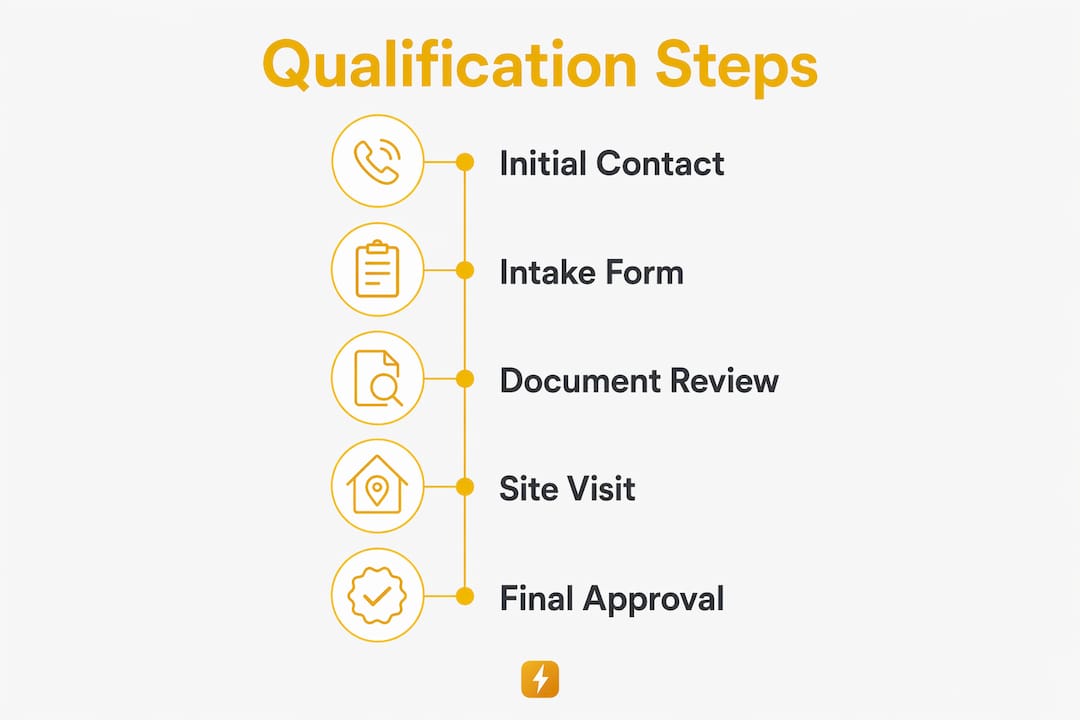
A repeatable process is what separates contractors who rarely have payment disputes from those who constantly chase checks. Follow these steps in sequence.
-
Send a pre-qualification intake form. Collect basic project details, budget range, timeline, and ownership confirmation before any in-person meeting. Snapqualify's intake forms automate this step and generate a color-coded SnapScore based on the homeowner's responses.
-
Review financial documents. Request proof of funds or financing within 48 hours of the initial inquiry. Written bids must itemize materials, labor, permits, and payment terms. A homeowner who cannot provide funding documentation at this stage is not ready for a large project.
-
Verify legal standing. Confirm the homeowner's name on the deed matches the name on your contract. Check the local building department's portal for any open permits or code violations on the property.
-
Confirm insurance. Call the insurer directly to verify active general liability and homeowner's coverage. Do not rely solely on a certificate of insurance. Policies lapse, and a lapsed policy becomes your liability.
-
Conduct a site visit. Walk the property with the homeowner present. Note any conditions that contradict what was described in the intake form. Discrepancies between the form and the site are a major red flag.
-
Score and decide. Use your qualification scorecard to assign a risk level. Communicate your decision clearly. If the homeowner does not meet your criteria, say so in writing and explain what they need to provide before you can proceed.
Pro Tip: Tie your final contract to milestone-based payments rather than a lump sum. Deposits over 25% of the total project cost indicate cash-flow risk on the homeowner's side.
Common pitfalls when assessing homeowners for projects
The most expensive mistakes in homeowner qualification are not complex. They are simple oversights that feel harmless in the moment.
- Accepting verbal assurances as proof. A homeowner who says "the money is ready" without documentation is not financially qualified. Verbal commitments do not hold up when a project stalls.
- Ignoring documentation inconsistencies. If the name on the deed does not match the contract signatory, stop. Do not proceed until the discrepancy is resolved in writing.
- Failing to match criteria to project scope. A $15,000 bathroom remodel and a $200,000 addition require different levels of scrutiny. Scale your qualifying criteria to the complexity and dollar value of the work.
- Skipping lien waiver requirements. Requiring signed lien waivers from subcontractors with each payment reduces the risk of liens being placed on the homeowner's property. Most homeowners do not know to ask for this. You should.
"Most contractor disputes arise from miscommunication. A precise scope document is the most effective qualifying tool you have. If the homeowner cannot or will not commit to a written scope, that tells you everything you need to know before you sign anything."
Borderline cases require a direct conversation, not a guess. If a homeowner scores in the yellow zone on your assessment, ask specific follow-up questions. Request additional documentation. Give them a clear path to qualification rather than a vague rejection. That approach protects your reputation and sometimes converts a borderline lead into a well-prepared client.
Key takeaways
Qualifying homeowners before large projects is the most reliable way to avoid scope creep, payment disputes, and project failure.
| Point | Details |
|---|---|
| Financial proof is non-negotiable | Require written proof of funds or financing before investing time in a detailed bid. |
| Legal authority must be verified | Confirm the homeowner's name on the deed matches every contract document. |
| Use a scoring tool | A structured scorecard or self-assessment removes subjectivity from your decision. |
| Match criteria to project size | A $200,000 addition requires deeper vetting than a small remodel. |
| Milestone payments reduce risk | Structure payments to project milestones and cap deposits at 25% of total cost. |
What I've learned from years of watching qualification go wrong
The contractors I respect most share one habit: they qualify the homeowner as rigorously as the homeowner qualifies them. That mindset shift changes everything.
Most people in this industry treat qualification as a formality. They collect a signature and move on. The problems show up six weeks later when the homeowner runs out of funds, disputes the scope, or disappears when the final invoice arrives. By then, you have already spent your labor, your materials, and your goodwill.
The detail that surprises most contractors is how much a structured intake process improves the quality of clients who actually follow through. When you send a homeowner a detailed questionnaire and ask for documentation upfront, the disorganized ones self-select out. The serious ones complete it quickly and come to the first meeting prepared. That filter alone is worth more than any contract clause.
The 2026 standard for evaluating homeowner readiness is moving toward automated intake and AI-assisted scoring. That is not a trend to resist. It is a tool that gives you a defensible, consistent process every time. Use it.
— Colin
Snapqualify makes homeowner qualification faster and more reliable
Contractors who use Snapqualify's platform send homeowners a branded intake form before the first site visit. The form collects project scope, budget, timeline, and experience details. Snapqualify's AI then analyzes the responses and generates a color-coded SnapScore that flags risk in seconds.

That score gives you a clear starting point for every client conversation. No more gut-feel decisions. No more chasing documentation after the project starts. Snapqualify integrates into your existing workflow and works for roofers, electricians, plumbers, HVAC technicians, painters, and general contractors. If you want a repeatable way to screen clients for renovations and protect your business from problem projects, Snapqualify is built for exactly that. Visit snapqualify.com to see how the platform works.
FAQ
What are the most important criteria for homeowner project eligibility?
Financial proof, legal ownership, and a written scope of work are the three core criteria. A homeowner who cannot provide all three is not ready for a large project.
How do I verify a homeowner's insurance coverage?
Call the insurer directly to confirm active general liability and homeowner's coverage. Certificates of insurance can reflect lapsed policies, so direct verification is the only reliable method.
What is a Reno-Ready Home Score?
The Reno-Ready Home Score is a 60-point self-assessment that rates a home's renovation readiness. Scores below 30 indicate serious issues requiring professional evaluation before any work begins.
How should I structure payments for large home improvement projects?
Tie payments to clear project milestones rather than a lump sum schedule. Deposits over 25% of the total project cost signal cash-flow risk on the homeowner's side.
What is the fastest way to qualify homeowners before quoting?
Send a structured intake form before the first site visit. Platforms like Snapqualify automate this step and generate a risk score from the homeowner's responses, saving you hours of manual vetting.