

Screening clients for renovation projects is the process of evaluating potential clients before committing your time, materials, or crew to determine whether they are a realistic, reliable, and well-aligned fit for the work ahead. Skip this step and you risk scope creep, late payments, and projects that stall halfway through. A structured screening process is the single most effective way to protect your business from unsuitable clients and set every project up for a clean finish. The industry standard for client assessment for renovations has evolved significantly, and the best contractors now treat qualification as a formal step, not an afterthought.
What criteria should you use to screen potential renovation clients?
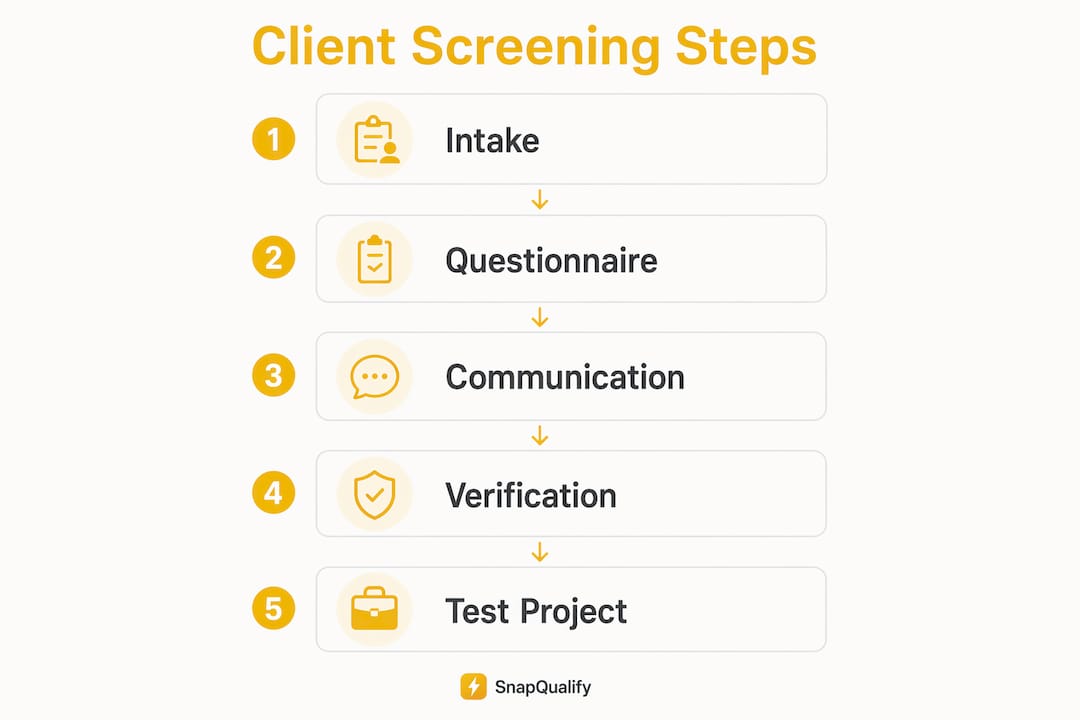
Client assessment for renovations starts with five core criteria. Each one signals whether a project is worth pursuing or likely to become a problem.
- Project scope clarity. A client who cannot describe what they want in specific terms is not ready. Vague scope at the start becomes change orders and disputes later.
- Budget realism. The client's stated budget should align with the actual cost of the work they are describing. If there is a significant gap, address it before the first site visit.
- Timeline flexibility. Clients who demand unrealistic deadlines without understanding permit lead times or material availability create pressure that leads to shortcuts.
- Client experience level. First-time renovation clients need more hand-holding. That is not a disqualifier, but it does affect your pricing, communication plan, and contract terms.
- Communication responsiveness. How quickly and clearly a client responds to your initial inquiry tells you a great deal. Communication quality during vetting is the strongest predictor of renovation success, and early red flags rarely disappear once work begins.
Pro Tip: Send a brief intake questionnaire before your first call. Clients who complete it promptly and with detail are signaling engagement. Clients who ignore it or give one-word answers are showing you exactly how the project will go.
Renovation project vetting does not require a lengthy process. A focused intake form covering scope, budget, timeline, and prior renovation experience takes a client under ten minutes to complete and gives you the data you need to make a confident decision.
How to verify client credentials and project feasibility
Once a client passes your initial criteria check, verification is the next step. This is where you confirm that what they told you matches reality.
- Collect written bids or proposals. Getting 3 to 5 written bids is the industry standard for cost-effective market comparison. Fewer than three bids may leave you without enough context to price competitively. More than five suggests the client is price shopping rather than selecting on value.
- Verify funding or financing. Ask directly whether the client has funds available or is financing the project. A client with pre-approved financing or confirmed savings is far less likely to delay payments at milestone stages.
- Check permit history. Experienced contractors review permit history to gauge client readiness. Homeowners who have filed permits before show higher project commitment and understand the regulatory process.
- Request references from similar projects. Check 2 to 3 references from comparable work completed within the last 12 to 24 months. Recent references from similar project types give you the most accurate picture of how this client operates.
- Order a pre-renovation structural assessment. Pre-renovation structural assessments costing $500 to $1,500 can prevent large unforeseen expenses by identifying structural and mechanical issues before you commit. That cost is minor compared to discovering a foundation problem mid-project.
Pro Tip: Propose a small paid test interaction before signing a full contract. A small paid test project effectively evaluates a client's working style, communication, and reliability at low risk. Think of it as a trial run for both sides.
A feasibility study early in the project also protects you from rushing into commitments without a full understanding of constraints and costs. Experts consistently warn that skipping this step leads to expensive mistakes that could have been avoided in the first week.
What are the best practices for communication screening?
Communication screening is where most contractors lose money. They focus on the numbers and ignore the signals. Here is what to watch for during your client qualification process.
Green flags in client communication:
- Responds to messages within 24 hours during the inquiry phase
- Asks specific, informed questions about scope, materials, or process
- Provides complete answers when you ask for project details
- Acknowledges your timeline and budget constraints without pushback
Red flags that predict future problems:
- Evasive or vague answers about budget when asked directly
- Unrealistic demands framed as non-negotiable ("I need this done in two weeks, no exceptions")
- Dismissiveness toward your intake process or contract requirements
- Inconsistent information across different conversations
Red flags in client communication during pre-contract vetting should never be ignored. They predict future issues with near-certainty. A client who is difficult to communicate with before you have started work will be significantly harder to manage once you are on site and money is changing hands.
Use checkpoint interactions deliberately. Send a follow-up email after your first call summarizing what was discussed and ask the client to confirm. This single step reveals whether they read carefully, respond accurately, and take the process seriously. For a deeper look at specific warning signs, the contractor client red flags checklist from Snapqualify covers 15 patterns worth reviewing before you sign anything.

Tools and frameworks for client screening
Manual screening works, but it is inconsistent. The quality of your client selection depends entirely on whether you remember to ask the right questions every time. A systematic framework removes that variable.
| Screening method | Best for | Key limitation |
|---|---|---|
| Written bid collection | Comparing project scope and pricing | Time-intensive; requires 3 to 5 bids minimum |
| Reference checks | Verifying past client behavior | Only as reliable as the references provided |
| Communication evaluation | Predicting project management fit | Subjective without a structured scoring system |
| Digital intake platforms | Automating qualification at scale | Requires initial setup and client adoption |
| Permit history review | Confirming client seriousness | Not available in all jurisdictions |
Digital platforms like Snapqualify automate the intake and scoring process. Clients complete a branded online form covering project scope, budget, timeline, and experience. The platform's AI analysis generates a color-coded SnapScore that indicates client reliability and project suitability before you spend an hour on a site visit. For contractors managing multiple leads simultaneously, this kind of automated client qualification for projects is the difference between a full pipeline and a chaotic one.
A manual checklist still has its place for smaller operations. At minimum, your client selection process for remodeling should cover:
- Written project description from the client
- Confirmed budget range with funding source noted
- Timeline expectations documented
- At least two references contacted directly
- Permit status confirmed for the relevant work type
Pro Tip: Document every screening interaction. Date-stamped notes from intake calls and email threads become your protection if a client later disputes what was agreed before the contract was signed.
For contractors who also vet subcontractors alongside clients, vetting both parties together using a unified framework reduces gaps and keeps your qualification process consistent across every project.
Key takeaways
Effective client screening for renovation projects requires structured criteria, verified credentials, and deliberate communication evaluation applied consistently before any contract is signed.
| Point | Details |
|---|---|
| Start with five core criteria | Assess scope clarity, budget realism, timeline, experience level, and communication responsiveness upfront. |
| Verify beyond the conversation | Confirm funding, check permit history, and contact 2 to 3 recent references from similar projects. |
| Treat communication as data | Response speed, specificity, and consistency during intake predict how a client will behave on site. |
| Use structural assessments early | A $500 to $1,500 pre-renovation assessment prevents costly surprises after work has begun. |
| Systematize with digital tools | Platforms like Snapqualify automate scoring and reduce inconsistency in your qualification process. |
Why I stopped trusting my gut on client screening
After years of watching projects go sideways, I can tell you the pattern is almost always the same. The contractor had a bad feeling early on, ignored it, and paid for it later. I have seen it happen with budget disputes, scope explosions, and clients who disappeared when the final invoice arrived.
The contractors who avoid these situations are not better judges of character. They are more disciplined about process. They ask the same questions every time, document the answers, and let the data make the call instead of their instincts. Rushing to narrow client options too early is one of the most expensive mistakes in this industry. Thorough upfront information gathering consistently improves outcomes.
The detail most people overlook is permit history. A homeowner who has navigated permits before understands that projects take time, cost more than expected, and require cooperation. That mindset makes every conversation easier. A homeowner who has never pulled a permit often has no frame of reference for how construction actually works, and that gap shows up in every interaction from week two onward.
Do the screening. All of it. It feels like extra work until the first time it saves you from a six-figure dispute.
— Colin
See how Snapqualify handles client screening for you
Snapqualify is built specifically for trade contractors and home services businesses that need a faster, more consistent way to qualify leads. Clients complete a branded intake form covering project scope, budget, timeline, and experience. Snapqualify's AI analysis then generates a SnapScore that tells you at a glance whether a client is a strong fit or a risk worth reconsidering. You get the information you need before the first site visit, not after you have already invested hours. Snapqualify also takes data protection seriously, so every client response is handled with the security your business requires. Stop guessing and start qualifying with confidence.
FAQ
What does it mean to screen clients for renovation projects?
Screening clients for renovation projects means evaluating a potential client's scope clarity, budget, timeline, and communication style before committing to a contract. The goal is to confirm project suitability and reduce the risk of disputes, late payments, or scope creep.
How many bids should I collect before selecting a contractor or client?
The industry standard is 3 to 5 written bids. Fewer than three provides insufficient market comparison, while more than five typically signals price shopping rather than value-based selection.
What are the biggest red flags during client screening?
Evasiveness about budget, unrealistic timeline demands, and slow or inconsistent communication during the inquiry phase are the strongest predictors of future project problems. These patterns rarely improve once work begins.
Should I conduct a structural assessment before starting a renovation?
A pre-renovation structural assessment costing $500 to $1,500 is worth the investment on any project involving structural or mechanical systems. It identifies hidden issues before they become expensive mid-project surprises.
Can digital tools replace manual client screening?
Digital platforms like Snapqualify automate intake and scoring but work best alongside, not instead of, direct reference checks and permit history reviews. Automation handles consistency; human verification handles depth.