

Cash flow is the difference between a profitable contracting business and one that closes its doors despite a full project schedule. To improve cash flow as a small contractor, you need to control three things: how fast money comes in, how long it stays tied up in retainage or receivables, and how clearly you can see what's coming next. Most contractors lose ground not because of bad projects but because of late invoicing, weak deposit systems, and no real forecasting. Tools like Joist, Stripe, and structured payment schedules exist precisely to fix these gaps. This guide covers the specific cash management strategies that move the needle fastest.
How can faster invoicing and payment terms improve contractor cash flow?
The single fastest way to improve cash flow in a small contracting business is to send invoices the same day or the next day after completing work. Invoicing latency is treated by experienced contractors as a primary cash flow leak, not a minor administrative delay. Every day you wait to bill is a day added to your collection cycle, and that compounds across every job you run simultaneously.
Here are the steps to tighten your invoicing process:
- Invoice on completion. Set a rule: no job closes without an invoice sent that day. Use mobile field software like Joist or Jobber to generate and send invoices from the job site before you drive away.
- Shorten your payment terms. Net 30 is the default, but net 15 is better. Net 7 is appropriate for smaller residential jobs. Shorter terms create urgency without damaging client relationships when they are set upfront.
- Offer an early payment discount. An early payment discount of 2% within 10 days costs less than carrying a credit line and motivates clients who have the cash to pay quickly.
- Automate follow-ups. Set automated reminders at 3 days before due, on the due date, and 3 days after. Most clients pay late because no one reminded them, not because they intended to stiff you.
- Confirm receipt. After sending an invoice, call or text to confirm the client received it. This one step eliminates the "I never got it" excuse and starts the clock officially.
Pro Tip: If you are still emailing PDF invoices manually, you are adding 24 to 48 hours to every collection cycle. Platforms like Joist or Jobber send invoices instantly from the field and log every view and payment, giving you a paper trail without the paperwork.
What role does retainage play and how can you manage it?

Retainage typically ranges from 5% to 10% withheld from every progress payment, and it can sit locked for months after your crew has finished and moved on. On a $200,000 project with 10% retainage, that is $20,000 you cannot touch until the owner signs off. If you are financing materials or payroll in the meantime, that retainage is costing you real money in interest.
Retainage is not just a contractual formality. It is a tangible cost of capital that requires planning from the moment you sign the contract. Here is how to manage it:
- Negotiate the percentage before signing. Push for 5% instead of 10% on residential work. Many owners agree when you frame it as standard practice for experienced contractors.
- Request milestone-based release. Instead of waiting for full project completion, negotiate retainage release tied to specific milestones: rough-in complete, inspections passed, punch list signed off.
- Track every retainage balance. Use a simple spreadsheet or your accounting software to log retainage held per project, the expected release date, and the contact responsible for approving it.
- Schedule release reminders. Set a calendar alert 30 days before expected retainage release to begin the approval conversation early. Owners forget. You cannot afford to.
- Factor retainage into your bid. If you know 10% will be held for 90 days, price that carrying cost into your overhead. Treating retainage as free money is how contractors end up cash-strapped on profitable jobs.
Pro Tip: On larger commercial jobs, ask whether a retention bond can replace withheld cash. A retention bond protects the owner while releasing your cash immediately. Not every GC will agree, but it is worth asking on any job over $100,000.
How to build cash flow forecasting and track the right metrics
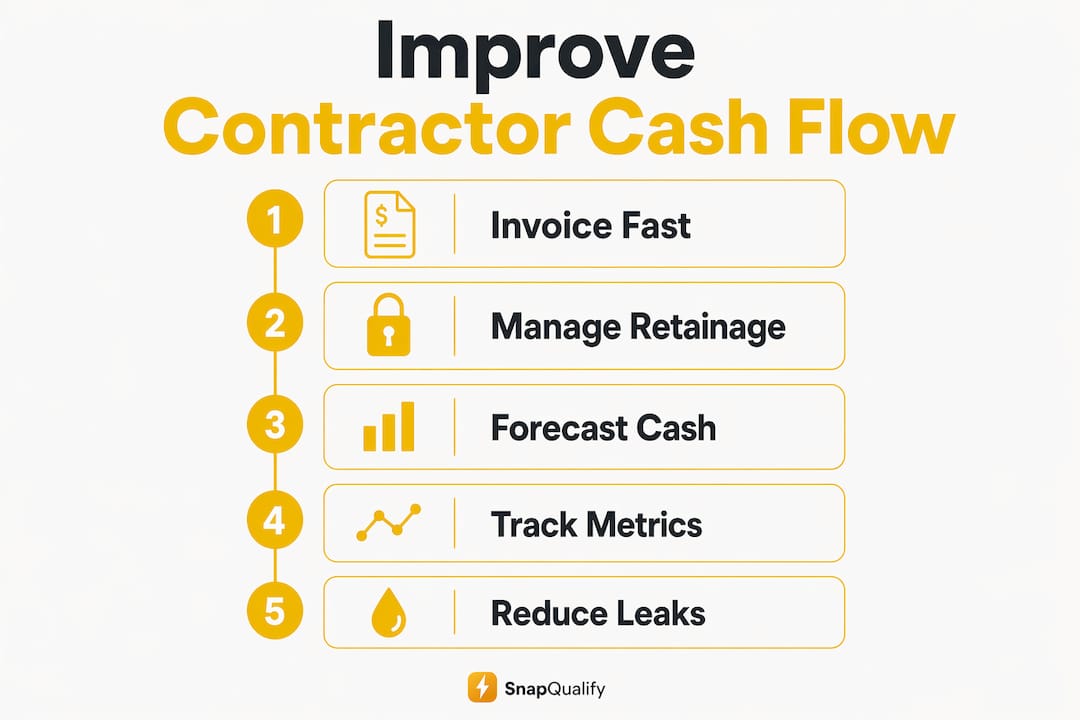
Rolling 3 to 6 month forecasts updated with actual results are the most practical tool for spotting cash timing problems before they become emergencies. A forecast does not need to be complex. It needs to be current.
The two metrics every contractor should monitor weekly are Days Sales Outstanding (DSO) and Days Payable Outstanding (DPO). DSO and DPO tell you how fast cash is moving through your business. A rising DSO means clients are paying slower. A rising DPO means you are stretching your own suppliers, which damages relationships and credit terms. Together, they give you a real-time read on cash cycle health.
| Metric | What it measures | Target for small contractors |
|---|---|---|
| Days Sales Outstanding (DSO) | Average days to collect payment after invoicing | Under 30 days |
| Days Payable Outstanding (DPO) | Average days to pay your own suppliers | 15 to 45 days |
| Accounts receivable as % of revenue | Proportion of revenue still uncollected | Under 15% of monthly revenue |
| Rolling forecast accuracy | Variance between projected and actual cash | Within 10% monthly |
Keeping accounts receivable under 15% of monthly revenue is a benchmark used by fractional CFOs to flag cash flow risk early. If your receivables exceed that threshold, you have a collections problem, not just a timing issue.
Update your forecast every Monday morning. Pull your actual cash balance, log payments received, and adjust your projected inflows for the next 30 days based on what is actually outstanding. This weekly habit takes 20 minutes and prevents the kind of surprise shortfalls that force contractors to delay payroll or skip material orders.
What operational practices reduce cash flow leaks?
Beyond invoicing and retainage, several day-to-day practices either protect or drain your cash. Understanding contractor cash flow at a process level reveals where the leaks actually live.
- Require deposits on every job. A 25% to 33% deposit before mobilization is standard and reasonable. It filters out uncommitted clients and covers your initial material costs without touching your operating cash.
- Use draw schedules on larger projects. Break payment into milestones tied to measurable progress: 25% at mobilization, 25% at rough-in, 25% at substantial completion, 15% at final, and 10% at retainage release.
- Accept multiple payment methods. ACH transfers, credit cards, and online payment portals all reduce friction. Clients who can pay by card at 10 PM on a Tuesday will pay faster than those who need to mail a check.
- Build a formal follow-up cadence. Structured follow-up processes with escalation calls tied to due date buckets reduce stagnant receivables. Email at 3 days past due, call at 7 days, and escalate to a formal demand letter at 21 days.
- Protect your lien rights. Mechanic's lien rights are your strongest legal tool for ensuring payment, but missed notice deadlines are the most common reason claims fail. Build preliminary notice filings into your project startup checklist as a calendar task, not an afterthought.
Pro Tip: Clients who dispute invoices are often clients who were never clearly educated on payment terms at the start. Send a one-page payment policy with every signed contract. It eliminates most disputes before they start and signals that you run a professional operation.
Key takeaways
Contractors who improve cash flow consistently do so by treating billing, retainage, and forecasting as active management tasks, not administrative chores.
| Point | Details |
|---|---|
| Invoice immediately | Send invoices the same day work is completed to cut days off every collection cycle. |
| Negotiate retainage terms | Push for milestone-based retainage release and factor carrying costs into every bid. |
| Monitor DSO weekly | Track Days Sales Outstanding to catch slow-paying clients before they become a crisis. |
| Require deposits | A 25% to 33% upfront deposit on every job protects your cash from the first day of work. |
| Protect lien rights | File preliminary notices at project start to preserve your legal right to payment. |
What I've learned about cash flow the hard way
Most contractors I talk to know they have a cash flow problem. What they underestimate is how much of it is self-inflicted. Late invoicing, no deposit policy, retainage that never gets followed up on. These are not client problems. They are process problems.
The contractors who stabilize their finances fastest are not the ones who land bigger jobs. They are the ones who tighten their billing cycle by a few days, start requiring deposits, and spend 20 minutes every Monday looking at their numbers. Those small changes compound quickly. A contractor running $1.5 million in annual revenue who cuts their DSO from 45 days to 25 days frees up roughly $82,000 in working capital. That is not a rounding error.
The mindset shift that matters most is this: cash flow management is not accounting. It is project management applied to money. You track progress on a job site every day. Do the same with your receivables. The clients who cost you the most are almost always the ones you saw warning signs on early and ignored. Screening clients before you commit is just as important as billing them correctly after you finish.
— Colin
Start protecting your cash flow with Snapqualify
One of the most overlooked financial tips for contractors is that cash flow problems often start before the first invoice is sent. They start with the wrong client. Snapqualify helps you screen clients before you commit, using intelligent intake forms and AI-powered risk analysis to generate a color-coded SnapScore that signals client reliability and project suitability. Fewer problem clients means fewer late payments, fewer disputes, and less time chasing checks. If you want to stabilize cash flow from the first point of contact, explore how Snapqualify protects your business and the client data you collect along the way.
FAQ
How do I improve cash flow as a small contractor fast?
Send invoices the same day work is completed, require a deposit on every new job, and shorten your payment terms to net 15. These three changes can reduce your average collection time by 10 to 20 days within the first month.
What is retainage and why does it hurt cash flow?
Retainage is 5% to 10% withheld from each progress payment until project completion, and it can lock up thousands of dollars for months after your work is done. Negotiating milestone-based release and tracking balances proactively reduces the financial strain.
What is a good DSO target for a small contractor?
Days Sales Outstanding under 30 days is the target for healthy cash flow. If your DSO exceeds 45 days, you likely have a collections process problem that needs a formal follow-up cadence.
How much deposit should a contractor require?
A deposit of 25% to 33% of the total contract value before mobilization is standard practice. It covers initial material costs and filters out clients who are not financially committed to the project.
When should I file a mechanic's lien?
File a preliminary notice at the start of every project, not after a payment dispute arises. Missing notice deadlines is the most common reason lien claims fail, so building it into your project startup routine is the only reliable approach.