

A landscaping contract scope is the written specification of every task, material, frequency, and boundary a contractor commits to deliver for a client. Without it, both parties are guessing. Industry guidance divides landscaping services into three tiers: maintenance, enhancements, and construction. Each tier carries different pricing, authorization requirements, and risk exposure. Getting the scope right before work starts is the single most effective way to prevent disputes, protect your margins, and set clear expectations on both sides.
What is a landscaping contract scope and what must it include?
A defensible scope of work requires an itemized list of tasks, precise frequencies, explicit material specifications, and a written list of work exclusions. A narrative description is not enough. Scopes must read like checklists, not paragraphs, because disputes mainly arise from the gap between what a client imagined and what the contract actually says.
Every complete landscaping contract scope should cover:
- Task descriptions: Each service listed individually, such as mowing, edging, pruning, mulching, and fertilizing, with no bundling of unrelated tasks.
- Frequency and timing: Specify weekly, biweekly, monthly, or seasonal schedules for each task. Vague terms like "as needed" create arguments.
- Material specifications: Use botanical names, container sizes, and quality grades. A 3-gallon Acer palmatum (Japanese Maple) costs around $45; a 36-inch box specimen costs $1,800. That price gap shows exactly why generic plant descriptions fail.
- Service boundaries: Define the exact areas covered, using a site map or attached exhibit. Identify who is responsible for site preparation and property access.
- Exclusion list: State clearly what is not included. Tree trimming above 10 feet, irrigation repairs, and large storm debris removal are common exclusions that must be written out explicitly.
- Change order process: Any work outside the defined scope requires a written change order with separate pricing before work begins.
Pro Tip: Attach a labeled site map as an exhibit to your contract. A visual boundary removes any ambiguity about which beds, turf areas, or hardscape zones fall under the agreement.
How are maintenance, enhancement, and construction services different?

Misclassifying services is one of the fastest ways to erode profit on a landscaping job. Each tier has a distinct definition, and treating them as interchangeable is a costly mistake.
| Service tier | Definition | Common examples |
|---|---|---|
| Maintenance | Recurring tasks that restore existing conditions | Mowing, edging, pruning, leaf removal, fertilizing |
| Enhancement | Discrete improvements that change landscape composition | New plantings, seasonal color rotations, mulch top-dressing upgrades |
| Construction | Capital work creating new features or installations | Retaining walls, irrigation system installation, paver patios |
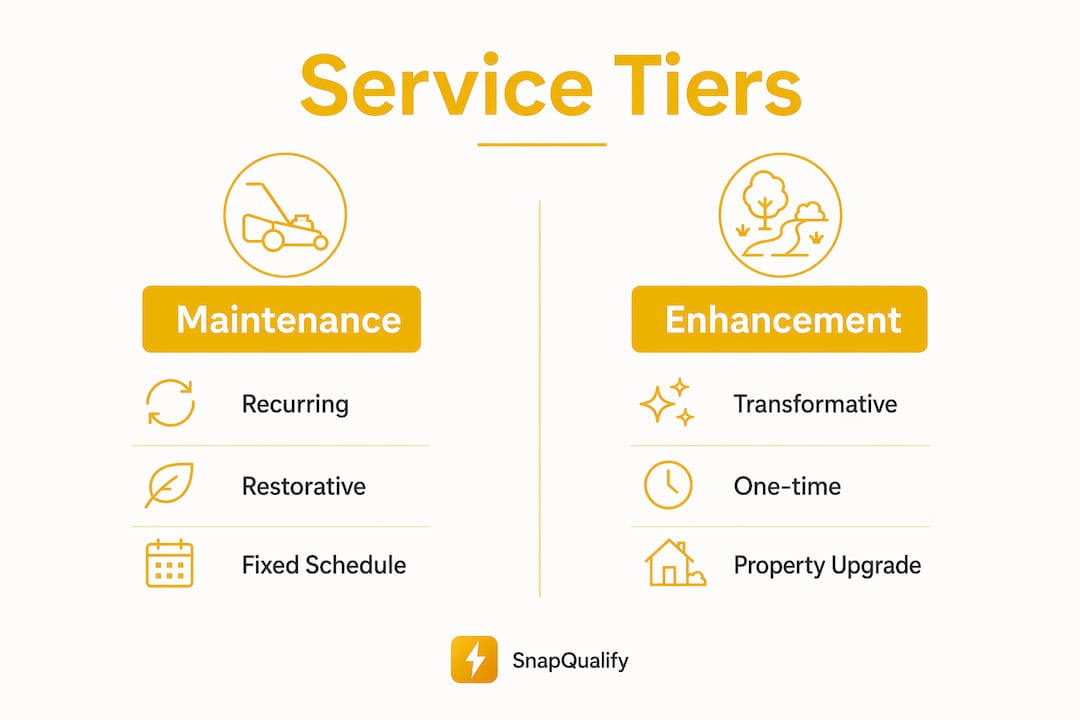
Maintenance work runs on a fixed recurring schedule and is priced accordingly. Enhancements change what the property looks like and require separate client authorization before you start. Treating enhancements as maintenance without separate pricing triggers profit erosion and client dissatisfaction. Construction work involves capital investment, permitting considerations, and a completely different liability profile than routine upkeep.
The practical rule is simple: if the work changes the landscape rather than maintains it, it needs its own line item, its own price, and its own signed approval.
What common pitfalls cause landscaping contract disputes?
Scope is the most mishandled section of landscaping contracts. Vague language is the root cause of most disagreements, and the fix is specificity at every level.
- Using generic plant descriptions. Writing "ornamental tree" instead of "Lagerstroemia indica 'Natchez,' 15-gallon container" opens the door to substitutions and cost disputes. Botanical names and container sizes are not optional details.
- Omitting an exclusion list. If your contract does not explicitly exclude irrigation repairs, a client will expect you to fix a broken head at no extra charge. Excluded activities such as tree trimming above 10 feet and large storm debris removal must be written out to require formal change orders.
- Skipping hardscape and irrigation specs. Generic scope templates miss landscape-specific complexity. Irrigation zone flow rates, paver base assembly depth, and drainage specifications belong in the scope, not in a verbal conversation.
- Blurring liability boundaries. Scope must be paired with clear liability and insurance clauses. Responsibility for drainage failure, property damage during access, and plant mortality after installation should each be addressed in writing.
- No formal change order clause. Without a written process for out-of-scope requests, you end up doing extra work for free. A change order clause forces both parties to agree on price before work proceeds.
Pro Tip: Build a contract scope checklist before every bid. Review it line by line with the property owner during the proposal meeting. Shared review reduces surprises after work starts.
How to apply a landscaping contract scope in practice
Drafting a strong scope is only half the job. Applying it correctly throughout the project is what actually prevents disputes.
- Draft collaboratively. Walk the property with the client before writing the scope. Note every area, every plant bed, and every structure that could become a point of confusion later.
- Use photos and exhibits. Attach dated site photos alongside the site map. Photos document existing conditions and protect you if a client later claims damage occurred during your work.
- Negotiate change orders early. Set the expectation at contract signing that any work outside the written scope requires a signed change order. Clients who understand this upfront rarely push back when it happens.
- Include notice periods for recurring contracts. Recurring maintenance contracts often use automatic 12-month renewal clauses with a 30 to 60 day cancellation notice window. This protects your revenue and reduces administrative burden.
- Review scope at renewal. Landscape conditions change. A scope written two years ago may no longer reflect the property's current needs. Annual scope reviews prevent the slow drift toward uncompensated work.
- Communicate throughout the term. Send brief written updates when conditions affect scheduled work, such as drought restrictions or storm damage. Written communication creates a record and reinforces the boundaries of your agreement.
Understanding scope creep prevention is just as relevant in landscaping as it is in construction. The same principles apply: define the work, document changes, and never perform out-of-scope tasks without written authorization.
Key takeaways
A landscaping contract scope must itemize every task, material, frequency, and exclusion in writing to prevent disputes and protect both parties.
| Point | Details |
|---|---|
| Define all three service tiers | Separate maintenance, enhancement, and construction work with distinct pricing and authorization. |
| Use botanical names and sizes | Specify plant cultivars and container sizes to prevent costly substitution disputes. |
| Write an explicit exclusion list | Name every excluded task so out-of-scope work triggers a formal change order. |
| Attach a site map | A labeled exhibit removes boundary ambiguity and supports your position in any dispute. |
| Include a renewal notice period | A 30 to 60 day cancellation window on recurring contracts protects your revenue and planning. |
The detail that separates good contracts from expensive lessons
After reviewing a lot of landscaping contracts, the pattern is clear. The ones that end in disputes are almost never missing a signature. They are missing specificity. A contractor writes "lawn maintenance" and a property owner reads "everything related to the lawn." Those two interpretations can cost thousands of dollars to resolve.
The three-tier classification of maintenance, enhancements, and construction is not just an organizational tool. It is a profit protection system. When you blur those lines, you absorb the cost of the confusion. I have seen landscapers perform full seasonal color rotations under a maintenance contract because the scope said "plant care." That is an enhancement. It needed its own price.
Property owners benefit just as much from a detailed scope. You know exactly what you are paying for, when it will happen, and what falls outside the agreement. A clear scope is not a contractor protecting themselves from you. It is both parties agreeing on reality before money changes hands.
The industry is moving toward more granular documentation, and that is the right direction. If your current contract template uses narrative paragraphs instead of itemized checklists, it is time to update it. The liability exposure alone makes the revision worth the effort.
— Colin
How Snapqualify helps landscaping contractors protect their work
Knowing what belongs in a landscaping contract scope is one thing. Keeping that documentation organized, secure, and accessible is another challenge entirely.
Snapqualify is built for trade contractors who need to manage client information and project details without the administrative drag. The platform screens clients before you commit to a project, so you spend time on jobs that are worth your effort. When you combine a well-drafted scope with Snapqualify's secure data protection, your contract documentation stays protected and your client qualification process stays consistent. Landscaping contractors who know their clients before signing are far less likely to end up chasing payment or absorbing scope creep costs.
FAQ
What is a landscaping contract scope?
A landscaping contract scope is a written specification listing every task, material, frequency, service boundary, and exclusion a contractor agrees to deliver. It functions as a checklist, not a narrative description.
What should be excluded from a landscaping scope of work?
Common exclusions include tree trimming above 10 feet, irrigation system repairs, and large storm debris removal. Each exclusion must be written out explicitly so that out-of-scope requests trigger a formal change order.
Why do landscaping contracts need botanical names?
Botanical names and container sizes prevent plant substitution disputes. A 3-gallon Japanese Maple and a 36-inch box specimen of the same species differ by over $1,700 in cost, making vague plant descriptions a serious financial risk.
How do maintenance and enhancement services differ in a contract?
Maintenance covers recurring tasks that restore existing conditions, such as mowing and pruning. Enhancements change the landscape's composition or appearance and require separate pricing and written client authorization before work begins.
How often should a landscaping contract scope be reviewed?
Recurring maintenance scopes should be reviewed at each annual renewal. Landscape conditions change over time, and an outdated scope creates the conditions for uncompensated work and client disagreements.