
Home service businesses lose bids primarily because of sales process failures, not pricing. The average contractor closes only 25–40% of estimates, meaning 60–75% of every bid represents lost revenue. That gap is not driven by competitors undercutting you on price. It is driven by slow follow-up, weak sales funnels, and proposals that give homeowners no reason to choose you. Understanding why home service businesses lose bids is the first step toward fixing the right problem.
Why do home service businesses lose bids?
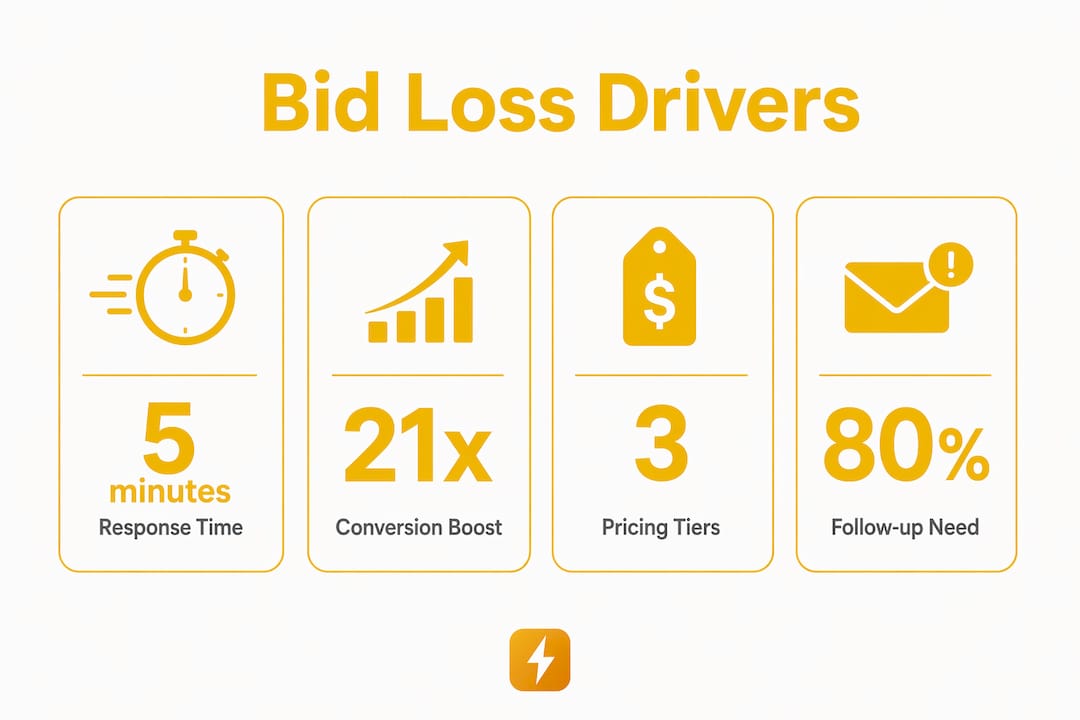
Speed and persistence determine most bid outcomes. Leads contacted within 5 minutes are 21 times more likely to convert than those reached after 30 minutes. That gap is not a small edge. It is the difference between winning the job and watching a competitor walk through the door first.

Delay compounds fast. A 24-hour response drops your close rate by 40%. Wait 72 hours and you lose 80% of that lead's conversion potential. Homeowners move on quickly, especially when they are collecting multiple quotes at once.
Follow-up is where most contractors leave money on the table. Closing a sale requires 5 or more follow-ups in the majority of cases, yet most contractors stop after one attempt. When a homeowner goes quiet, the instinct is to assume rejection. The reality is usually distraction, a busy week, or a spouse who has not weighed in yet.
- Call within 5 minutes of receiving an inbound lead, every time.
- Follow up at least 5 times across different channels: phone, text, and email.
- Send your proposal within 1 hour of the site visit. 63% of homeowners collect 3 or more quotes, and speed signals professionalism.
- Track every touchpoint so you know exactly where each lead stands.
Pro Tip: Set a calendar reminder for every lead the moment you leave the site visit. If you do not follow up within the hour, your proposal lands in a pile with two others.
Is your pricing really the problem?
The most common mistake contractors make is treating a sales funnel problem as a pricing problem. When bids stop converting, the reflex is to cut prices. That reflex is expensive and usually wrong.
Dropping your price starts a cycle that is hard to escape. Lower margins mean less cash for marketing, hiring, and equipment. That weakens your ability to compete, which tempts another price cut. Contractors who enter this cycle rarely win more jobs. They just earn less on every job they do win.
Before you touch your pricing, audit your funnel. Ask yourself these questions:
- What is your booking rate? If fewer than 60% of inbound calls turn into site visits, your marketing is attracting the wrong leads.
- What is your close rate? If you are below 25%, the problem is almost certainly follow-up or proposal quality, not price.
- Where do leads drop off? Identify the exact stage where prospects go cold and fix that stage first.
- What channel are your leads coming from? Leads from referrals close at far higher rates than cold digital leads. Channel quality affects bid success more than most contractors realize.
Pro Tip: Run a 30-day audit before making any pricing decision. Track every lead from first contact to close or loss. The data will tell you exactly where your funnel breaks.
Cutting prices without this audit is like replacing a tire when the engine is the problem. You spend money and the car still does not run.
How does tiered pricing improve your win rate?
Tiered pricing, structured as Good/Better/Best options, doubles proposal wins and increases close rates by 21%. The reason is behavioral, not financial. When a homeowner sees one price, the decision is binary: buy or do not buy. When they see three options, the decision shifts to which one fits best.
The middle option carries the most psychological weight. Behavioral economics calls this the "compromise effect." Most buyers avoid the cheapest option because it feels like a risk, and avoid the most expensive because it feels excessive. The middle tier wins the majority of selections. That is where you put your preferred margin.
| Tier | What it includes | Strategic purpose |
|---|---|---|
| Good | Core service, standard materials | Anchors the price floor, qualifies budget |
| Better | Upgraded materials, warranty, priority scheduling | Captures the majority of buyers |
| Best | Premium materials, extended warranty, full service | Raises average ticket, makes Better look reasonable |
Transparent pricing also builds trust. Homeowners value clear cost breakdowns and multiple options. A proposal that explains what each tier includes removes the fear of hidden costs, which is one of the top reasons homeowners delay or decline.
Track which tier your clients select most often. If everyone picks "Good," your "Better" tier is not differentiated enough. If no one picks "Best," raise the price or add more value to it.
Pro Tip: Present all three tiers in person or on a video call when possible. Contractors who walk homeowners through tiered options close at significantly higher rates than those who email a PDF and wait.
Should you bid on every job that comes in?
Bidding on fewer jobs improves your overall win rate. This is counterintuitive, but the math is clear. Focusing on qualified, high-probability projects can move your win rate from 20% to 60%. That means winning 3 out of 5 bids instead of 1 out of 5, with less time spent on proposals.
A bid/no-bid assessment filters out jobs that drain your time without a realistic chance of winning. Use these criteria before committing to a full proposal:
- Budget fit: Does the homeowner's stated budget align with your minimum margin requirements?
- Project scope: Is the work within your core specialty, or would it require subcontracting most of it?
- Decision timeline: Is the homeowner ready to move within 30 days, or are they "just getting ideas"?
- Competition level: Do you know who else is bidding? If three larger firms are already involved, factor that in.
- Client signals: Does the homeowner seem organized, responsive, and realistic about costs?
Vetting homeowners before quoting is a skill that pays for itself fast. Read the 2026 guide to vetting homeowners before quoting to understand which signals predict a good client versus a costly one. Spending two hours on a proposal for a low-probability lead is two hours you could have spent closing a qualified one.
Key Takeaways
Home service businesses lose most bids because of slow follow-up, weak sales funnels, and single-price proposals, not because competitors charge less.
| Point | Details |
|---|---|
| Speed wins bids | Respond to leads within 5 minutes to be 21x more likely to convert them. |
| Follow up five times | Most sales require 5+ contacts; stopping after one forfeits the majority of leads. |
| Audit before cutting prices | Diagnose your funnel first; price cuts without data worsen margins without improving wins. |
| Use tiered pricing | Good/Better/Best proposals double win rates by shifting focus from price to value. |
| Bid selectively | Focusing on qualified jobs can raise your win rate from 20% to 60%. |
What I have learned from watching contractors misread their own numbers
Most contractors I have seen struggle with bid losses share one blind spot: they look at the outcome (lost bid) and assume the cause (too expensive) without checking the data. They cut their price, win a few jobs at thin margins, and call it a fix. Six months later, they are busier but not more profitable, and the close rate is still inconsistent.
The contractors who turn things around do something different. They track their estimate-to-close time and count their follow-up touchpoints. When they see that 70% of their losses happen after zero follow-up, the fix becomes obvious. It is not the price. It is the silence after the proposal.
Tiered pricing is the other shift that consistently surprises contractors. Most resist it because presenting three options feels complicated. In practice, it simplifies the conversation. The homeowner stops asking "is this worth it?" and starts asking "which version do I want?" That is a much easier conversation to have.
My honest advice: do not touch your pricing until you have 30 days of funnel data. Fix your follow-up first. Then present tiered options with confidence. You will close more bids at better margins before you ever need to discount a dollar.
— Colin
How Snapqualify helps you win more bids
Losing bids to poor lead qualification costs contractors real money every week. Snapqualify gives you a structured way to screen clients before you invest time in a full proposal.
The platform sends clients a branded intake form that captures project scope, budget, and timeline. AI analysis then generates a color-coded SnapScore that tells you, at a glance, whether a lead is worth pursuing. You stop wasting proposals on low-probability clients and focus your energy on jobs you can actually win. Snapqualify also helps you build a cleaner pipeline, so your follow-up cadence targets the right leads at the right time. Learn more about how Snapqualify protects your client data while doing it.
FAQ
Why do contractors lose bids even with competitive pricing?
Most bid losses come from slow follow-up and weak proposals, not price. Contractors who respond within 5 minutes and follow up at least 5 times win far more bids than those who compete on cost alone.
How many times should you follow up after sending a proposal?
Follow up at least 5 times before closing a lead as lost. 80% of sales require 5 or more contacts, and silence from a homeowner usually means distraction, not rejection.
Does tiered pricing really work for home service bids?
Yes. Good/Better/Best pricing increases close rates by 21% and doubles proposal wins by shifting the homeowner's decision from "buy or not" to "which option fits best."
How do I know if I have a pricing problem or a funnel problem?
Check your close rate. If you are below 25%, the issue is almost always follow-up or proposal quality. Review the common reasons bids get rejected to identify the exact stage where leads drop off.
Should I bid on every project that comes in?
No. Selective bidding improves win rates from 20% to 60% by concentrating your resources on qualified, high-probability opportunities instead of spreading effort across low-fit projects.