

Branded contractor intake forms are structured, company-branded digital questionnaires that collect client information, qualify leads, and trigger project workflows before a contractor ever visits a site. The benefits of branded contractor intake forms go well beyond first impressions. They cut onboarding time, filter out problem clients, reduce payment disputes, and give you a documented paper trail from day one. For trade contractors and small construction business owners, these forms are not an administrative nicety. They are a financial control tool.
1. Benefits of branded contractor intake forms for client onboarding
Onboarding a new client used to take days of back-and-forth calls, emails, and manual data entry. Automated branded intake workflows reduce client onboarding times from 4.5 days to 16 hours and cut administrative workload from 22 to 4 hours weekly. That is not a minor efficiency gain. That is time you get back to run jobs.

Branded forms also change how clients perceive your business from the very first touchpoint. A clean, logo-forward intake form signals that you run a professional operation. High-quality digital intake forms act as trust-signals that differentiate contractors from competitors still using paper or generic email chains. Clients who see a polished form are more likely to take the process seriously and provide accurate information.
Structured forms eliminate the guesswork in early communications. Instead of chasing clients for project details, your form asks the right questions upfront. Same-day job delays drop from 11% to 3% when contractors use integrated automated form and contract workflows. That reduction directly protects your schedule and your revenue.
- Collect project scope, site address, budget range, and access details before the first call
- Capture signed acknowledgments for deposit terms and cancellation policies at intake
- Send automated confirmation emails so clients know what to expect next
Pro Tip: Connect your branded intake form to your CRM or field service management tool via API. Pre-populating client data from the form into your project dashboard removes duplicate entry and cuts onboarding friction significantly.
2. How branded forms improve lead qualification
Not every inquiry is worth your time. Branded intake forms filter out window-shoppers before you spend an hour on a site visit. Structured intake processes allow contractors to identify unqualified leads before committing field resources, which protects both your schedule and your margins.
The question set matters. Repair jobs require roughly 10 core questions to qualify a lead effectively. Remodeling projects need up to 22 questions to capture enough detail for accurate scoping. Matching your question count to project type is a contractor intake forms best practice that most contractors ignore.
Form completion rate is itself a lead signal. A client who abandons a 12-question form halfway through is telling you something about their commitment level. A client who answers every question thoroughly, uploads photos, and provides a realistic budget is a far stronger prospect. You learn this before you ever pick up the phone.
- Ask about budget range, project timeline, and prior contractor experience
- Include a question about property ownership to avoid permit complications later
- Request photos of the work area to pre-qualify scope before the site visit
- Ask whether the client has received other estimates to gauge decision-stage readiness
Keeping forms under 25 questions is critical. Client drop-off rates increase sharply beyond that threshold. A shorter, well-targeted form gets completed. A long, generic one gets abandoned.
3. Ways branded forms improve project management and site documentation
A branded intake form is the first record in your project file. When it captures the right data, it becomes a single source of truth for scope, client expectations, and site conditions. Custom forms integrated with project management tools provide real-time analytics and reporting that keep your team aligned from kickoff to closeout.
Offline capability matters on active jobsites. Forms that capture data without a signal and sync automatically when connectivity returns preserve data integrity in the field. Photo upload fields let clients document existing conditions before work begins, which protects you in any scope dispute.
Forms function as workflow triggers, not just data collection tools. A completed intake form can automatically route a lead to the right estimator, update a project dashboard, verify insurance, and schedule a site visit. That chain of automation runs without anyone on your team lifting a finger.
Pro Tip: Add fields for certificates of insurance, contractor license numbers, and permit requirements directly in your intake form. Tracking compliance documents at intake prevents costly delays when inspections or subcontractor coordination comes up later.
| Form Feature | Project Management Benefit |
|---|---|
| Photo upload fields | Documents pre-existing conditions and limits scope disputes |
| Offline data capture | Preserves accuracy on jobsites without reliable signal |
| Automated dashboard updates | Keeps project status current without manual entry |
| Compliance document fields | Centralizes COIs and licenses from the first touchpoint |
4. Financial and operational advantages for small contracting businesses
Intake forms are a financial tool. Contractors who treat intake as a core financial process see more predictable cash flow and fewer payment disputes. The reason is simple. When scope, budget, and access limits are documented at the start, there is no room for a client to claim they never agreed to something.
Scope creep is the margin killer most contractors underestimate. A client who adds work mid-project and then disputes the invoice is a direct result of a weak intake process. Including budget range, access restrictions, and change order acknowledgment fields in your form creates a paper trail that holds up in any dispute.
Form-driven billing and documentation lead to improved payment timing and healthier cash flow for small trade businesses. When your intake form captures deposit terms and milestone payment schedules upfront, clients enter the project with clear financial expectations. That clarity reduces the friction that leads to late payments.
- Include a field for agreed deposit amount and payment method
- Capture milestone payment triggers tied to project phases
- Document access hours and site restrictions to prevent delay claims
- Add a field confirming the client has reviewed your cancellation policy
Understanding contractor cash flow management starts at intake. The data you collect in the first five minutes of a client relationship shapes every financial interaction that follows.
Key Takeaways
Branded contractor intake forms are the most underused financial and operational control tool available to small trade businesses.
| Point | Details |
|---|---|
| Onboarding speed | Automated branded forms cut onboarding from 4.5 days to 16 hours. |
| Lead filtering | Matching question count to project type removes unqualified leads before site visits. |
| Workflow automation | Completed forms trigger insurance checks, routing, and dashboard updates automatically. |
| Financial protection | Documenting scope, budget, and payment terms at intake reduces disputes and late payments. |
| Site documentation | Offline-capable forms with photo uploads create a reliable project record from day one. |
Why most contractors are using intake forms wrong
I have watched contractors spend thousands on CRM software and then use their intake form as nothing more than a name-and-number collector. That is the wrong approach, and it costs real money.
The contractors who get the most out of branded intake forms treat them as the first step in a documented business process, not a formality. They use the form to qualify the client, set financial expectations, and trigger the next step in their workflow automatically. The form does the work so they do not have to.
My honest advice: start with one well-built form for your most common project type. Get the question set right, add your branding, and connect it to whatever tool you use to manage jobs. Once you see how much time it saves, you will build forms for every project category you handle. Designing an intake form that works is a one-time investment that pays back on every single job.
Sustainable growth in trade contracting ties directly to administrative discipline. The contractors who scale without chaos are the ones who documented everything from the first client touchpoint.
— Colin
How Snapqualify helps contractors qualify clients from the first form
Snapqualify is built specifically for trade contractors who want more than a basic contact form.
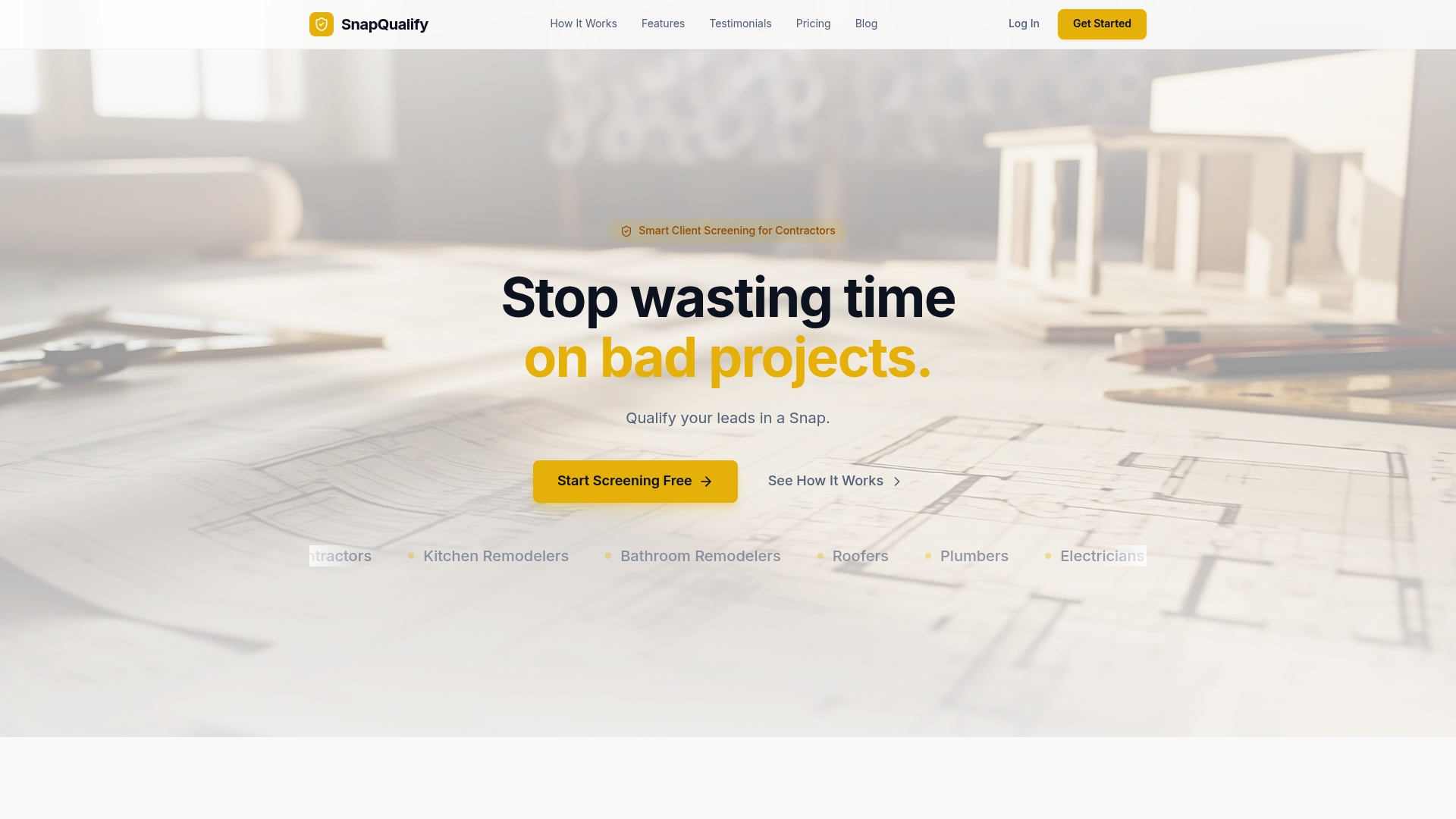
The platform gives you a branded intake form your clients complete online. Their answers are analyzed with AI and experience-based scoring to generate a color-coded SnapScore that tells you, at a glance, whether a client is worth pursuing. Roofers, electricians, plumbers, HVAC technicians, painters, and general contractors all use Snapqualify to filter problem clients before a single site visit. The result is fewer disputes, fewer late payments, and more time spent on jobs that actually pay. See how Snapqualify works and set up your branded intake form today.
FAQ
What are the main benefits of branded contractor intake forms?
Branded contractor intake forms reduce onboarding time, filter unqualified leads, automate workflows, and document scope and payment terms before work begins. They protect your margins and your schedule from the first client interaction.
How many questions should a contractor intake form include?
Repair projects need roughly 10 questions for effective lead qualification. Remodeling projects need up to 22. Forms exceeding 25 questions see a sharp increase in client drop-off rates.
Can intake forms help prevent payment disputes?
Yes. Documenting budget, scope, deposit terms, and milestone payments at intake creates a paper trail that holds up in any billing dispute. Contractors who treat intake as a financial process see fewer late payments and more predictable cash flow.
How do branded intake forms improve lead quality?
Structured question sets filter out clients who are not serious, do not have a realistic budget, or are not ready to commit. Form completion rate itself signals client intent before you invest time in a site visit. Learn more about qualifying leads with intake forms.
Do intake forms work for all trade contractor types?
Yes. Roofers, electricians, plumbers, HVAC technicians, painters, landscapers, and general contractors all benefit from structured intake. The question set changes by trade and project type, but the core process applies across the board.