

A construction contingency is a designated reserve of funds within a project budget, set aside to cover unexpected costs that cannot be precisely predicted at the time of contracting. Standard practice allocates 5–10% of total project costs for straightforward builds, rising to 20% for complex renovations or brownfield sites. Every experienced project manager treats this reserve as a non-negotiable line item, not an optional cushion. Without it, a single unforeseen site condition or design gap can derail your entire project budget.
What is a construction contingency and why does it matter?
A construction contingency is defined as a pre-approved budget reserve that absorbs financial shocks without requiring emergency capital requests or lender renegotiation. Its core purpose is to protect project margin, cash flow, and delivery schedule when unexpected events occur.
The reserve protects EBIT and cash flow by allowing work to continue without pulling funds from other budget lines. That protection matters most when unforeseen site conditions, regulatory changes, or late design revisions hit mid-project. A project without contingency forces you into reactive mode: stop work, call the lender, and explain why costs exceeded the original estimate.
Contingency also signals financial discipline to lenders and owners. A well-structured contingency fund tells every stakeholder that the project team planned for the unknown, not just the known.

How contingency percentages vary by phase and project type
Contingency requirements shift significantly as a project matures. Early feasibility studies carry the most uncertainty, so reserves run higher. Active construction carries the least, because scope and conditions are largely defined.
| Project Phase | Recommended Contingency |
|---|---|
| Early feasibility | 15–25% |
| Schematic design | 10–15% |
| Construction documents | 5–10% |
| Active construction | 3–5% |
Project type also drives the percentage. Owner's contingency by project type typically runs as follows:
- Tenant improvements: 5–7%
- Ground-up commercial: 8–10%
- Specialized builds (biotech, data centers): 12–18%
Specialized builds carry higher reserves because mechanical complexity, regulatory requirements, and procurement lead times create more unknowns. A standard office fit-out has far fewer variables than a cleanroom or a high-voltage data center.
Pro Tip: Set your contingency percentage before design begins, not after. Locking it in early prevents scope creep from quietly eroding your reserve before construction starts.
What are the different types of construction contingencies?
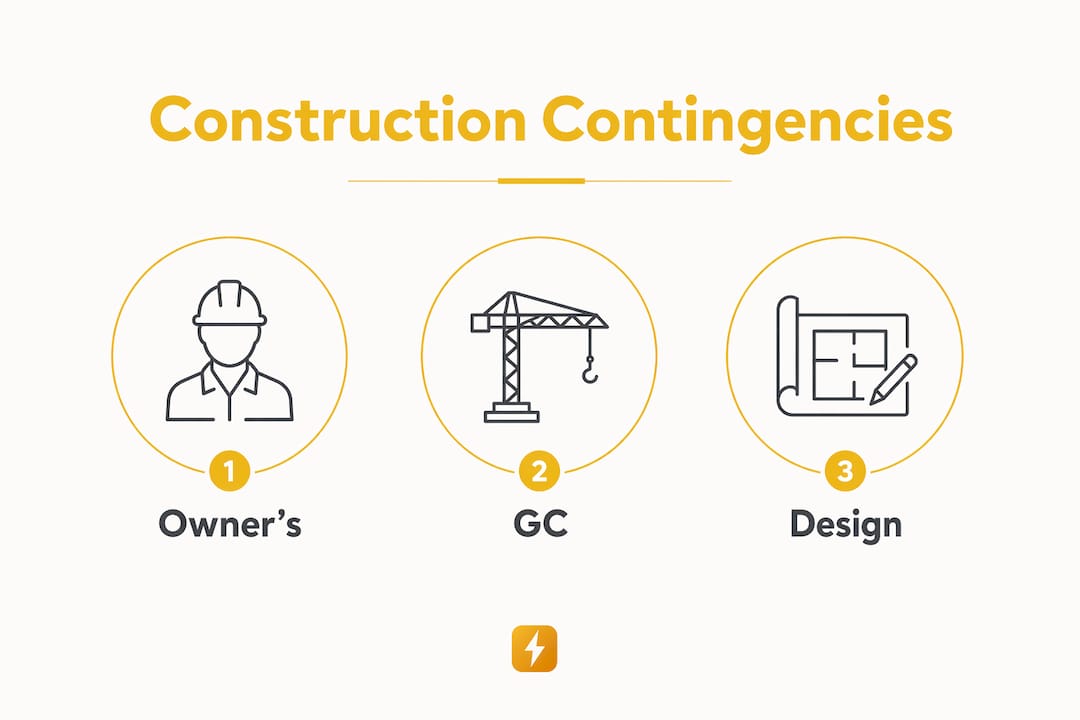
Three distinct contingency types exist in a well-structured construction budget. Mixing them in a single pro forma line is one of the most common and costly mistakes in project management.
Owner's contingency covers risks the owner controls: scope additions, regulatory changes, unforeseen site conditions, and design revisions requested after contract execution. This reserve sits outside the GC's contract and is managed directly by the owner or their representative.
GC contingency lives inside a Guaranteed Maximum Price (GMP) contract. It covers contractor-controlled risks: subcontractor defaults, minor quantity errors, and productivity shortfalls. GC contingency inside GMP typically runs 2–5% of the contract value. The GC controls this fund, not the owner.
Design contingency is held within the architect's or engineer's fee structure during the design phase. It covers scope gaps, coordination errors, and specification changes before construction documents are finalized. Once the project moves to construction, this reserve is typically closed out.
| Contingency Type | Who Controls It | Typical Range | Covers |
|---|---|---|---|
| Owner's contingency | Owner | 5–18% | Scope changes, site conditions, regulatory shifts |
| GC contingency | General contractor | 2–5% | Subcontractor issues, quantity errors |
| Design contingency | Architect/Engineer | 1–3% | Design gaps, coordination errors |
Keeping these three reserves as separate contingency line items prevents one risk category from draining all available funds. It also keeps your lender's auditor satisfied, since lenders require visible, distinct reserves for each risk type.
Best practices for managing your contingency fund
Effective contingency management is about process, not just percentages. The reserve only works if you control how and when it gets used.
Require formal certification for every drawdown. Formal approval procedures by project superintendents are the standard for maintaining contingency integrity. No verbal approvals. Every draw needs a written change order, a cost justification, and a signature from the authorized party.
Common mistakes that drain contingency reserves before they are needed:
- Scope creep: Undocumented additions to work scope consume contingency silently. Every scope change, regardless of size, needs a formal change order tied to a specific contingency type.
- Poor documentation: Missing site logs, incomplete RFI records, and unsigned change orders make it impossible to track where contingency funds went.
- Using contingency as profit padding: Reallocating unused contingency to profit at project close, before final risks are resolved, is a funding risk. Informal reallocations cause funding stops when lenders audit the draw schedule.
- Weak site management: Rework caused by poor coordination is not an unforeseen cost. It is a management failure. Charging it to contingency masks the real problem.
Reviewing your construction contract scope before project kickoff is one of the most effective ways to reduce unnecessary contingency draws from the start.
Pro Tip: Establish a reallocation protocol in writing before the project starts. Define which contingency type covers which risk, who approves each draw, and what triggers a scope-reduction conversation.
How does contingency planning prevent construction cost overruns?
Internal management deficiencies cause 70% of construction cost overruns. That figure reframes the entire purpose of contingency planning. Most overruns are not caused by earthquakes or supply chain collapses. They are caused by scope changes, poor documentation, and weak change management.
A properly managed contingency fund does three things simultaneously:
- It absorbs genuine unknowns without stopping work.
- It creates a paper trail that protects you during lender audits.
- It triggers early warning signals when reserves deplete faster than expected.
That last point is critical. Early-stage contingency depletion before 50% project completion is a hard signal to begin scope-reduction discussions immediately. Waiting until the fund is empty forces you into crisis management.
"Most cost overruns originate in planning and design phases but become visible only during construction execution. Proactive monitoring is the only way to catch them before they become emergencies."
Lenders treat contingency as a restricted equity reserve, not a flexible budget line. Misusing it as a general slush fund can result in withheld draw funding. That is a project-stopping event. Protecting your contingency integrity protects your relationship with your lender.
Avoiding contractor time wasters like unvetted scope additions and undocumented client requests directly preserves your contingency for the risks it was designed to cover.
Key Takeaways
A construction contingency is a pre-approved, segregated budget reserve that protects project margin, lender confidence, and delivery schedule when unforeseen costs arise.
| Point | Details |
|---|---|
| Standard allocation range | Reserve 5–10% for standard projects and up to 20% for complex or brownfield builds. |
| Phase-based percentages | Reduce contingency from 15–25% at feasibility to 3–5% during active construction as certainty increases. |
| Separate contingency types | Keep Owner's, GC, and design contingencies as distinct line items to prevent one risk from draining all reserves. |
| Formal drawdown process | Require written change orders and superintendent sign-off for every contingency draw without exception. |
| Early depletion warning | If contingency drops significantly before 50% completion, trigger scope-reduction talks immediately. |
Why I think most teams misuse their contingency fund
Most project teams treat contingency as a budget buffer of last resort. That framing is wrong, and it costs them money.
Contingency is a financial safeguard with a specific risk profile. It is not a catch-all for bad estimating, poor scope definition, or client-driven scope creep. When teams blur that line, the fund disappears before the real unknowns arrive. I have seen projects hit genuine unforeseen conditions at the 60% mark with zero contingency left because the first half of the job was managed loosely.
The fix is not a bigger contingency percentage. The fix is strict change management from day one. Segregate your reserves by risk type. Document every draw. And treat early depletion as a red flag, not a normal occurrence.
The teams that consistently finish on budget are not the ones with the largest contingency funds. They are the ones with the clearest protocols for using them.
— Colin
How Snapqualify helps you protect your project budget
Managing contingency funds starts before a single shovel hits the ground. It starts with knowing whether your client is likely to introduce the scope changes and payment issues that drain reserves in the first place.
Snapqualify is built for trade contractors and construction professionals who want to qualify clients before committing to a project. The platform uses AI-powered intake forms to generate a color-coded SnapScore, giving you a fast read on client reliability, budget clarity, and project suitability. That upfront screening reduces the scope creep and documentation gaps that consume contingency funds on preventable problems. Screen your next client with Snapqualify before the contract is signed, and protect your reserves for the risks that actually matter.
FAQ
What is a construction contingency in simple terms?
A construction contingency is a reserved portion of a project budget set aside to cover unexpected costs. It typically ranges from 5–10% for standard projects and up to 20% for complex builds.
What is the difference between Owner's contingency and GC contingency?
Owner's contingency covers risks the owner controls, such as scope changes and site conditions. GC contingency, held inside a GMP contract, covers contractor-controlled risks and typically runs 2–5%.
How do you calculate contingency for a construction project?
Apply a percentage to your total project cost based on phase and complexity. Use 15–25% at early feasibility, 5–10% during design development, and 3–5% during active construction.
Why do construction lenders care about contingency funds?
Lenders treat contingency as a restricted equity reserve. Misusing it without formal documentation can result in withheld draw funding, which stops the project.
What causes contingency funds to run out too early?
Internal management issues including scope creep, poor documentation, and undocumented change orders cause 70% of cost overruns, which are the primary reason contingency funds deplete before project completion.