

Evaluating project risk before bidding is the practice of systematically scoring a construction opportunity across financial, contractual, and operational dimensions before committing estimating resources. Contractors who skip this step routinely win jobs that cost more to complete than they pay. The industry standard approach combines a bid/no-bid framework with a risk scoring matrix, two tools that turn gut instinct into a documented, repeatable decision. Used together, they protect your margins, your subcontractor relationships, and your time.
What are the main risk categories to assess before bidding?
A sound contract bidding risk assessment starts with five categories. Each one can independently sink a project if you ignore it.
- Owner financial health. Unknown owners, slow-pay histories, and clients without a clear funding source are the most common cause of unpaid invoices. Check payment history before you price a single line item. A client red flags checklist gives you a structured starting point.
- Contract terms. Pay-when-paid clauses, unlimited indemnity, and missing price-adjustment provisions can convert a profitable job into a liability. Contract red flags like liquidated damages and retainage timing carry more financial risk than most site conditions, and legal review is essential before you commit.
- Design completeness. Incomplete drawings produce scope creep. If the plans are still in schematic phase, your estimate will be a guess.
- Schedule feasibility. Accelerated schedules increase labor premiums and shrink your subcontractor pool. A compressed timeline is a cost risk, not just a scheduling inconvenience.
- Competitive and strategic fit. Bidding against an incumbent with a long owner relationship, or pursuing a project type outside your core capability, lowers your win probability and raises execution risk.
Three or more red flags across these categories is a strong signal to decline. Four critical factors drive every bid/no-bid decision: client financial capability, project risk, profit potential, and number of competitors.
How do you build a risk scoring matrix for bidding?
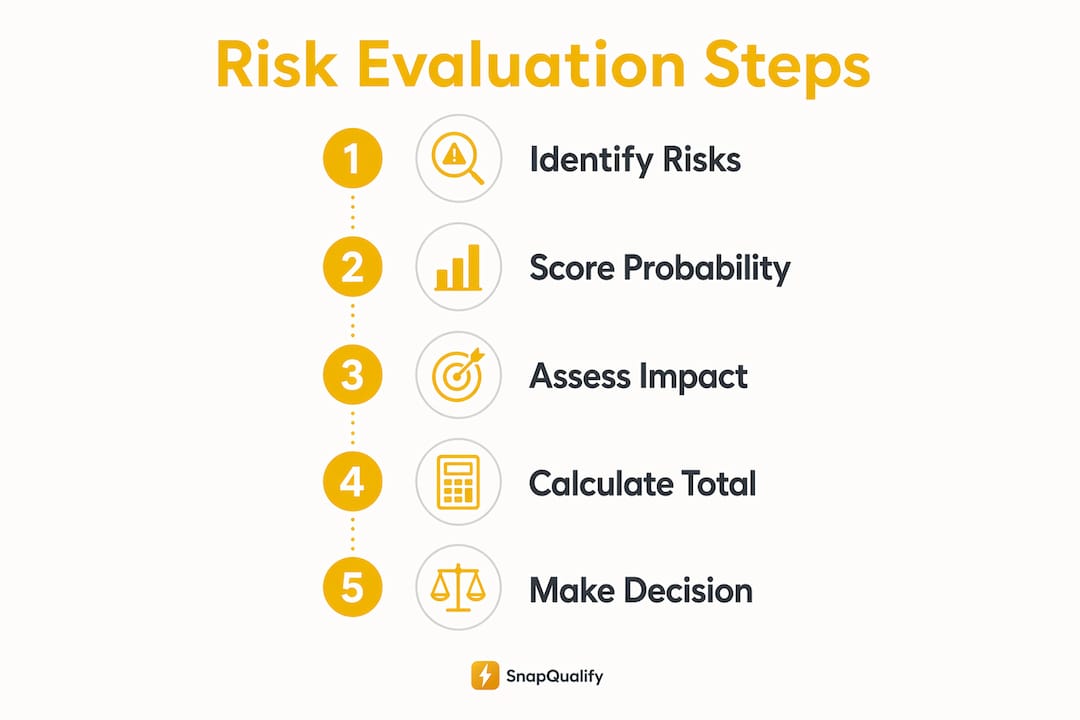
A risk scoring matrix quantifies what you already know intuitively. Professional firms score probability and impact on a 1–5 scale per risk category, then multiply the two numbers to get a risk priority score.
- List every risk category. Use the five categories above as your rows: owner financials, contract terms, design completeness, schedule, and strategic fit.
- Score probability. Rate the likelihood that the risk occurs: 1 = very unlikely, 5 = near certain.
- Score impact. Rate the financial or operational damage if it does occur: 1 = minor, 5 = project-threatening.
- Calculate priority. Multiply probability × impact. A score of 15 or higher on any single category demands a mitigation plan or a no-bid decision.
- Sum the totals. Add all category scores. Use thresholds to guide your decision.
| Total score | Decision |
|---|---|
| Below 30 | Bid with standard contingency |
| 30–50 | Executive review, adjust fee and contingency |
| Above 50 | Default no-bid unless strategic override applies |
Pro Tip: Document your risk register even when you decide to bid. Formal risk assessment creates a feedback loop that reveals which categories your firm consistently misjudges, improving every future estimate.

A scoring framework supplements human judgment, not replaces it. A high score in one category does not automatically kill a bid if the rest of the project scores well. The matrix forces an explicit team conversation instead of a gut call made under deadline pressure.
When should you make a go/no-go decision?
The go/no-go decision is the formal checkpoint where you decide whether to invest estimating hours. Make it early. Complete your bid/no-bid checklist within 24–48 hours of receiving the bid invitation. That window closes before you have spent real money on takeoffs or subcontractor outreach.
The checklist scores five weighted categories:
- Owner quality. Do you know this client? Is their payment history clean?
- Project fit. Does the scope match your license, bonding, and core capability?
- Capacity. Do you have the crew, equipment, and management bandwidth right now?
- Competition. How many bidders are invited? Is an incumbent already on site?
- Strategic value. Does winning this job open a new market or strengthen a key relationship?
Projects scoring below 2.5 on a 1–5 scale should be declined automatically. Scores in the middle range go to a principal or owner for a final call. Only high-scoring projects move into full estimating.
Pro Tip: Never invite subcontractors to bid before you complete your go/no-go review. Seasoned firms screen first, then invite subs. Pulling subs into a bid you later decline wastes their time and strains the relationship.
Declining early is a resource preservation decision, not a missed opportunity. The estimating hours you save on a bad-fit project go directly toward winning a better one.
How do you adjust your bid based on risk scores?
Your risk score is not just a go/no-go signal. It is a pricing input. Contractors who document risks and adjust contingencies accordingly align their pricing with actual exposure instead of guessing at a round number.
- Low-risk projects. Bid with a standard contingency of 3–5%. Use an aggressive posture if the relationship is strong and competition is light.
- Medium-risk projects. Load 8–12% contingency. Adjust your fee upward to reflect the management burden. Clarify scope exclusions explicitly in your bid documents.
- High-risk projects. If you bid at all, load 15% or more. Negotiate harmful contract clauses before signing. Require a larger deposit and milestone payments tied to defined deliverables.
Scope clarity in your bid documents is as important as the numbers. Write out every assumption. List what is excluded. A vague bid invites disputes that cost more to resolve than the contingency you loaded. For a deeper look at how overbidding affects margins, the pattern usually traces back to unquantified risk, not math errors.
Key Takeaways
Contractors who evaluate project risk before bidding win better jobs, protect their margins, and build stronger subcontractor relationships through disciplined, repeatable screening.
| Point | Details |
|---|---|
| Screen five risk categories | Assess owner financials, contract terms, design completeness, schedule, and strategic fit on every bid. |
| Use a probability × impact matrix | Multiply scores to get a risk priority number; totals above 50 default to no-bid. |
| Decide go/no-go within 48 hours | Complete your checklist before inviting subs or starting takeoffs to avoid wasted estimating effort. |
| Price to your risk score | Load contingency at 3–15%+ based on your total risk score, not a fixed company default. |
| Document every assessment | Risk registers reveal patterns in your bidding blind spots and sharpen future estimates. |
Why I think most contractors skip the step that matters most
I have watched contractors spend 60 hours estimating a job they knew in their gut was wrong for them. The owner was vague, the drawings were incomplete, and three other firms were already circling. They bid anyway because the job was big and walking away felt like losing. They won. Six months later they were chasing a check and eating change orders.
The sunk cost fallacy is the real enemy here. Once you have spent two weeks on a proposal, declining feels like throwing money away. The fix is to make the hard call before you spend the two weeks. A go/no-go matrix applied early is the only tool that consistently breaks that pattern.
What I have found is that the firms with the healthiest margins are not the ones who bid the most. They are the ones who bid selectively and price accurately. A 12-question bid/no-bid scorecard takes under five minutes to complete. Five minutes of discipline at the front end beats 60 hours of regret at the back end. Build the habit, share the template with your team, and treat a no-bid decision as a win, not a retreat.
— Colin
How Snapqualify helps you screen projects before you bid
Risk evaluation works best when it starts with the client, not the contract. Snapqualify gives trade contractors and small construction businesses a fast, structured way to screen clients before a single estimating hour is spent.
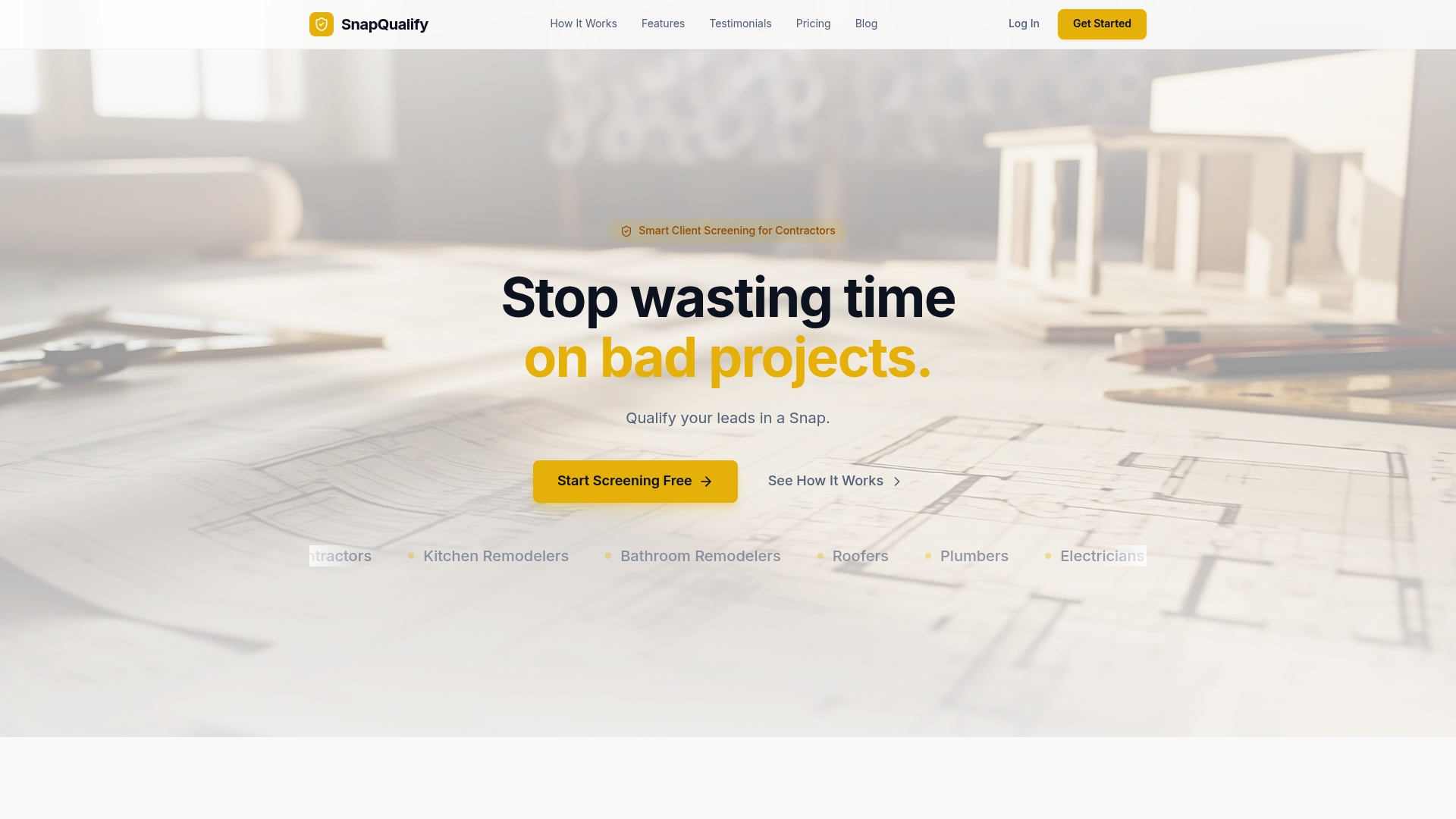
Snapqualify's intake forms collect project scope, budget, and client background data automatically. The platform's AI analysis generates a color-coded SnapScore that flags reliability and project suitability at a glance. You get a clear signal on whether a client is worth pursuing before you commit your time. Your bid data stays protected through Snapqualify's data security measures, so your pricing and client information never leave a controlled environment. If you want to qualify leads faster and bid with more confidence, Snapqualify fits directly into your existing workflow.
FAQ
What does it mean to evaluate project risk before bidding?
Evaluating project risk before bidding means scoring a construction opportunity across categories like owner financials, contract terms, and schedule feasibility before committing estimating resources. The goal is to pursue only projects where the risk level matches your capacity and margin requirements.
How long does a bid/no-bid checklist take to complete?
A bid/no-bid checklist takes under five minutes to complete and should be done within 24–48 hours of receiving a bid invitation. That timing prevents wasted subcontractor outreach and estimating effort on projects you will ultimately decline.
What is a risk scoring matrix in construction bidding?
A risk scoring matrix rates each risk category by probability and impact on a 1–5 scale, then multiplies the two scores to produce a risk priority number. High combined scores trigger mitigation planning or a default no-bid decision.
When should a contractor automatically decline a bid?
A contractor should decline automatically when a project scores below 2.5 on a 1–5 bid/no-bid scale, or when three or more red flags appear across owner quality, contract terms, and competitive position. Early decline preserves estimating resources for better-fit opportunities.
How does risk scoring affect contingency pricing?
Risk scores directly determine contingency loading: low-risk projects carry 3–5%, medium-risk projects carry 8–12%, and high-risk projects require 15% or more. Documenting risks and adjusting fees accordingly aligns your price with actual exposure instead of a fixed company default.