

Screening clients for specialty trade work is the process of evaluating potential clients to confirm they meet legal, financial, and project-specific requirements before you commit time or resources. Done right, it separates profitable projects from costly ones before a single tool leaves your truck. Prequalification must occur before bidding to ensure only capable, reliable clients compete for your schedule. Electricians, plumbers, HVAC technicians, and general contractors who skip this step routinely absorb the cost of scope creep, late payments, and projects that were never a good fit.
What do you need to screen clients for specialty trade work?
Effective client screening for trades starts with collecting the right data points. You need legal entity information, financial health signals, and license verification before you can make a sound judgment. Verify legal entity status, active license standing, and litigation history before signing any agreement. These three checks alone eliminate the majority of high-risk clients.
Here is the core information to collect from every prospective client:
- Business registration and legal name. Confirm the entity is registered in your state and operating legally.
- EIN and all DBAs or aliases. Clients sometimes operate under multiple names. Missing one can mean missing a red flag.
- Active license status. Check the relevant state licensing board for your trade. An electrician in Texas, for example, verifies through the Texas Department of Licensing and Regulation.
- Insurance and bonding capacity. Request current certificates. Gaps in coverage shift liability to you.
- Litigation history. Search court records for payment disputes, contractor complaints, or fraud.
| Verification step | Best approach |
|---|---|
| Business registration | State Secretary of State database |
| License status | State trade licensing board |
| Insurance certificates | Request directly; confirm with insurer |
| Litigation search | County court records and PACER |
| Alias and DBA check | Automated multi-name search tools |
Pro Tip: Use a digital intake form to collect this information before your first call. Clients who refuse to provide basic business details are telling you something important.
Manual verification is slow. Managing coordination for just 3 subcontractors costs an average of 6–12 hours of administrative time per week. Automated platforms that pull license status and flag expiring credentials cut that burden significantly.
How to run a step-by-step client screening process
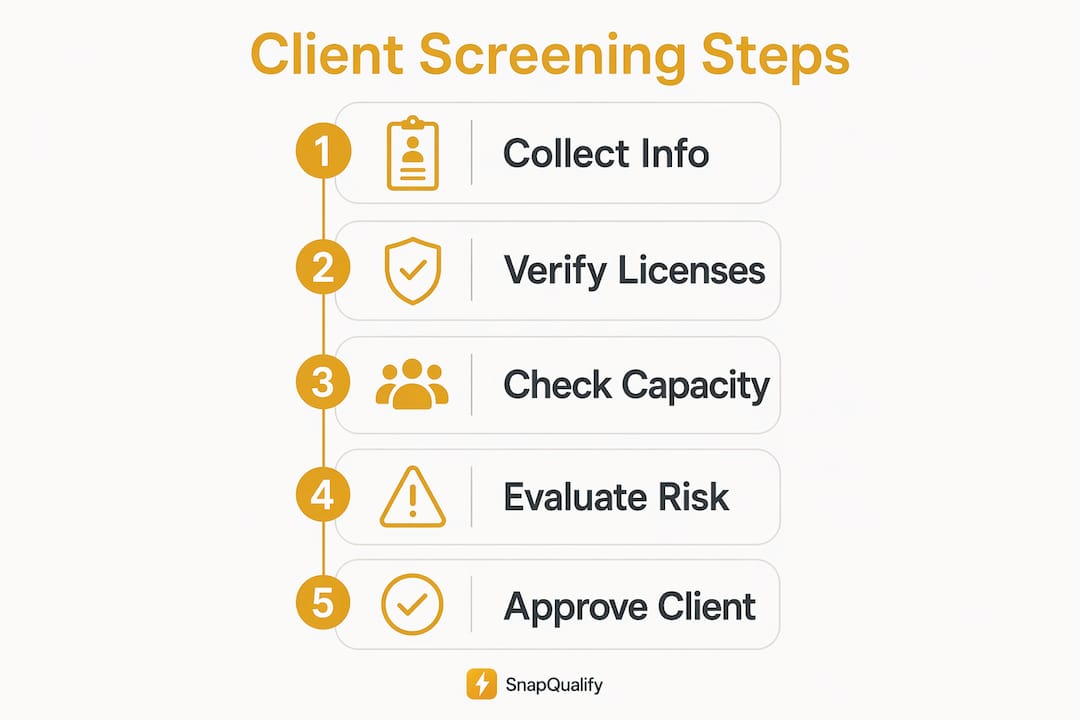
A structured process removes guesswork from qualifying specialty trade clients. Follow these steps in order, and adjust the depth of each step based on project size and payment exposure.
- Send a tiered intake form. Tiering prequalification requirements by contract value prevents overscreening small jobs or underscreening high-risk ones. A $5,000 bathroom plumbing job needs a lighter form than a $200,000 commercial electrical fit-out.
- Review the form before the call. Spot missing fields, inconsistent answers, or vague project descriptions. These are your first signals.
- Conduct a screening call. Keep your questions focused and your mouth mostly closed. Clients who dominate initial calls with demands and unrealistic expectations are likely poor fits. Your job is to listen, not pitch.
- Run a multi-name legal search. Search the client's primary business name, all DBAs, and key personnel names. A single-name search misses too much.
- Verify license class and geographic coverage. Confirm the license covers the specific trade work and the project location. A license valid in one county may not cover another.
- Assess financial capacity. Review bonding limits and insurance coverage relative to your project's value. A client bonded for $50,000 on a $300,000 project is a mismatch.
- Make a go or no-go decision. Document your reasoning. If you pass on a client, note why. That record protects you and improves your process over time.
Pro Tip: Build a simple scoring sheet with five criteria rated 1–3. Any client scoring below 10 goes on hold pending additional verification. This removes emotion from the decision.
The screening call is where most contractors lose ground. They talk about their capabilities instead of asking about the client's history, budget reality, and past contractor relationships. Flip that ratio and you will catch red flags that paperwork alone never reveals.

What are common mistakes when screening clients for specialty trade work?
Most screening failures come from shortcuts, not ignorance. Contractors know they should verify clients. They just underestimate how often a single missed step costs them thousands.
The most expensive mistake in client screening is checking only the name on the contract. All aliases, DBAs, and related entities must be searched for conflicts and litigation history. A client operating under three business names can hide a trail of unpaid contractors behind the cleanest-looking primary entity.
Watch for these recurring errors:
- Using one form for every project. A one-size-fits-all intake form produces weak data on complex projects and wastes time on simple ones. Match form depth to project risk.
- Skipping license class verification. A contractor licensed for residential work is not automatically qualified for commercial. Verify the specific class and scope.
- Ignoring geographic relevance. A client based three states away managing a local project often signals poor oversight capacity and slow payment cycles.
- Misjudging client backlog. A client juggling five active projects may not have the attention or cash flow your job requires.
Manual conflict checks take 45–90 minutes and miss potential conflicts 25–30% of the time. Automated tools search multiple name variants in seconds. The time savings alone justify the switch, and the accuracy improvement protects your business.
How do you assess project viability beyond basic screening?
Basic screening confirms a client is legitimate. Advanced evaluation confirms the project is actually worth taking. These are two different questions, and both matter.
The most reliable capability test is project size matching. A client's largest completed project should represent at least 70% of the proposed project scope. If a client has only managed $80,000 projects and is asking you to quote $500,000 in specialty electrical work, the risk of scope confusion and payment delays rises sharply.
Capacity assessment follows a similar logic. Clients working at 50–75% of their capacity make better partners than those running at full load. An overcommitted client causes schedule delays, change order disputes, and slow approvals. A client with bandwidth gives your project the attention it needs.
| Evaluation factor | Green signal | Red signal |
|---|---|---|
| Project size match | Largest past project is 70%+ of proposed scope | No comparable past project |
| Client capacity | 50–75% currently committed | Fully booked or vague on workload |
| Geographic proximity | Project within normal service area | Remote with no local presence |
| Payment history | Clean record, milestone-based agreements | Disputes or vague payment terms |
Pro Tip: Maintain a prequalified client list. Once a client passes your full screening, flag them as approved. Future bids with that client skip the full process and go straight to project-specific checks. This cuts your intake time in half on repeat business.
Geographic proximity matters more than most contractors realize. A client managing a project far outside their normal area often signals poor site oversight, slower decision-making, and higher dispute risk. Proximity is a proxy for accountability.
Key Takeaways
Qualifying specialty trade clients before bidding is the single most effective way to protect your margins and avoid problem projects.
| Point | Details |
|---|---|
| Screen before bidding | Prequalification must happen before bid submission, not after. |
| Verify all entity names | Search primary names, DBAs, and aliases to catch hidden litigation. |
| Tier your intake forms | Match form depth to contract value to save time and improve data quality. |
| Match project size | Clients should have completed projects at least 70% the size of your proposed scope. |
| Automate verification | Automated checks are faster and catch conflicts manual searches miss 25–30% of the time. |
What I've learned from years of watching contractors skip this step
Contractors who resist client screening almost always frame it as a sales problem. They worry that asking too many questions will scare off good clients. That fear is backwards. The clients who push back hardest on basic verification questions are exactly the ones you need to screen out.
The contractor client red flags that matter most rarely show up on a form. They show up in tone. A client who can't answer basic questions about their budget, timeline, or past contractor relationships is not being coy. They are showing you how the project will run. I have seen experienced electricians and plumbers walk away from jobs that looked great on paper because one screening call revealed a client who had burned three previous contractors.
Technology has changed what is realistic here. A structured prequalification process that once took days of phone calls and manual searches now takes hours with the right tools. The contractors who build and maintain an approved client list move faster on bids, waste less time on dead ends, and close more of the right work. Discipline in screening is not a barrier to growth. It is the foundation of it.
— Colin
Snapqualify makes client screening faster for trade contractors
Chasing down licenses, insurance certificates, and litigation records manually burns hours you do not have. Snapqualify automates the core steps of client prequalification for contractors, from intelligent intake forms to AI-powered risk scoring that flags problem clients before you invest in a quote.
The platform generates a color-coded SnapScore for each prospective client, giving you a clear signal on reliability and project fit in minutes. Expiring credentials trigger automatic alerts. Your approved client list stays current without manual follow-up. Snapqualify also applies data security standards that keep your client information and business records protected. If you are ready to stop losing hours to manual screening, Snapqualify is built for exactly that.
FAQ
What does it mean to screen clients for specialty trade work?
Client screening for trades is the process of verifying a prospective client's legal status, license standing, financial capacity, and project history before committing to a bid or contract. The goal is to confirm the client and project are a viable fit before you invest resources.
When should prequalification happen in the bidding process?
Prequalification must occur before bidding, not after. Screening clients after submitting a bid wastes your time and exposes you to projects you should have declined from the start.
Why is checking aliases and DBAs so important?
A client may operate under multiple business names. Searching only the primary name misses litigation, payment disputes, and fraud connected to related entities. Automated multi-name searches catch what manual checks miss 25–30% of the time.
How do I know if a client has enough capacity for my project?
Look for clients currently committed at 50–75% of their capacity. Fully booked clients create schedule delays and slow approvals. Capacity assessment is a standard part of evaluating project viability for specialty trade work.
What is the fastest way to build a prequalified client list?
Use tiered intake forms matched to project size, automate license and litigation checks, and flag approved clients in a centralized system. Once a client passes full screening, future bids with them require only project-specific verification.