

A residential job is defined as construction or service work performed on buildings designed for people to live in, such as single-family homes, townhouses, and small apartment complexes. A commercial job covers work on buildings designed for business, institutional, or public use, including offices, retail stores, hospitals, and schools. Understanding what is a residential vs commercial job shapes every decision you make as a contractor, from the tools you carry to the contracts you sign.
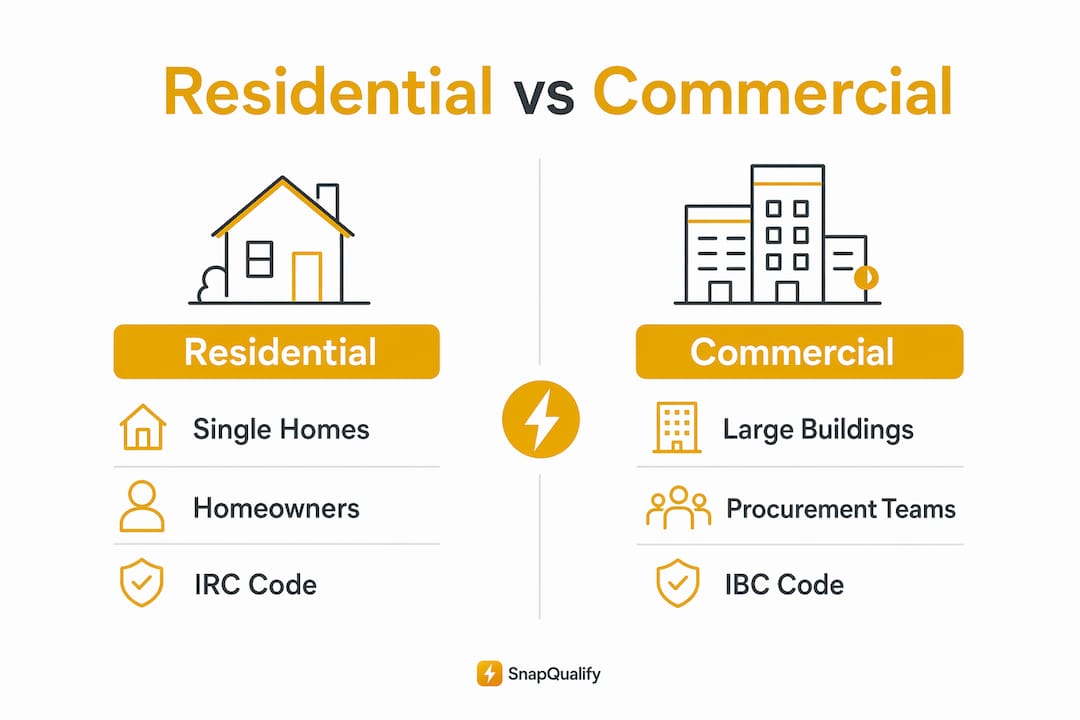
What is a residential vs commercial job?
The core difference between residential and commercial jobs comes down to building use, scale, and the regulatory environment surrounding each. Residential work centers on lifestyle and comfort, while commercial construction focuses on business operations, durability, public safety, and long-term efficiency. That distinction ripples through every part of a project.
Residential projects typically involve a single home or small development. You work with one client, one site, and a relatively contained scope. Commercial projects involve larger buildings with more complex systems, more stakeholders, and longer timelines. Building a custom kitchen is a residential job. Building a hospital wing is a commercial one.

The client type also signals the category. Homeowners hire you for residential work. Facility managers, procurement teams, and general contractors hire you for commercial work. Each group has different expectations, different contracts, and different ways of measuring success.
What are the typical project sizes and scopes?
Project scale is the most visible difference between residential and commercial construction jobs.
- Residential projects typically involve a single structure, one primary trade, and a timeline measured in days or weeks. Examples include roofing a single-family home, rewiring a townhouse, or installing HVAC in a duplex.
- Commercial projects require coordination across multiple trades on a shared schedule. Examples include fitting out a retail center, constructing a school, or renovating an office floor. Multi-trade coordination involving HVAC, plumbing, and electrical is standard on commercial sites.
- Labor and materials scale accordingly. A residential paint job might need one crew for two days. A commercial repaint of an office building could require multiple crews working in phases over several weeks.
- Management complexity increases sharply on commercial jobs. You need scheduling tools, site supervisors, and clear communication protocols to keep trades from blocking each other.
Residential service jobs generally carry project values between $350 and $600, while commercial jobs range from $800 to $4,000 or more depending on scope. That gap reflects the difference in labor hours, materials, and coordination overhead.
Pro Tip: Before bidding a commercial job for the first time, visit the site during active construction hours. The pace and coordination required will tell you more than any spec sheet.
How do regulations and codes differ between job types?
The regulatory divide between residential and commercial construction is significant and non-negotiable.
| Factor | Residential (IRC) | Commercial (IBC) |
|---|---|---|
| Governing code | International Residential Code | International Building Code |
| Building height | Typically three stories or fewer | No height cap; varies by occupancy |
| Fire safety requirements | Basic egress and smoke detection | Sprinkler systems, fire-rated assemblies |
| Accessibility standards | Limited ADA requirements | Full ADA compliance required |
| Structural engineering | Often prescriptive design | Engineered drawings required |
| Licensing | Residential contractor license | Commercial contractor license (state-specific) |
Buildings three stories or fewer for one- or two-family dwellings fall under the IRC, while larger or more complex buildings are regulated by the IBC. Classification depends on occupancy type, height, and building use, not the owner's identity.
Commercial jobs also require more documentation before work begins. Risk assessments, method statements, construction phase plans, and COSHH assessments are standard requirements on commercial sites. Residential quoting and invoicing processes are far simpler by comparison. Many states also require separate licensing for residential and commercial contractors, so check your state's requirements before taking on a new project type.
What are the differences in client relationships and payment terms?
Working with a homeowner feels nothing like working with a procurement team. The differences in client relationships between residential and commercial jobs affect how you communicate, how you get paid, and how you protect yourself legally.
Residential clients are usually homeowners with a personal stake in the outcome. They want updates, they ask questions, and they make decisions based on trust as much as price. Your relationship with them is direct and often informal. A simple written quote or proposal is usually enough to get started.
Commercial clients operate differently. Facility managers and procurement teams focus on compliance, cost control, and schedules rather than personal rapport. They use formal contract types, and performance clauses are standard. Understanding construction contract scope before you sign protects you from scope creep and disputes.
Payment terms also split sharply between the two sectors:
- Residential jobs often pay within 24–48 hours of invoice. Many contractors collect a deposit upfront and final payment on completion.
- Commercial jobs commonly run on Net-30 or Net-60 terms. Businesses must cover wages and expenses while waiting for invoice payments, which creates real cash flow pressure.
Pro Tip: If you move into commercial work, build a cash reserve equal to at least 60 days of operating costs before you start. Net-60 terms can hit hard if you are not prepared.
How do workflow and site coordination differ?
Day-to-day operations on a residential site look very different from a commercial one. Understanding those differences helps you prepare the right team and the right systems.
- Residential sites typically involve a solo tradesperson or small crew working with flexible pacing. You set your own schedule, coordinate directly with the homeowner, and adapt as the job evolves. Autonomy is the norm.
- Commercial sites run on shared timelines with multiple trades working simultaneously. An electrician cannot rough in until the framer clears the wall. A painter cannot start until the drywall crew finishes. Multi-disciplinary coordination with tight timelines is the defining feature of commercial site work.
- Safety protocols are more formal on commercial sites. OSHA compliance, site inductions, personal protective equipment requirements, and toolbox talks are routine. Residential sites have safety requirements too, but enforcement and documentation are less intensive.
- Communication systems matter more at scale. On a commercial job, a missed message between trades can cost thousands in rescheduling. Learning to manage multiple trade leads efficiently is a skill that pays for itself quickly.
The shift from residential to commercial is not just a bigger job. It is a different operating model. The surrounding ecosystem of contracts, insurance, and documentation differs profoundly between the two sectors, even when the underlying technical work looks similar.
Key Takeaways
Residential jobs and commercial jobs differ across every dimension that matters to a contractor: scale, regulation, client type, payment terms, and site coordination.
| Point | Details |
|---|---|
| Building use defines the category | Residential means habitation; commercial means business, institutional, or public use. |
| Codes and licensing differ | IRC governs residential; IBC governs commercial, with stricter fire, structural, and accessibility rules. |
| Client dynamics shift completely | Homeowners value trust; commercial clients prioritize compliance, cost, and schedule. |
| Payment timelines vary sharply | Residential pays in 24–48 hours; commercial runs Net-30 to Net-60, requiring working capital. |
| Site coordination scales up | Commercial jobs demand multi-trade scheduling and formal safety protocols that residential work does not. |
Why the choice between job types matters more than most contractors realize
I have spoken with dozens of tradespeople who assumed commercial work was just a bigger version of residential. It is not. The technical skills transfer, but the business model does not. You need more insurance, more documentation, and more cash in the bank before you ever break ground.
That said, commercial work offers real advantages. Day rates for commercial trades run noticeably higher than residential equivalents, and long-term contracts with facility managers can stabilize your pipeline in ways that residential volume never quite does. The trade-off is that you earn those rates by operating like a business, not just a tradesperson.
My honest advice: do not abandon residential work the moment commercial opportunities appear. Residential jobs keep cash flowing while you build the relationships and credentials that commercial clients require. The contractors I have seen scale successfully treat residential as their foundation and commercial as their growth layer. They do not choose one. They time the transition carefully.
Watch for contract red flags on both sides. Residential clients can be just as risky as commercial ones if you skip proper vetting. The job type does not determine your risk. Your intake process does.
— Colin
How Snapqualify helps contractors across both project types
Whether you work residential jobs, commercial projects, or both, the risk of taking on the wrong client is real. Snapqualify is built for trade contractors who want to qualify leads before committing time and resources to a project.

Snapqualify uses AI-powered intake forms to screen clients on project scope, budget, and experience. The result is a color-coded SnapScore that tells you whether a client is worth pursuing before you spend hours on a quote. For contractors managing the documentation demands of commercial work or the trust-based dynamics of residential clients, that early signal matters. Learn more about how Snapqualify protects your business and your data at Snapqualify's security page.
FAQ
What is the main difference between residential and commercial jobs?
Residential jobs involve construction or service work on homes and small multi-family buildings. Commercial jobs cover offices, retail stores, hospitals, schools, and other non-residential structures.
Which building code applies to residential vs commercial construction?
Residential construction typically falls under the International Residential Code (IRC) for buildings three stories or fewer. Commercial construction is governed by the International Building Code (IBC), which carries stricter structural, fire safety, and accessibility requirements.
Do residential and commercial contractors need different licenses?
Many states require separate licenses for residential and commercial contractors. Always verify your state's licensing requirements before bidding on a project type outside your current license category.
How do payment terms differ between residential and commercial jobs?
Residential jobs commonly pay within 24–48 hours of invoice. Commercial jobs typically run on Net-30 or Net-60 payment terms, which requires contractors to manage cash flow carefully during the wait.
Can a residential contractor take on commercial work?
A residential contractor can transition to commercial work, but it requires higher insurance coverage, formal contract knowledge, and additional documentation such as risk assessments and method statements before starting any job.