

Small jobs are defined as low-margin or nuisance work that appears profitable on the surface but generates negative returns once indirect costs are included. A $2,000 job with $1,800 in direct expenses looks like a $200 gain. Add admin time, supplier runs, and drive time, and that gain disappears entirely. Understanding why small jobs cause big losses is the first step to protecting your margins and your schedule.
Why small jobs cause big losses through hidden overhead
The profit on a small job rarely survives contact with reality. Scope creep, unqualified leads, and informal change orders disrupt workflow and make margin erosion invisible until after the job is done. By then, you have already spent the time.
The costs that kill small job profitability are rarely the ones you quote for. They live in the work around the work:
- Scheduling and coordination: Every job requires phone calls, texts, and calendar management before a single tool is picked up.
- Procurement trips: Small jobs rarely justify bulk orders, so you make multiple supplier runs at full fuel and time cost.
- Pre-work and post-work overhead: Site visits, estimates, invoicing, and follow-up calls all consume hours that never appear in your quote.
- Drive time: A 45-minute round trip to a small job eats directly into your effective hourly rate.
Filling 30% of your schedule with these jobs means donating 30% of your operational capacity. That is not a rounding error. That is a structural drain on your business.
Pro Tip: Track your actual time on the next three small jobs, including drive time, admin, and procurement. Most contractors discover their real hourly rate on these jobs is well below their target rate.

Opportunity cost is the most underestimated factor. Every hour spent on a $200-margin job is an hour you cannot spend on a $600-margin job. Saying yes to the small job is an implicit decision to say no to something better. Check out why contractors overbid jobs to see how this pattern compounds over time.
How do small claims and minor fixes escalate into cash flow crises?
Small claims feel manageable in the moment. They become dangerous when they pile up and stretch your payment timeline.
- Water damage claims average $300,000–$400,000 in remediation costs, yet many start as minor leaks that fell below deductible thresholds and were left unaddressed.
- Only 20% of large claims are paid within 60 days, and there is a 40% chance of delays exceeding six months. That gap in cash flow can stall your entire operation.
- Labor shortages affect 76.2% of contractors, making it harder to respond quickly to small damage issues before they escalate into major remediation work.
- Minor fixes that go undocumented become disputed items later, creating payment disputes that cost more to resolve than the original repair was worth.
The pattern is consistent: a small loss compounds into bankruptcy not through one catastrophic event but through dozens of small claims that each delay cash, consume labor, and generate administrative burden. A single water leak that goes unaddressed for 30 days can require full drywall removal, mold remediation, and structural repairs. The cost of overlooked jobs is almost always higher than the cost of addressing them at the source.
Proactive risk measures change this equation. IoT monitoring systems can reduce water damage losses by up to 90% by catching issues before they escalate. Jobsite audits serve the same function for construction defects. The contractors who avoid death by a thousand claims are the ones who treat small risks as urgent, not optional.
How do operational frictions quietly drain your productivity?
Micro-inefficiencies are the most dangerous cost category because they become invisible. Manual file renaming, redundant data entry, and repeated non-value-added tasks become routine so quickly that most teams stop noticing them. Once a bad habit is normalized, it stops triggering any corrective response.
The math on small frictions is striking. A 2.5-second delay per unit across 18,000 daily units equals 45,000 seconds of lost time per day. That translates to 12.5 labor hours daily, or the equivalent of two full-time employees producing nothing. In a construction context, the same principle applies to repeated site check-ins, manual timesheets, and verbal-only change order approvals.
| Friction Type | Daily Time Lost | Annual Impact |
|---|---|---|
| Manual timesheet entry | 15–20 min per crew member | 60+ hours per employee |
| Verbal change order tracking | 10–30 min per job | Untracked scope creep |
| Repeated supplier calls | 20–40 min per small job | Capacity consumed |
| Undocumented site visits | Varies | Billing gaps and disputes |
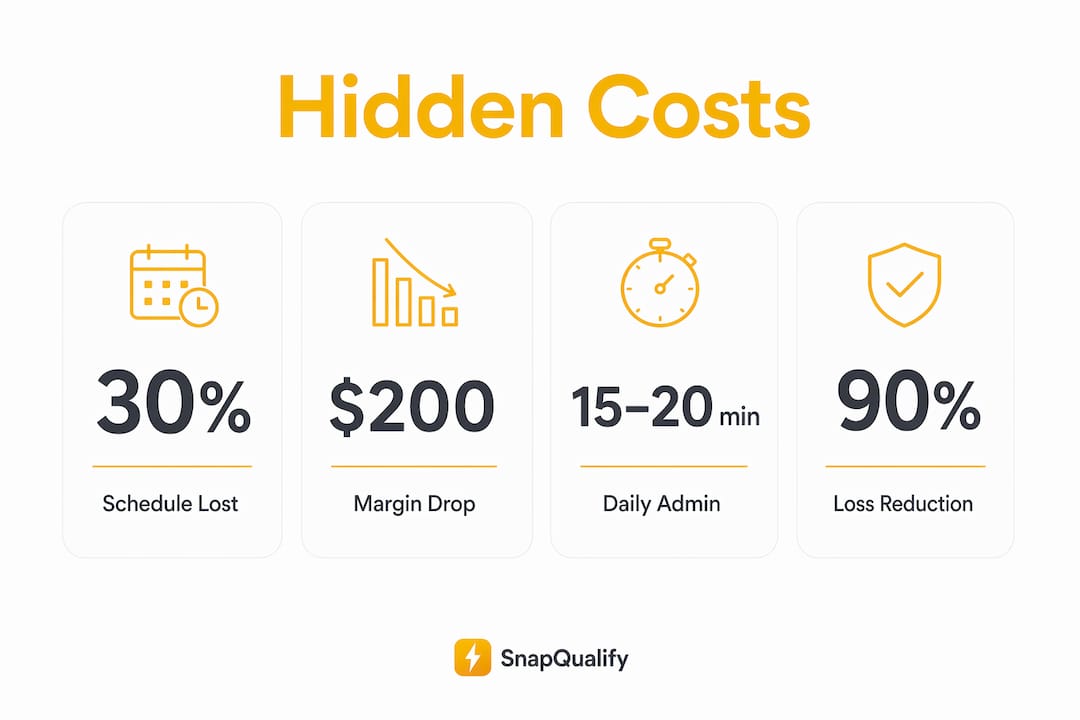
Small wastes multiply across your workforce and high-frequency tasks to produce large annual productivity losses. The psychological toll compounds the financial one. Decision fatigue from managing too many small, low-value tasks reduces the quality of decisions on your high-value work. Tolerating small mistakes as normal also signals to your crew that standards are flexible, which creates broader quality and morale problems.
Pro Tip: Audit one recurring admin task this week. Time it precisely, multiply by how often it happens per month, and calculate the annual cost. The number will surprise you.
Addressing contractor time wasters systematically, rather than one at a time, produces the fastest results. Batch similar tasks, digitize approvals, and document every scope change in writing.
What practical steps protect your margins on small jobs?
The goal is not to avoid all small jobs. The goal is to know exactly which ones are worth taking and to run them without leaking money.
- Vet every job before committing. Scope clarity at the start prevents scope creep mid-project. Ask about budget, timeline, and decision-making authority before you quote. Use project risk indicators to flag jobs that carry outsized hidden costs.
- Separate every change order in writing. Informal approvals and verbal agreements increase the risk of untracked scope creep and lost profitability. A signed change order, even for a $200 addition, protects your margin and your relationship.
- Set a minimum job threshold. Calculate your true cost per job mobilization, including admin, drive time, and procurement. Any job that cannot cover that cost plus your target margin is not worth taking.
- Say no strategically. Accepting every job regardless of fit results in inconsistent quality, stressed crews, and reputation damage. Turning down a bad-fit small job frees capacity for a better one.
- Digitize your documentation. Replace verbal approvals and paper timesheets with digital records. This reduces billing gaps, speeds up invoicing, and gives you accurate job cost data.
Construction project vetting is not just a pre-sale activity. It is an ongoing discipline that protects every job from the moment of first contact through final payment.
Key Takeaways
Small jobs cause big losses when their indirect costs, operational frictions, and opportunity costs exceed the visible revenue they generate.
| Point | Details |
|---|---|
| Hidden overhead erases margin | Admin, drive time, and procurement trips consume the profit on low-value jobs before work begins. |
| Small claims compound fast | Unaddressed minor damage and delayed payments cascade into cash flow crises that threaten solvency. |
| Micro-frictions multiply silently | Repeated small inefficiencies become invisible routines that drain labor hours and reduce crew performance. |
| Change orders need documentation | Every scope addition, regardless of size, requires a written, signed change order to protect your margin. |
| Strategic refusal protects capacity | Saying no to bad-fit small jobs frees your schedule for higher-margin work and reduces crew stress. |
The uncomfortable truth about small jobs I've learned over time
Most contractors I talk to know, on some level, that certain small jobs are not worth it. They take them anyway because the calendar looks thin or because saying no feels risky. That instinct is understandable. It is also expensive.
What I have observed consistently is that the contractors who struggle most with profitability are not the ones losing money on big projects. They are the ones whose schedules are packed with small jobs that look fine individually but collectively drain the business. The crew is busy, the invoices go out, and the bank account barely moves. That is the trap.
The harder lesson is that tolerating small inefficiencies and marginal jobs creates a culture where low standards become the baseline. Your crew adapts to the pace and quality level of the work you accept. When you raise the bar on job selection, you often raise the bar on execution quality at the same time.
Protecting your margins on small jobs is not about being selective to the point of turning away good work. It is about knowing your real costs well enough to recognize when a job is costing you more than it pays. That knowledge is the foundation of every profitable construction business I have seen.
— Colin
How Snapqualify helps you vet jobs before they cost you
Knowing a job is risky before you commit to it changes everything. Snapqualify gives contractors a fast, structured way to screen clients and projects before investing time in estimates, site visits, or proposals.
The platform uses intelligent intake forms and AI-based risk analysis to generate a color-coded SnapScore for each potential client. That score reflects budget clarity, project scope, and client reliability, giving you a clear signal before you spend a single hour on the job. For roofers, electricians, plumbers, HVAC technicians, painters, and general contractors, Snapqualify integrates directly into your existing workflow without adding complexity. Screen your next client before the small job becomes a big loss.
FAQ
Why do small jobs lose money even when they look profitable?
Small jobs lose money because indirect costs like admin time, drive time, and procurement trips are rarely included in the original quote. A job that shows $200 in profit on paper often breaks even or loses money once all time is accounted for.
How do small claims affect contractor cash flow?
Small claims delay payment and consume labor without generating proportional revenue. With only 20% of large claims paid within 60 days, repeated small claims create cash flow gaps that compound quickly.
What is the biggest hidden cost on small construction jobs?
Opportunity cost is the largest hidden expense. Every hour spent on a low-margin job is an hour unavailable for higher-margin work, making the real cost of small jobs far higher than their direct expenses suggest.
How can contractors reduce losses from minor operational inefficiencies?
Digitizing approvals, documenting every change order in writing, and auditing recurring admin tasks are the most direct ways to reduce friction-based losses. Batch similar tasks and eliminate manual steps wherever possible.
When should a contractor say no to a small job?
Say no when the job cannot cover your true mobilization cost plus your target margin. Use a minimum job threshold based on your actual overhead per mobilization to make this decision consistently rather than case by case.